
Inside the Elephant Trunk: 90,000 Muscle Bundles and What They Do
Last updated: November 26, 2026
7 min read
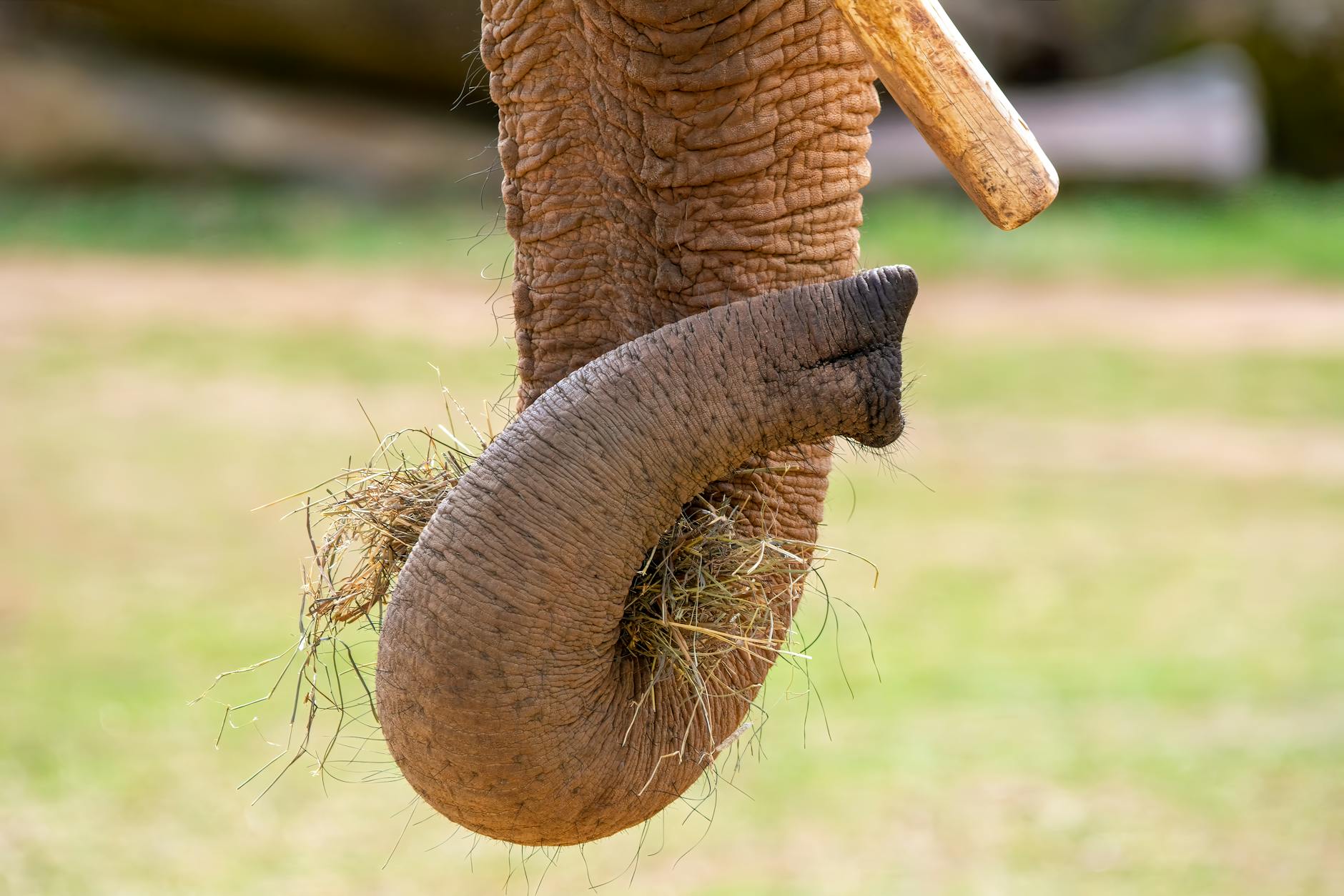
An elephant trunk is a muscular hydrostat fused from the nose and upper lip. A 2023 reconstruction of one Asian elephant calf trunk found about 90,000 muscle fascicles. The trunk has no bones or joints, and a working range from shifting heavy timber to picking up a single grain of rice. Almost everything an elephant does in a day flows through this one appendage.
Key facts at a glance
| Muscle count | About 90,000 muscle fascicles (Longren and colleagues, 2023); older estimates ranged from 40,000 to 150,000 |
| Bones | None. The trunk is a muscular hydrostat |
| Length | Around 2 m in adult bush elephants |
| Weight | Around 140 kg in adult bush bulls |
| Tip differences | African elephants have two finger-like projections; Asian elephants have one |
| Water capacity | Around 8 to 12 litres held at one time |
| Sensitivity | Fine enough to pick up a single grain of rice |
What a trunk actually is
The elephant trunk is not a separate organ bolted onto the face. It is a fused, vastly elongated nose and upper lip, built from the same structures other mammals carry. In an elephant embryo you can see the upper lip and nose still distinct early on, gradually merging and extending as the calf develops. By birth the trunk is fully formed, though it is close to useless as a precise tool until the calf spends a few months learning to drive it.
The trunk is just one of many surprising elephant features. For more, see our round-up of ten facts about elephants you probably did not know.
Inside, it is a muscular hydrostat: a solid muscle structure with no skeleton, held in shape by the incompressibility of muscle tissue itself. Squid tentacles and the human tongue work the same way. The internal architecture runs around two long nasal passages the full length of the trunk, surrounded by layered radial, longitudinal, and oblique muscles. Older articles gave totals from 40,000 to 150,000 because they counted different things. The trunk’s muscles are split into tiny bundles called fascicles, and a 2023 microCT study by Longren and colleagues, published in Current Biology, counted about 90,000 of them in one Asian elephant calf.
Why it can do almost anything
No bones plus a great many muscles gives the trunk a degrees-of-freedom advantage over almost any other animal appendage. A primate arm is constrained by the geometry of each joint. The trunk can curl, twist, flex, stretch, contract, and grip at any point along its length, independently of every other point. An elephant can hold its trunk in an S, an O, a coil, a corkscrew, or dead straight, and switch between them in seconds.
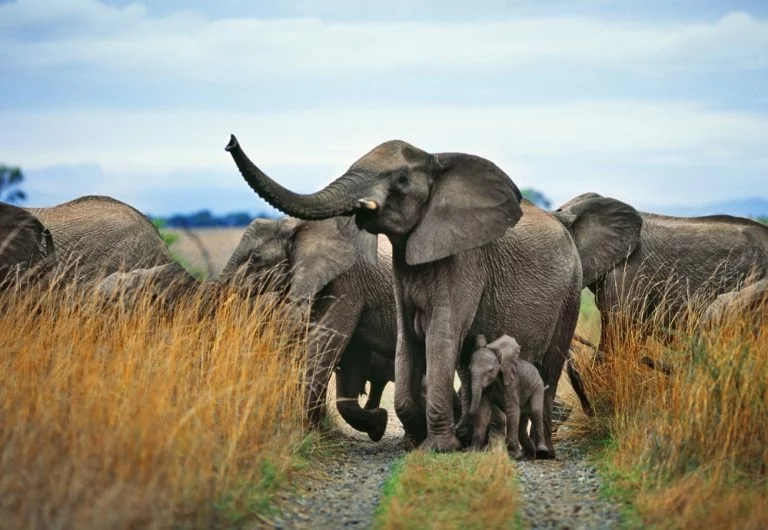
The tip is where the precision lives. African elephants have two opposing finger-like projections there, used together like thumb and forefinger. Asian elephants have one and rely more on rolling and curling the tip against itself. That is part of why Asian elephants tend to pick objects up by curling around them while African elephants pinch.
What the trunk does in a typical day
- Breathing: structurally it is a nose, and most elephant breathing happens through it
- Smelling: elephant scent reception is exceptional, with more smell genes than any other land mammal
- Drinking: scoop water in, then squirt into the mouth. Elephants do not drink through the trunk like a straw
- Eating: gripping grass, leaves, branches and bark, and stripping leaves off twigs in one motion
- Touching: trunk-to-mouth and trunk-to-body greetings are core to elephant social life
- Hygiene: spraying water, throwing dust, scratching with the tip
- Tool use: throwing branches, holding objects to scratch with, waving leafy branches at flies
- Lifting: heavy loads carried by coiling and gripping
- Trumpeting and rumbling: the trunk shapes and amplifies vocal output
- Snorkelling: deep crossings with the tip held above the water
Hydrostat mechanics in plain language
A muscular hydrostat works because muscle tissue is essentially incompressible. When the longitudinal muscles on one side contract, the other side stays the same length and the trunk curves. When radial muscles contract, the trunk gets thinner and longer, because the volume has to go somewhere. When circular and longitudinal muscles contract together at the tip, you get the grip that lets an elephant pick up something the size of a coin.
Engineers building soft robots have spent years studying the trunk for exactly this reason. Strength, dexterity, and damage tolerance in one structure is hard to design from scratch: bruise a trunk and it does not fail, the elephant simply works around the injury.
The smell engine
A 2014 comparative genomics study led by Yoshihito Niimura found the African elephant carries roughly 2,000 functional olfactory receptor genes, the largest repertoire of any animal yet sequenced and more than twice a dog’s. The trunk is the delivery system for that.
What elephants do with it is remarkable. They locate water at distance, distinguish individuals from urine and dung, and read reproductive and stress signals across the herd. Lucy Bates and colleagues showed in 2007 that Amboseli elephants could tell Maasai from Kamba by the smell of their clothing alone, and reacted with fear only to the group that spears elephants.
That extraordinary sense of smell has even been studied for security work, as we explain in our piece on bomb-sniffing elephants and the surprising science of their noses.
It also explains what a trunk held high in the air actually is: a slow radar sweep of everything upwind.
When the trunk fails
Trunks are tough but not invincible. Crocodile attacks at waterholes occasionally cost an elephant part of its trunk. Wire snares set for bushmeat cut in and become embedded. Disease and poor diet in captivity can leave a trunk visibly compromised. An elephant that loses control of its trunk is in serious trouble: drinking becomes hard, feeding slows, and social communication is impaired.
Rehabilitation centres do take on trunk injury cases, and orphans with badly damaged trunks have survived in the care of the Sheldrick Wildlife Trust by adapting how they feed, with veterinary support. For an example of trunk-related rescue work, see our piece on dramatic elephant rescues.
Calves and learning to use the trunk
Calves are born with a fully formed trunk and almost no idea what to do with it. For the first few weeks it looks like a clumsy fifth limb swinging around without purpose. They drink milk through the mouth, not the trunk, usually with the trunk pushed off to one side, and they trip over it. Basic tip control comes in at around two months. By six months they can drink through the trunk reliably, throw small objects, and start the trunk-greetings with siblings and aunts. Full adult dexterity takes years.
Why the trunk is the centre of elephant intelligence
Most of what we measure as elephant intelligence runs through the trunk: tool use, social grooming, problem solving, communication, fine discrimination of objects, learning by imitation. All of it needs a trunk that is dexterous, sensitive, and wired tightly into the brain. Work by Michael Brecht’s group at the Humboldt University of Berlin found that the elephant facial nucleus, the brainstem structure that drives the face and trunk, contains by far the largest facial motor neuron counts recorded in any land mammal, with African elephants ahead of Asian ones. For more on this, see our piece on facial nucleus neurons.
Frequently asked questions
How many muscles does an elephant trunk have?
About 90,000 muscle fascicles (small bundles of muscle), according to a 2023 microCT study published in Current Biology. Older estimates ranged from 40,000 to 150,000. The trunk has no bones and works as a muscular hydrostat.
Can an elephant trunk pick up small objects?
Yes. The tip is precise enough to pick up a single grain of rice or a coin. African elephants use two opposing projections; Asian elephants use one and roll the trunk against itself.
How much can an elephant lift with its trunk?
Working elephants routinely shift heavy timber, and the trunk is at its strongest wrapped around an object rather than gripping with the tip, because that brings multiple muscle groups to bear at once.
How much water can an elephant trunk hold?
Around 8 to 12 litres at a time. The elephant scoops water in and then squirts it into the mouth. They do not drink through the trunk the way a straw works.
What is the difference between African and Asian elephant trunks?
African elephants have two finger-like projections on the tip and pinch. Asian elephants have one and curl the tip against itself. Asian elephant trunks are also typically smoother and less wrinkled.
Can elephants smell with their trunks?
Yes, and better than any other land mammal we know of. They have the largest olfactory gene repertoire yet sequenced, and use it to find water, tell individuals apart, and read social and reproductive signals across the herd.
The trunk is the most distinctive elephant feature and the centre of how elephants act on the world. For more behaviour and anatomy pieces, browse our elephant facts hub.
This article is part of our elephant facts guide, which links every post on elephant bodies, minds and family life.
- Elephant Species: Complete Guide to All Living Elephants 2026: The three living elephant species and their subspecies: taxonomy, range, diet.
- Facial Nucleus Neurons in Elephants: A 2022 Science Advances study counted around 63,000 facial nucleus neurons in African elephants and 54,000 in Asian ones.
- 15 Elephant Facts That Surprise Almost Everyone: Fifteen checkable elephant facts, including the sleep figure most articles get wrong and which Angolan bull actually holds the record.
- Elephants and Water: Swimming, Drinking, and Trunks as Snorkels: How elephants drink, why they float, what the trunk-as-snorkel actually requires of the chest, and what the record really says about how far an elephant can swim.
Updated 14 September 2026: updated the trunk anatomy figure.
Updated 27 October 2026: corrected the trunk muscle count to the 2023 microCT figure of about 90,000 fascicles.




About 90,000 muscle bundles in one appendage is hard to picture until you watch an elephant pick a single grass blade out of a tuft. The grain-of-rice point is no exaggeration.
The hydrostat mechanics paragraph is the clearest explanation I have read. The volume-conservation argument makes the curving behaviour suddenly obvious.
Thank you. It took me a while to find a way to explain that without resorting to physics terms. The squid and tongue parallel helps.
Anyone who has watched a newborn calf try to drink milk while stepping on its own trunk knows the appendage is fully formed but not yet under control. Charming and clumsy in equal measure.
Curious why older articles say 40,000 muscles and this one says about 90,000 bundles. Is it really a definitional difference or are there structural variations between Asian and African?
Mostly definitional: older totals mixed up muscles and the bundles inside them. The 2023 study counted about 90,000 fascicles in one Asian calf’s trunk. It did not compare the two species, so we cannot say yet how African trunks differ.
The soft robotics teams studying trunks are decades behind elephant evolution but you can see why. The combination of grip strength and damage tolerance is hard to design.
About 90,000 muscle bundles in a structure with no bones. Going from lifting a log to picking up a grain of rice makes octopus arms look almost simple.