15 Elephant Facts That Surprise Almost Everyone
Last updated: September 14, 2026
3 min read
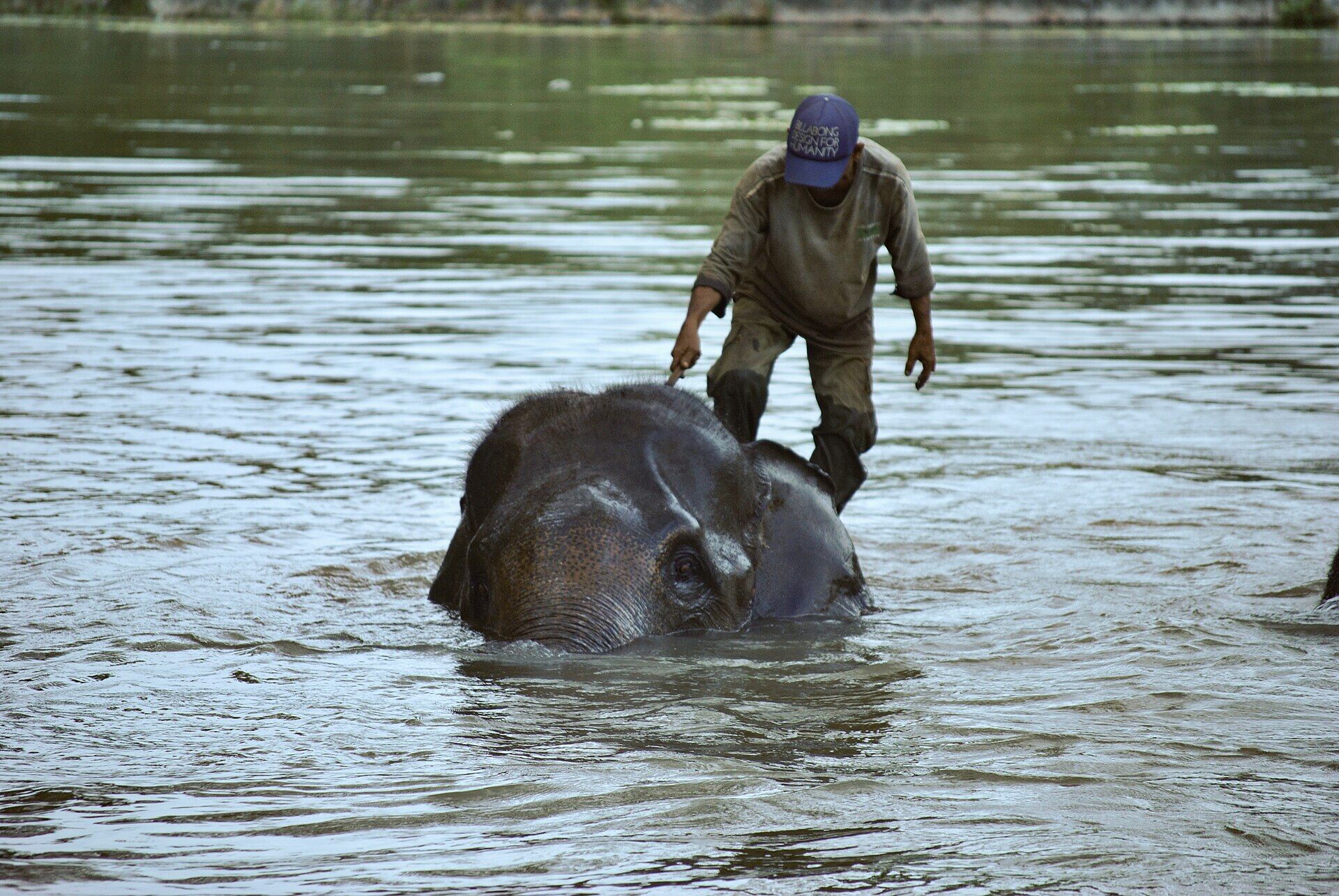
Sumatran elephant swimming with mahout, by Andreas Christian, CC BY-SA 4.0, via Wikimedia Commons.
Most of what people think they know about elephants is folklore. Here are fifteen things that are actually true.
Body
1. They cannot jump. Leg anatomy and sheer mass make it impossible. Elephants are among the very few mammals that never get all four feet off the ground at once, even at speed.
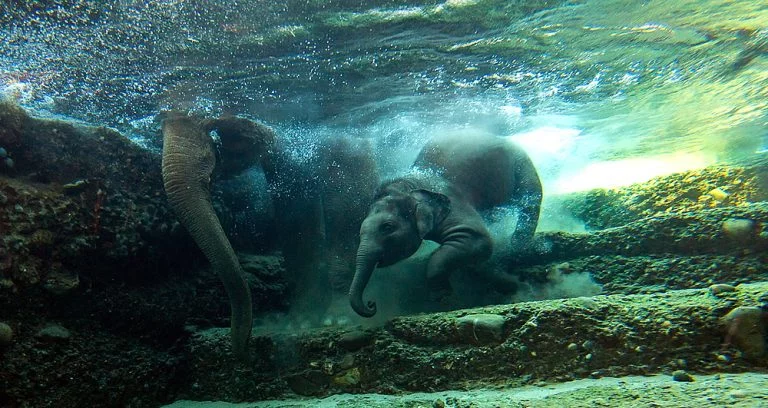
2. They are strong swimmers. Elephants paddle with all four legs and hold the trunk up as a snorkel, and they can keep it up for hours. In July 2017 the Sri Lankan navy spent about twelve hours recovering an elephant that had been swept roughly 16 km out to sea and was still swimming when they reached it.
3. A 2023 reconstruction of one Asian elephant calf trunk found about 90,000 muscle fascicles, arranged across radial, longitudinal and oblique groups, which is what gives it both the strength to push over a tree and the control to pick up a single blade of grass.
4. Asian elephants have one trunk fingertip, Africans have two. The Asian tip sits on top. African elephants have one above and one below, and can oppose them like a thumb and finger.
5. They sleep about two hours a day in the wild. Most of it standing. Lying-down sleep, which is when REM happens, is brief and comes round only every three or four nights. Captive elephants sleep considerably longer.
Behaviour
6. They drink with the trunk, not through it. Water is drawn into the trunk and then poured into the mouth. A 2021 study measured a mean trunk water capacity of about 5.5 litres.
7. They communicate over kilometres using infrasound. Rumbles with fundamentals below human hearing carry a few kilometres in ordinary conditions and up to about ten on a cool still evening.
8. They respond to their dead. Elephants investigate elephant remains with an attention they do not give to other species, and return to the sites over years.
9. They pass the mirror self-recognition test. First shown in Asian elephants at the Bronx Zoo in 2006.
10. They use tools. Branch fly-swatters, rocks for scratching, and in experiments, objects moved and stood on to reach food.
Ecology and society
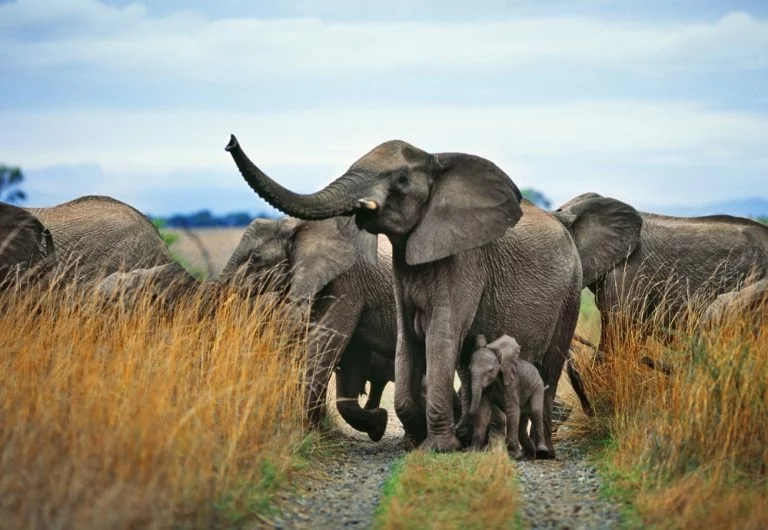
11. Family groups are matriarchies. The oldest female leads. Bulls leave at around 12 to 15 and live alone or in loose bachelor groups.
12. They are ecosystem engineers. A 2019 study in Nature Geoscience estimated that losing forest elephants from central African forest would cut its aboveground carbon biomass by around 7 percent, because the trees they disperse are the dense, carbon-heavy ones.
13. Their pregnancies are the longest of any land mammal. Around 22 months. A newborn weighs 100 to 120 kg.
14. Poaching pressure made tusklessness more common. Around 18.5 percent of female elephants in Gorongosa were naturally tuskless before Mozambique’s civil war. Among the females that survived fifteen years of ivory hunting, the figure was about 51 percent, and roughly a third of the females born since the war have no tusks at all. Poaching selected for elephants with nothing worth taking, and the 2021 Science paper that showed it identified the genes involved.
15. The record for the largest land mammal belongs to an Angolan bull. Guinness lists a bull shot at Mucusso in Angola on 7 November 1974, weighing about 12.24 tonnes and measuring 4.16 m from shoulder to forefoot. It is a different animal from the one you may have stood under: the elephant in the rotunda of the Smithsonian National Museum of Natural History is the Fenykovi bull, shot in Angola in November 1955 and mounted there since 1959.
Read next
Elephant facts pillar, famous elephants in history, elephant myths debunked.
Frequently asked questions
Can elephants jump?
No. Leg anatomy and body mass make it impossible, and elephants never have all four feet off the ground at once.
How long is an elephant pregnant?
Around 22 months, the longest of any land mammal. Newborn calves weigh 100 to 120 kg.
How much do elephants sleep?
About two hours a day in the wild, mostly standing. Lying-down REM sleep is brief and comes round every three or four nights. Captive elephants sleep more.
Can elephants swim?
Yes, and for a long time. They paddle with all four legs and use the trunk as a snorkel. In 2017 the Sri Lankan navy recovered an elephant still swimming roughly 16 km offshore after being carried out by a current.
How many muscles are in an elephant’s trunk?
A 2023 reconstruction of one Asian elephant calf trunk found about 90,000 muscle fascicles.
Keep reading
- 100 Elephant Facts: Everything to Know About Earth’s Largest Land Animal: Our master elephant fact sheet: anatomy, cognition, matriarchal society, infrasound, the trunk, tusks and ivory, diet.
- How Elephants Sleep: Why a 6-Ton Animal Rests Just Two Hours: Two matriarchs, 35 days of collar data from Chobe National Park, and the shortest sleep schedule recorded in any mammal.
- Elephant Quiz Trivia Game: An eight-question elephant quiz with the answers, plus the anatomy, behaviour and conservation facts you need to get them right.
- Inside the Elephant Trunk: About 90,000 Muscle Fascicles and What They Do: No bones, about 90,000 muscle-fibre bundles, and the best nose on land.
Updated 14 September 2026: updated the trunk anatomy figure.