
Elephants and Water: Swimming, Drinking, and Trunks as Snorkels
Last updated: September 14, 2026
7 min read
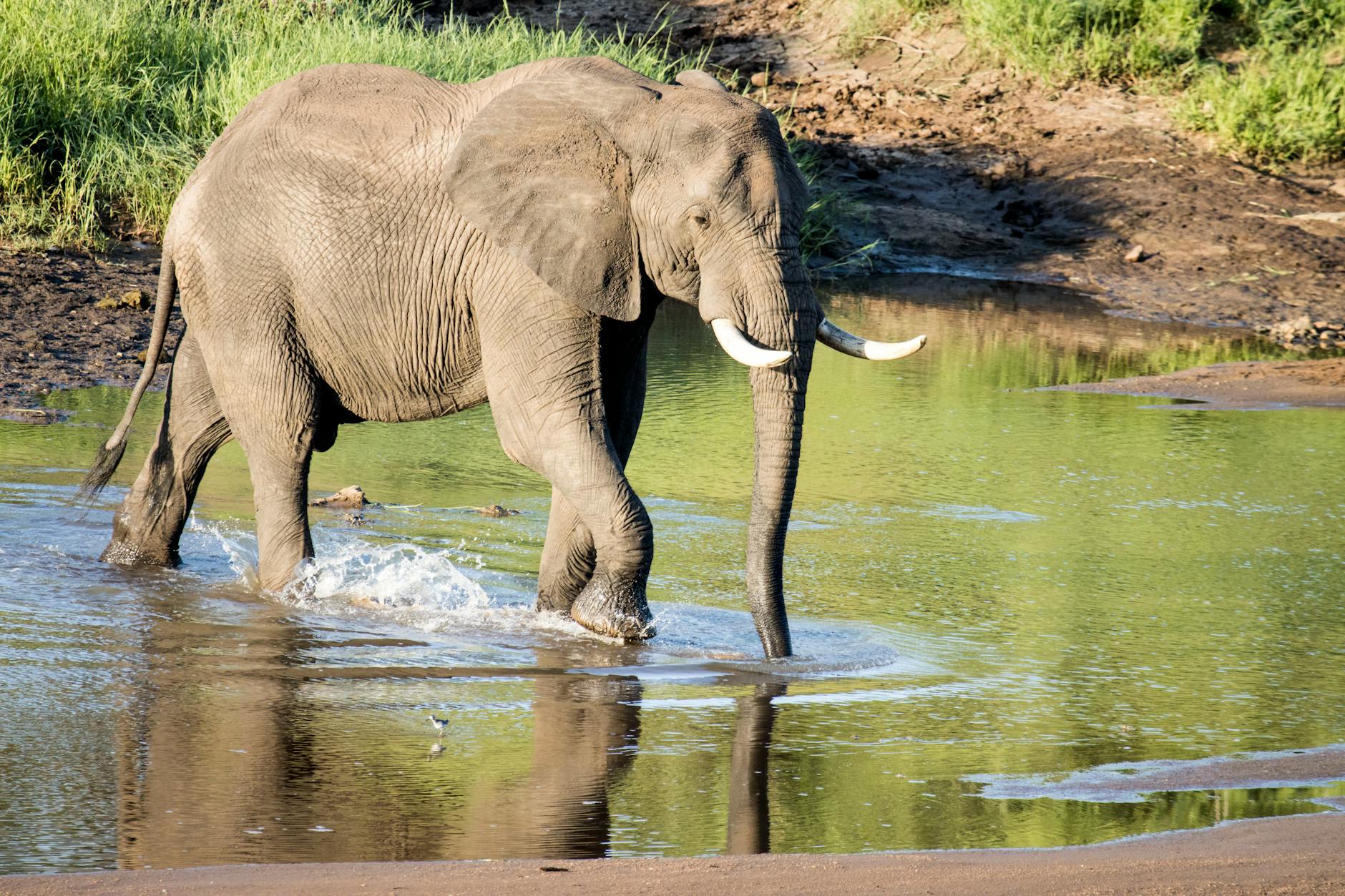
Elephants are confident, capable swimmers. They drink 100 to 200 litres a day, cross rivers and channels routinely, and use the trunk as a snorkel in deep water. The bond between elephants and water shapes their range, their daily schedule, and their movement routes more than almost any other single factor.
Key facts at a glance
| Daily water intake | 100 to 200 litres for an adult |
| Trunk capacity | Several litres in a single fill |
| Swimming distance | Multi-kilometre crossings documented in the Bay of Bengal and the Andamans |
| Documented open-sea case | An elephant found around eight nautical miles off Sri Lanka in July 2017 |
| Snorkel use | Trunk tip held above water in deep crossings |
| Calves and water | In the water within weeks, paddling with the herd within months |
How elephants drink
An elephant does not drink through its trunk like a straw. The trunk is a nose, and water inhaled into it would go straight towards the lungs. Instead the elephant uses the trunk as a scoop and a delivery system. It dips the tip into water, draws water part way up the nostrils, then curls the trunk and squirts the water into its mouth. The pattern repeats until thirst is satisfied, which for an adult bush elephant means 100 to 200 litres a day.
This is more sophisticated than it looks. The elephant has to control how much water it holds, keep it out of the airway, carry it without spilling, and aim accurately into the mouth. Calves struggle with this for the first months and often drink straight from the surface with their mouths instead. By 6 to 12 months most have the trunk technique mastered.
Swimming in deep water
Elephants swim with surprising ease for animals so large. They are buoyant, and they paddle with all four legs, holding the body almost level under the water with only the upper head and trunk tip above the surface. The trunk works as a snorkel, kept above the waterline so the animal breathes normally while the rest of the head is submerged. Other big land mammals that swim, horses and cattle and deer, cannot hold an air passage clear of the water the same way.
In Botswana’s Okavango Delta, herds routinely cross deep flooded channels, often with calves swimming between adults. In the Bay of Bengal and around the Andaman Islands, Asian elephants have swum between islands across distances that look implausible on a map.
You will find a figure of 48 km quoted around the internet as the longest elephant swim on record. We have not been able to trace it to a primary source, so we are not going to repeat it as fact. The best-documented open-water case is more recent and more modest: in July 2017 the Sri Lankan navy found an elephant swimming around eight nautical miles off the north-east coast, apparently swept out by a current, and spent about twelve hours towing it back to shallow water. If you know of a properly documented longer swim, leave a comment and we will update the piece.
The snorkel and what makes it work
The trunk is a long nose, and the elephant can keep the tip above water while the rest of the head is under. The two nasal passages running through it connect to the lungs, so breathing continues normally.
What makes this possible is not the trunk but the chest. Work by the respiratory physiologist John B. West at the University of California, San Diego showed that the elephant is the only mammal with no pleural cavity: the space between lung and chest wall that in every other mammal is a thin fluid-filled gap is, in elephants, filled with dense connective tissue. West argued this is a snorkelling adaptation. An elephant breathing through a raised trunk while its chest is a metre or two under water faces a large pressure difference across the chest wall, enough to rupture the fine blood vessels lining a normal pleural space. The elephant’s solid pleura removes the space where that damage would happen.
Calves and learning
Calves take to water early. Mothers lead a young calf into shallow water within the first weeks of life, and herd swimming sessions are a common feature of family routine in water-rich habitats. Calves practise the trunk snorkel by holding it above the surface during play. By 2 to 3 months they can paddle short distances with the herd. Mothers and older sisters will sometimes guide a struggling calf with the trunk across its back, lifting it slightly to keep the head clear. Drowning is rare in well-functioning herds, but it does happen in floods or in chaotic conditions where the herd is scattered.
Water in elephant daily life
Water shapes almost everything about an elephant’s day. The morning routine in most populations involves moving to water for drinking and a quick wallow. The midday rest period is often spent near or in water. The evening brings another long drinking and bathing session. Bulls in particular spend hours at waterholes when conditions are good, drinking and using the wallows for cooling, parasite control, and skin care. For more on that side of it, see our piece on mud baths.
Travel distances are set by water availability. In wet seasons, herds may spend days at a stretch in one area. In dry seasons the same herd walks far further between water sources, and desert-adapted populations in Namibia and Mali walk furthest of all. The Gourma elephants of Mali cover a circuit of roughly 600 km a year across a range of more than 32,000 square kilometres, which is the longest documented elephant migration anywhere. Knowing where water is, especially in bad years, is one of the matriarch’s most important pieces of knowledge.
Island elephants and long swims
Elephants in the Andaman Islands have a long history of sea swimming. They are descendants of working elephants brought in for logging operations, and the best known of them, a bull named Rajan, swam regularly in the sea off Havelock Island and became one of the most photographed elephants in Asia before his death in 2016. Those images did more than any study to show general audiences that an elephant at sea is a swimmer rather than an accident.
How often elephants make long open-water crossings in any given population is not well documented. What the Sri Lankan and Andaman cases show is that the physical capacity is clearly there.
Elephants and dams, canals, and human water
Human water infrastructure has reshaped elephant behaviour in some regions. Large dams have created new permanent water sources that some herds have folded into their movement routes. Irrigation canals work the other way: elephants step into steep-sided channels at night and cannot climb out, and conservation teams have to be called in for rescues. For an example of a rescue of this type, see our piece on an elephant rescued using Archimedes’ principle.
Climate change and shifting water
As rainfall patterns shift across Africa and Asia, the seasonal water elephants rely on is becoming less reliable. Seasonal pans dry earlier. River flows change. Routes that worked for generations no longer guarantee water at the right time. Conservancies in northern Kenya, Tanzania, and Botswana now actively manage some artificial water sources to carry herds through drought years. The challenge is doing that without disrupting natural movement: too many artificial waterholes in the wrong places hold herds in one zone, where they then over-graze, with knock-on damage to the wider habitat.
Frequently asked questions
How much water do elephants drink?
An adult elephant drinks 100 to 200 litres a day. They take it in via the trunk in scoops, squirting the water into the mouth rather than drinking through the trunk directly. Calves drink less and rely on milk for the first year of life.
Can elephants swim?
Yes, very well. Elephants are buoyant, paddle with all four legs, and swim with the trunk held above the water as a snorkel. Multi-kilometre crossings are routine in water-rich habitats.
How do elephants breathe while swimming?
Through the trunk. The trunk is a long extension of the nose, and elephants hold the tip above the waterline while the rest of the head is submerged. The two nasal passages connect to the lungs, so breathing is normal. The chest is built to take the pressure difference that comes with it.
Do elephants drink through their trunks?
No, not directly. They use the trunk as a scoop and a delivery system. Water is held in the trunk briefly, then squirted into the mouth and swallowed. Drawing water deep into the trunk would send it towards the lungs, which is why elephants are careful with the technique.
Do baby elephants swim?
Yes, from a few weeks old. Mothers lead calves into shallow water early and the herd often swims together in water-rich habitats. By 2 to 3 months calves can paddle short distances, and by 6 to 12 months they have the trunk snorkel mastered. Drowning is rare in well-functioning herds.
How far can elephants swim?
Further than most people expect, but the record is not well established. Multi-kilometre crossings between islands are documented in the Bay of Bengal and the Andamans, and in 2017 the Sri Lankan navy recovered an elephant swimming about eight nautical miles offshore. Longer figures circulate online without a traceable source, so we do not quote them.
Water is one of the defining elements of elephant life, and the elephant body is built around it more than most people realise. For more on biology, behaviour, and habitat, browse our elephant facts hub.
More about elephants
- 100 Elephant Facts: Everything to Know About Earth’s Largest Land Animal: Our master elephant fact sheet: anatomy, cognition, matriarchal society, infrasound, the trunk, tusks and ivory, diet.
- How Come Elephants Swim So Well?: Elephants paddle with all four legs and breathe through the trunk like a snorkel.
- Elephants and Water: Drinking, Swimming, Digging and Bathing: How elephants drink at 540 km per hour, dig wells other animals then use, swim with the trunk as a snorkel, and why water access decides where a herd spends its year.
- Inside the Elephant Trunk: About 90,000 Muscle Fascicles and What They Do: No bones, about 90,000 muscle-fibre bundles, and the best nose on land.
Updated 14 September 2026: updated a trunk anatomy teaser.



The 48 km swim in 1980 is one of those stories I do not quite believe until I check the Sri Lankan naval records. Then I do believe it and it is even more extraordinary.
The trunk-as-snorkel paragraph plus the thick pleural membrane point is the cleanest explanation of why elephants can do this when other large mammals cannot. The marine-mammal parallel is striking.
Yes, John West’s pleural membrane work is brilliant. The convergence with cetacean diving anatomy is one of those evolutionary patterns that suggests the elephant trunk is doing more than a long nose normally does.
Andaman Island elephants swimming between islands is something I read about as a kid and assumed was a tall tale. Photographs are not tall tales.
Climate-driven water shifts are the part of this that worries me. Migration routes that worked for centuries are losing reliability and the matriarchs cannot pass on knowledge that no longer matches the landscape.
The 12-litre trunk fill and the 200-litre daily intake adds up to roughly 16 to 25 separate scoops per day. Watching the rhythm of a herd at a waterhole is a study in repetition.
Lovely framing. The waterhole rhythm is one of the more meditative things to watch on safari. Slow, deliberate, and completely focused for an hour at a time.
The 48 km Bay of Bengal swim from 1980 is one of those facts that sounds apocryphal but is documented. Asian elephants swimming between islands shaped the original colonization of Sri Lanka, Sumatra and the Andamans.
100 to 200 litres a day is roughly equivalent to two bathtubs. Multiply by a herd of 12 and you understand why dry-season range collapses around the few remaining water points. It is why matriarch memory matters so much.