
Elephant Tusks Explained: Growth, Function, and Why Poachers Want Them
Last updated: September 14, 2026
7 min read
Tusks are oversized upper incisors. They grow continuously for life, do real ecological work (digging, lifting, defence, stripping bark), and they are the single biggest reason elephants are killed by poachers. Understanding the tusk explains a lot of what happens to elephants in the wild.
Key facts at a glance
| What a tusk is | An elongated upper incisor, not a canine |
| Composition | Dentine (ivory) on the outside, pulp cavity with blood vessels and nerves inside |
| Growth | Continuous through life, around 17 cm a year in healthy bulls |
| Heaviest recorded pair | 102.7 kg and 97 kg (226 lb and 214 lb), from a bull shot on the slopes of Kilimanjaro in 1898, now at the Natural History Museum in London |
| Tusk presence | Most African elephants of both sexes; only some male Asian elephants have full tusks |
| Tuskless elephants | A naturally occurring trait, more common in heavily poached populations |
| Tusk handedness | Most elephants favour one tusk and wear it down faster |
What a tusk actually is
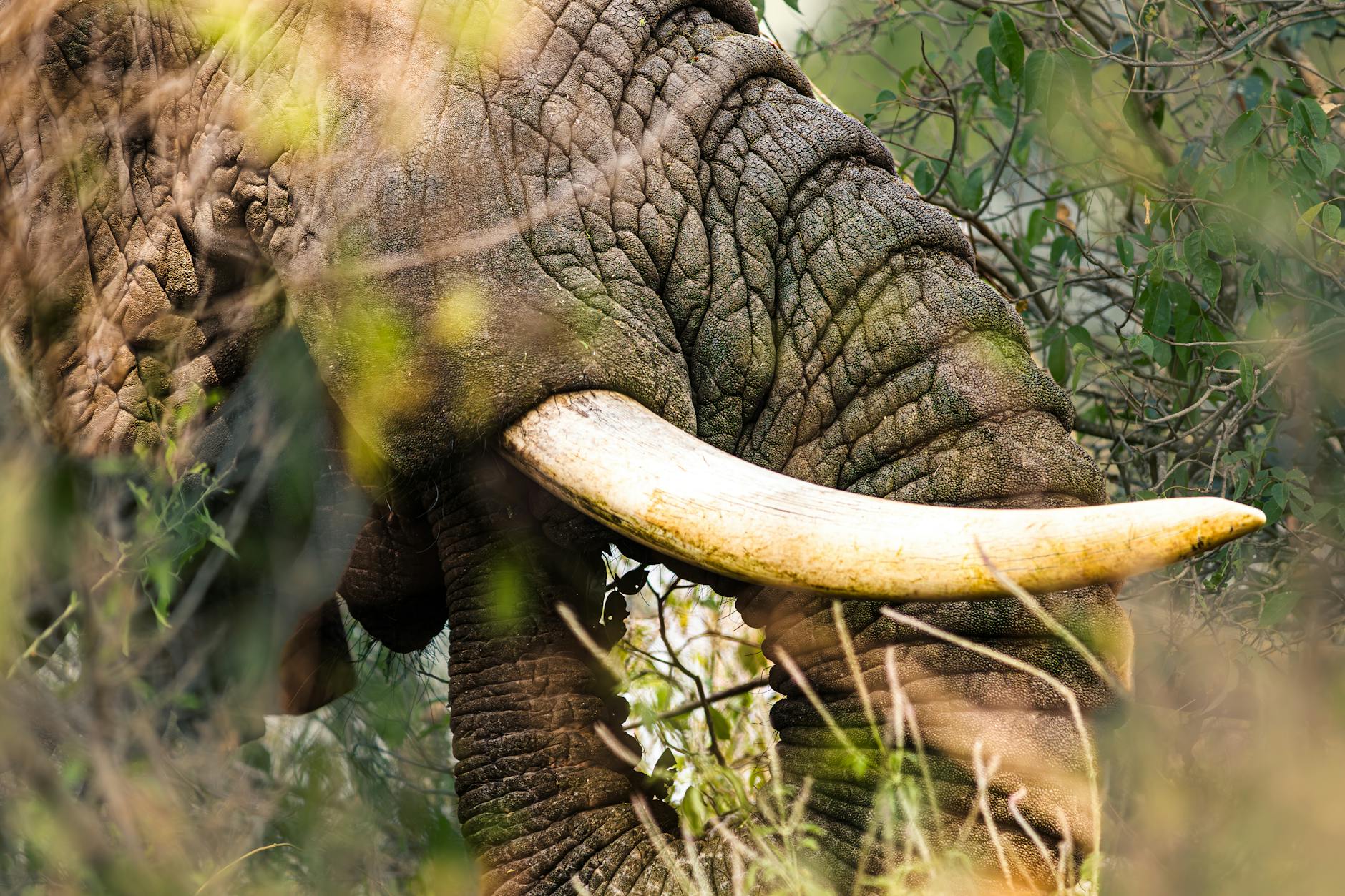
People often call elephant tusks teeth but picture them as canines. They are not. Tusks are massively elongated upper incisors. They erupt from the maxilla and grow forward, with about a third of the total length sitting inside the skull at the root. The visible portion is solid dentine, which is what ivory is, but the inner third is a pulp cavity full of blood vessels and nerves. This is why tusk fractures bleed and why a damaged tusk can become infected and life-threatening.
That incisor origin is what makes elephant tusks unusual. Other tusked mammals grow theirs from different teeth: the walrus tusk and the narwhal’s spiral tusk are both canines. Elephant tusks are elongated upper incisors. Hyraxes also have continuously growing upper incisors that function as small tusks.
Calves have one more pair of incisors, called tushes, which fall out and are replaced by the permanent tusks at around a year old. Once the permanent tusks come in, they grow for the rest of the animal’s life.
What elephants do with their tusks
Tusks are working tools. Elephants use them to dig for roots, water and salt; to strip bark from trees for fibre and minerals; to lift and move heavy objects, including downed trees and the bodies of dead family members; and to fight, defend and display. Bulls in musth use tusks against rivals, and damage and breakage are common in the dry season. Females use them to defend calves from predators, and lions, hyenas and crocodiles all back off from a charging matriarch.
Most elephants are tusk-handed. They favour one side and wear it down through repeated use, in the same way humans favour one hand. A field guide can often tell which is the dominant tusk at a glance: the master tusk is shorter, blunter, and shows more chipping along the working edge.
Why tusks matter ecologically
In dry seasons, elephants dig with their tusks to reach water below the surface of dry riverbeds, and the holes they leave are used by zebra, kudu, baboon and warthog for weeks afterwards. They break open salt licks, releasing minerals smaller herbivores cannot get at. They strip bark, opening trees up to insects and birds. In central African forests they dig at clay seams in mineral pits, and the resulting pools draw hundreds of other species.
Remove the elephants and you lose all of it. This is the practical content of calling elephants a keystone species: the landscape features other animals depend on are ones elephants make. For more on this gardening role, see our piece on elephant conservation.
Ivory: why a tooth drives a global criminal trade
Ivory is dentine with an unusually fine grain. It carves cleanly, polishes to a near-glassy finish, and ages well. It has been a luxury material across Asia and the Mediterranean for thousands of years. The modern trade expanded enormously in the 19th and 20th centuries, particularly through European colonial expansion, and it has never fully stopped despite the 1989 CITES ban.
Demand fell after China closed its legal domestic ivory market in 2017, but it has rebounded in pockets across south-east Asia, with Vietnam, Laos and Myanmar identified as transit and consumption hubs in TRAFFIC reporting. The supply side is the ugly part: a pair of average tusks is worth enough at end retail to make killing a several-tonne animal financially attractive. For the deeper history, see our piece on the ivory trade.
Why some elephants now have no tusks
Tusklessness is a naturally occurring trait in female African elephants, and normally an uncommon one. Where poaching is heavy, it stops being uncommon, because the elephants with tusks are the ones being killed.
Gorongosa National Park in Mozambique is the documented case. Research published in Science in October 2021, led by Shane Campbell-Staton, found that around 18.5 percent of female elephants there were tuskless before the Mozambican civil war, and around 51 percent of the adult females that survived it were. Fifteen years of ivory hunting during the war had selected hard against tusks, and the survivors have been passing the trait to their daughters. The rate among females born since is running at roughly a third.
That study is the clearest evidence there is that ivory poaching is removing elephants and reshaping elephant biology, and nobody yet knows what a population of largely tuskless females does to the ecological work described above.
Big-tusker bloodlines and why they matter
A small fraction of bulls in Africa carry exceptionally large tusks, often passing 45 to 50 kg per side. These are the super tuskers or hundred-pounders, named for the old hunters’ threshold of 100 lb per tusk. Conservationists in Kenya, especially in Tsavo where the Tsavo Trust runs a dedicated programme, and in Botswana and Zimbabwe, have spent decades tracking known individuals and protecting their bloodlines. Losing one to a trophy hunter or a poacher does not just kill an iconic animal, it removes a carrier of large-tusk genetics from a region.
This is one reason elephant trophy hunting stays controversial even where it is legal. For our deeper writing on this, see our piece on elephant trophy hunting.
Tusks in Asian elephants
Only male Asian elephants carry full tusks, and they are called tuskers in Sri Lankan and Indian usage. Females generally have short tushes or nothing visible. The proportion of tusked males varies enormously by region: fewer than 7 percent of bulls in Sri Lanka, around 45 percent in north India, and close to 95 percent in south India.
Sri Lanka’s near-total tusklessness is generally read the same way as Gorongosa’s: tuskers were captured and killed preferentially over centuries, and the genes went with them. Asian elephant tusks are typically smaller and less curved than African ones, but they are still ivory and still drive poaching.
Frequently asked questions
Are elephant tusks teeth?
Yes. They are elongated upper incisors, the same kind of tooth you have at the front of your mouth. They are dentine on the outside, which is what ivory is, with a pulp cavity containing blood vessels and nerves inside, and they grow throughout life from a root inside the skull.
Do all elephants have tusks?
Most African elephants of both sexes do. Among Asian elephants only males grow full tusks, and even then the proportion varies from fewer than 7 percent in Sri Lanka to around 95 percent in south India. Tuskless females occur naturally in all populations at low rates, and that rate rises where poaching is heavy.
How fast do elephant tusks grow?
Around 17 cm a year in healthy bulls, though the rate depends on diet, age and genetics. The biggest tusks on record came from very old bulls, which is a large part of why exceptional tusks are now so rare: poaching removes animals before they get old enough to grow them.
What are the heaviest elephant tusks ever recorded?
The Kilimanjaro pair, from a bull shot on the slopes of the mountain in 1898. They weighed 226 lb and 214 lb, or 102.7 kg and 97 kg, and are held by the Natural History Museum in London.
Why are elephants killed for their tusks?
Ivory is a luxury carving material with a long history in Asia and the Mediterranean. Despite the 1989 CITES ban on international trade, demand persists in transit and consumption hubs across south-east Asia, and the end-retail price is high enough to make killing a several-tonne animal financially attractive.
Are some elephants born without tusks?
Yes, and it is a heritable trait. In Gorongosa National Park in Mozambique the tuskless rate among adult females rose from about 18.5 percent before the civil war to about 51 percent among the survivors, because poachers killed the tusked ones.
What are big tuskers and why do they matter?
Bulls whose tusks pass roughly 45 kg per side, the old 100 lb threshold. Very few exist at any given time. They carry the genetics for exceptional tusk size and are tracked and protected by programmes such as the Tsavo Trust in Kenya. Losing one removes a carrier of those bloodlines.
Tusks tie together biology, ecology and conservation politics more tightly than almost any other elephant feature. To go deeper, read our ivory trade explainer, browse our elephant facts hub, or read about the three living elephant species.
Read next
- 100 Elephant Facts: Everything to Know About Earth’s Largest Land Animal: Our master elephant fact sheet: anatomy, cognition, matriarchal society, infrasound, the trunk, tusks and ivory, diet.
- The Ivory Trade: A Plain-Language Guide to How It Works: Where ivory comes from, how it moves, why the 1989 CITES ban only half worked, and what the DNA forensics and the 2017 China closure actually changed.
- Are Elephants Left-Trunked or Right-Trunked?: Elephants split roughly evenly between left- and right-trunked.
- Elephant Teeth: Six Molars Across a Lifetime: Elephants cycle through six sets of molars, replaced horizontally rather than vertically.
Updated 14 September 2026: corrected an absolute claim about tusks.



The Gorongosa tuskless figure of over 30 percent rewired my brain. Selection pressure from poaching changing biology is a sentence I had to read twice.
It is a confronting finding. The 2021 Science paper by Shane Campbell-Staton laid out the genetic side; the practical conservation question of what tusklessness means ecologically is still wide open.
I had no idea tusks were incisors rather than canines. That makes the slow-growth-from-the-root thing much clearer.
The Tsavo Trust super-tusker programme deserves more attention. A few dozen bulls carry an outsized share of the large-tusk genes and one trophy hunt undoes decades of stewardship.
Question: is the 17 cm a year growth figure constant through life or does it slow with age? I have read both.
It slows. Younger bulls in good condition lay tusk down fastest. By the late 40s the rate drops noticeably, and older bulls compensate by sheer accumulated length and circumference rather than annual gain.
Tuskless females have always interested me. The Mozambique numbers are striking and the long-term ecological consequences must be hard to model.
The 102 kg Kenya 1898 record is the kind of tusk that does not really exist any more. Selective poaching over a century has functionally removed the genetics for big tusks. Modern bull tusks rarely exceed 40 to 50 kg even in protected populations.