
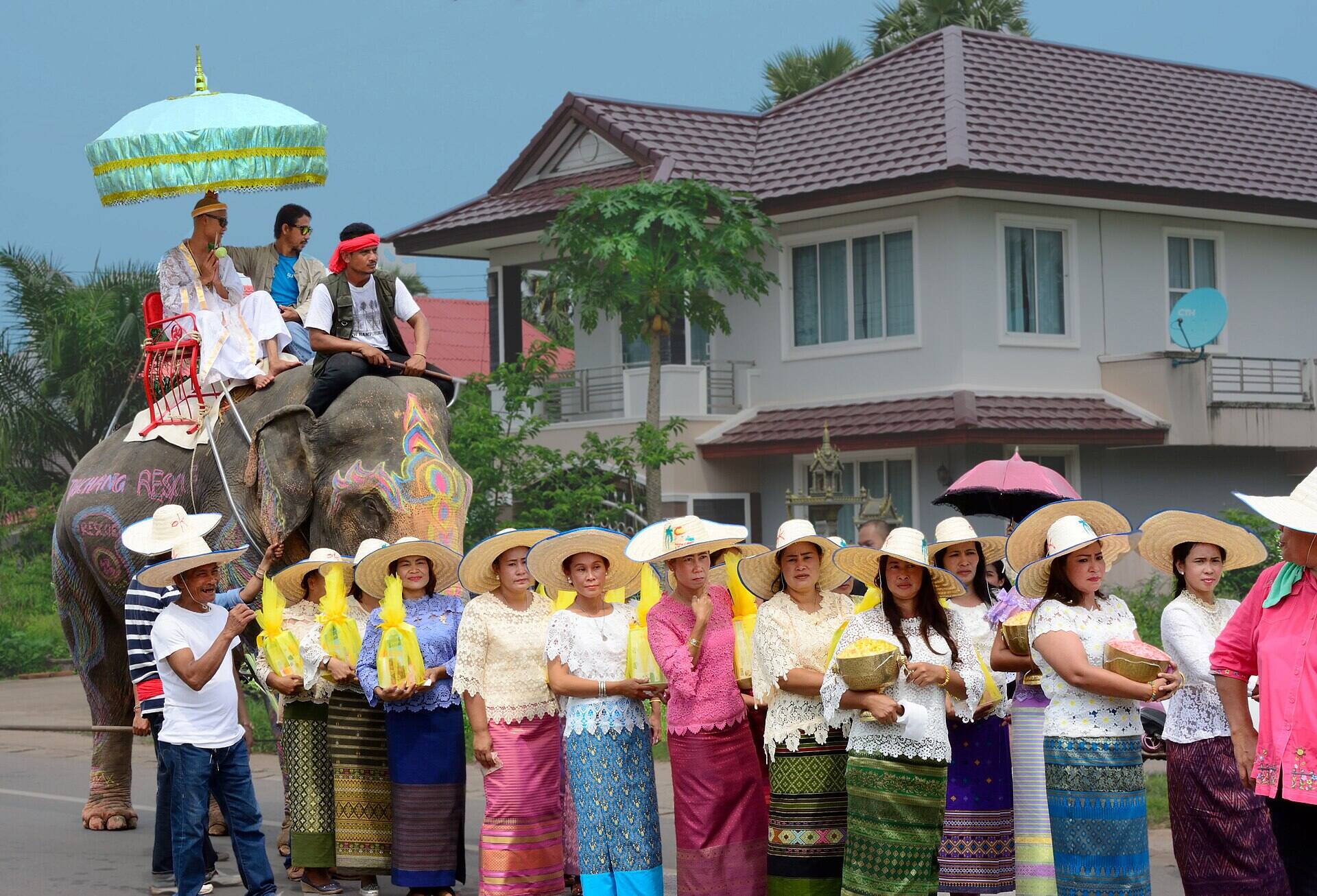
Elephants in Thai Culture: Royalty, Buddhism & Tourism
Last updated: October 26, 2026
7 min read
The elephant is the national animal of Thailand and a defining symbol of Thai history, religion, monarchy and tourism. The relationship stretches back at least a thousand years to the Sukhothai kingdom and runs through every part of Thai national identity, from the white elephants of the royal household to the working logging elephants of the north to the rescued sanctuary elephants of Chiang Mai. It is deeply respectful at the symbolic level and frequently troubled in practice, and the past two decades have been spent trying to close that gap.
Key cultural threads at a glance
| National animal | Thai elephant, formally designated as the national animal by Cabinet resolution on 26 October 2001 |
| Royal white elephant tradition | Continuous since the Sukhothai period (13th century) |
| National flag 1855 to 1916 | White elephant on a red field |
| Wild elephants today | Around 4,000 to 4,400 (Department of National Parks estimate) |
| Captive elephants today | Estimates range from around 3,000 to 4,500 |
| National logging ban | 1989 |
| National Thai Elephant Day | 13 March, established 1998 |
From war to royalty to logging
Captive elephants have been central to Thai statecraft for at least a thousand years. The Sukhothai kingdom, from the 13th to the 15th century, kept royal elephant stables and used elephants in war, ceremony and royal transport. The Ayutthaya period that followed made the elephant the central symbol of monarchical legitimacy, with the king’s right to rule expressed partly through possession of white elephants. The most famous battle in Thai national mythology, at Nong Sarai in 1593, was fought between King Naresuan of Ayutthaya and the crown prince of Burma in single combat on elephant back.
When the era of war elephants ended, Thai elephants moved into logging. The teak forests of the north were worked by captive elephants for more than a century. Elephants were the heavy-lift technology of Thai forestry, and logging camps employed thousands of animals and thousands of mahouts, many from Karen and Kuy communities with multi-generational elephant traditions.
The elephant’s symbolism in Thai culture is one reason it is such a popular design choice. See our gallery of elephant tattoo ideas.
The white elephant of Thai monarchy
In Thai and broader south-east Asian royal tradition, the white elephant is a symbol of royal merit and Buddhist righteousness. A Thai white elephant is an auspicious elephant selected by prescribed physical traits. It is not an albino. The tradition goes back at least to the Sukhothai period and continues today.
The white elephant also appears on the historic Thai naval ensign, on the Royal Order of the White Elephant, founded in 1861 by King Mongkut and still one of Thailand’s principal orders of merit, and on the chada, the royal crown used in coronation ceremonies. From 1855 to 1916 the national flag itself was a white elephant on a red field. For a deeper dive, see our piece on the white elephants of Thailand.
Elephants in Thai Buddhism
Thai Theravada Buddhism shares the wider south Asian tradition of treating the elephant as a sacred animal. The white elephant appears in the Jataka tales as a previous incarnation of the Buddha, and the Buddha’s mother Maya is said to have dreamt of a white elephant entering her side at the moment of his conception. Temple murals across Thailand depict elephants in narrative religious scenes, and elephant imagery runs through traditional Thai amulets and protective tattoos.
Captive elephants are sometimes used in alms-giving and merit-making ceremonies. The welfare implications of that have prompted reform discussions within the Thai sangha, though slowly.
The 1989 logging ban and what followed
Thailand banned commercial logging in 1989, in the aftermath of disastrous floods and landslides in the south that were blamed on deforestation. The ban was the right decision for the forests. For the elephants it was a cliff edge.
Logging camps closed. Mahouts lost their livelihoods overnight and were left holding an animal that eats around 150 kg a day and cannot be turned loose. Many converted to tourism, opening ride camps in Chiang Mai, Chiang Rai and the southern beach areas. Some ended up street begging in Bangkok, which has since been banned. Others went into circuses. The aftermath of 1989 was not managed, and the modern sanctuary movement exists largely as a response to it.
The ride-camp economy boomed until around 2015, when consumer attitudes turned decisively against riding. The transition has been bumpy, because the economics of converting a ride camp to a sanctuary are genuinely hard: sanctuaries take fewer visitors per day and need higher per-visit fees to cover the same feed bill.
The sanctuary movement
Elephant Nature Park, founded by Lek Chailert near Chiang Mai, set the template for ethical Thai elephant tourism: no riding, no shows, no bullhooks. Around a hundred rescued elephants live there. Her Save Elephant Foundation now runs a network extending across northern Thailand and into Cambodia and Myanmar, including a Saddle Off programme that helps partner camps convert to ride-free models.
The Surin Project in the north-east took a different approach, partnering with traditional Kuy mahout families to keep their elephants in semi-natural conditions while paying the families a wage from observation-only tourism. It is a useful counter-example to the idea that the only ethical outcome is separating mahouts from elephants.
The movement is real but incomplete. Plenty of facilities marketed as sanctuaries are repurposed tourist camps with better photography and the same underlying welfare problems. A quick self-test: if the front page of the website shows people riding elephants or bathing in close contact with them, it is not a credible sanctuary, whatever the word above the picture says.
Beyond Elephant Nature Park, the operations most consistently named as credible are Boon Lott’s Elephant Sanctuary in Sukhothai and Wildlife Friends Foundation Thailand, which runs a large multi-species rescue centre and elephant refuge in Phetchaburi province, about 40 minutes from Hua Hin.
Some of the industry pressure has come from the booking platforms rather than from within Thailand. Intrepid Travel stopped selling elephant rides in 2014, and TripAdvisor stopped selling tickets to attractions involving physical contact with captive wild animals in 2016. For the welfare context, see our piece on the elephant entertainment industry.
Wild elephants in Thailand
The Department of National Parks put the wild population at roughly 4,013 to 4,422 animals across 91 conservation areas in its January 2024 assessment, up from a low of around 1,800 in 1989. That is a conservation success and a growing conflict problem at the same time, and Thai authorities are now openly discussing population management.
The main populations are in the Western Forest Complex, Khao Yai, Kui Buri and the smaller eastern and southern complexes. Khao Yai is a UNESCO World Heritage Site and the easiest wild-elephant trip from Bangkok. Kui Buri in Prachuap Khiri Khan has the most reliable dawn and dusk sightings, with herds grazing at managed mineral licks.
National Thai Elephant Day
13 March is National Thai Elephant Day, established in 1998 to mark the elephant’s place in Thai history. It is not a public holiday, but it is widely observed at temples, sanctuaries and camps with merit-making ceremonies and welfare-awareness events.
Where to go next
For the wider species, see our Asian elephant species profile. For closely related cultural reads, see the white elephants of Thailand and elephants in Indian tradition. For where to actually go, see our guide to elephants in Thailand. For wider hubs, see elephant conservation and elephant facts.
Frequently asked questions
Why is the elephant so important in Thai culture?
Four overlapping reasons. The species is native and has been part of the country’s ecology for as long as there has been a country. Captive elephants were the backbone of war, transport and royal ceremony from the Sukhothai period onwards. Thai Theravada Buddhism treats the elephant as sacred. And the white elephant has been a symbol of royal legitimacy continuously since the 13th century.
What is a white elephant in Thai tradition?
An Asian elephant with the auspicious traits prescribed in Thai tradition and law. It is not an albino. The historic naval ensign, the Royal Order of the White Elephant and the chada coronation crown all derive from the tradition. See our long piece on the white elephants of Thailand.
When was the elephant named Thailand’s national animal?
26 October 2001. The Cabinet resolution formalised a much older cultural tradition. The elephant also appears on the historic naval ensign, on the Royal Order of the White Elephant, and on the coats of arms of several Thai provinces.
What happened to working elephants after the 1989 logging ban?
Most moved into tourism, opening ride camps in the north and the southern beach areas. Some ended up street begging in Bangkok, since banned. Others went into circuses. The transition was severe for mahout families, mostly Karen and Kuy communities, and the underlying economics remain the hardest part of captive elephant welfare reform.
Should I ride an elephant in Thailand?
No. The training used to make an elephant safe to ride, the phajaan or crush, is straightforwardly cruel, and chair-saddle riding puts sustained load on a part of the spine not built for it. Choose observation-only operations instead.
Where can I see wild elephants in Thailand?
Kui Buri National Park has the highest sighting reliability. Khao Yai is the closest major population to Bangkok and a UNESCO World Heritage Site. The Western Forest Complex holds wild elephants but is much less accessible on a short trip.
How many elephants are there in Thailand?
Roughly 4,000 to 4,400 wild elephants according to the Department of National Parks, plus a captive population that different sources put at anywhere from around 3,000 to 4,500. The captive figure is genuinely uncertain because registration is patchy and animals move between venues.
What is National Thai Elephant Day?
13 March, established in 1998. It is marked at temples, sanctuaries and camps with merit-making ceremonies and welfare-awareness events, and it is not a public holiday.
Continue exploring at our store
If this article sparked your interest, head over to the We Love Elephants merchandise store for related reads and gear.
This article is part of our elephant facts guide, which links every post on elephant bodies, minds and family life.
More about elephants
- Elephant Species: Complete Guide to All Living Elephants 2026: The three living elephant species and their subspecies: taxonomy, range, diet.
- White Elephants of Thailand: History, Royalty & Meaning: What a Thai white elephant actually is, the seven markers that define one, the war fought over them in 1563, and the 21 presented to King Bhumibol.
- Elephants in Sri Lankan Culture: Temples, Ceremony and Conflict: Two thousand years of reverence, the Kandy Esala Perahera and its welfare argument, and a human-elephant conflict that killed 3,484 elephants and 1,195 people between 2015 and 2024.
- Elephants in Thailand: Wild Numbers, Sanctuaries, and Ethics: Where Thailand’s 4,000-plus wild elephants live, what the captive tourism industry really looks like, and how to tell a working sanctuary from a rebranded ride camp.
Updated 14 September 2026: corrected Thailand’s national animal designation date.



the 100,000 working elephants in 1900 down to under 4,000 today number is staggering when you sit with it. the 1989 logging ban created a captive elephant unemployment crisis nobody really planned for, which is how a lot of them ended up in tourism camps in the first place. you can still see this play out in Surin if you visit.
spent a fortnight in Chiang Mai last year and Elephant Nature Park is doing the heavy lifting on rehoming logging-camp elephants. the ban-tourism push is making slow real progress on rides, the bathing-with-elephants thing is the next welfare battle though, those camps just rebranded.
Halliburton, you saw the Chiang Mai rebrand firsthand, that matches what BLES has been saying for years. The bathing camps especially keep slipping past welfare audits. The Sukhothai-era royal stable lineage is one thing, the modern tourism economy is another, and conflating the two is how the bad operators stay in business.