Bomb-Sniffing Elephants: The Surprising Science of Their Noses
Last updated: September 14, 2026
6 min read
A 2015 study run by US Army researchers with a South African elephant facility showed that African elephants can detect TNT with accuracy that beats trained bomb dogs. The work raised the obvious question of whether elephants could ever be deployed as working detection animals in landmine-affected regions, and the equally obvious welfare and practicality objections. Here is the science, the debate, and where the research actually went.
Key facts at a glance
| Lead researcher | Stephen Lee, US Army Research Office, with Sean Hensman and colleagues |
| Key publication | Applied Animal Behaviour Science, 2015 |
| Test elephants | Three African elephants at the Adventures with Elephants facility, Bela-Bela, South Africa |
| Compound tested | TNT, against a range of control scents |
| TNT target sensitivity | All 23 targets detected, with 18 false alerts among 502 distractors |
| Working dog comparison | Operational bomb dogs typically detect at 90 to 95 percent |
| Why this matters | Elephants have around 1,948 functional olfactory receptor genes, the most of any sequenced mammal |
| Operational deployment status | Research only, no field deployment |
Why elephants have such good noses
Elephants have the largest known olfactory repertoire of any mammal. A 2014 genome study led by Yoshihito Niimura at the University of Tokyo found that the African elephant has around 1,948 functional olfactory receptor genes, compared with around 811 in dogs and around 396 in humans. That genetic capacity translates into real behavioural discrimination. Wild elephants can locate water at long range, and the Amboseli work by Lucy Bates, Karen McComb and colleagues showed elephants can distinguish Maasai from Kamba clothing by scent alone, and react differently to each.
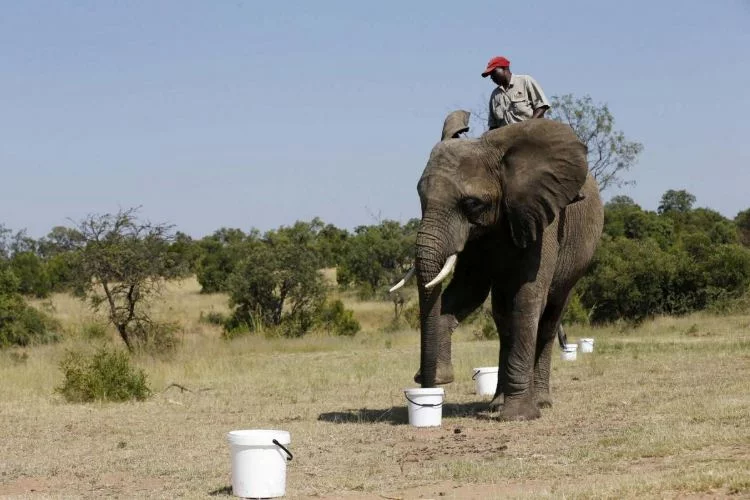
The 2015 explosives work built on that. Stephen Lee, a senior chemist at the US Army Research Office, worked with Sean Hensman at the Adventures with Elephants facility in Bela-Bela, South Africa, on a structured signal-detection task. An elephant was presented with a row of buckets, some containing TNT samples and some containing controls, and was trained to raise its trunk when it detected TNT. In the controlled test, the elephants detected all 23 TNT targets and made 18 false alerts among 502 distractors.
How well do bomb dogs do, for comparison?
Working bomb dogs deployed at airports, checkpoints, and large public events typically detect explosives at 90 to 95 percent accuracy under operational conditions. Dogs have been the standard explosives detection animal since the 1940s and the surrounding infrastructure (training, handlers, transport, breeding) is mature. The elephant result is a laboratory-condition discrimination score, not an operational one, so the comparison is true in the narrow technical sense and misleading in the practical sense.
Why bomb-sniffing elephants will probably never deploy
Six obstacles, most of them flagged by the researchers themselves. Logistics: an elephant cannot be walked into an airport checkpoint queue. Cost: a working elephant needs multiple handlers, food, water, veterinary care, and heavy transport. Welfare: deploying captive elephants into landmine-affected zones raises serious concerns whatever the intentions. Behaviour: an elephant in musth, or simply having a bad day, does not perform reliably, and the consequences of that are much larger than with a dog. Training: the test elephants had been hand-raised since calfhood at a specialist facility, which is not a scalable model. Alternatives: rats do the job, and are far easier to deploy.
What happened next
The honest answer is: not much, on the elephant side. The detection work has stayed in the research-and-demonstration phase and has produced no operational programme.
The rat programme is the one that scaled. APOPO, a Belgian-Tanzanian NGO, trains giant African pouched rats to detect landmines and tuberculosis. The rats are light enough not to trigger a mine, train quickly, and travel easily. APOPO reports having found and destroyed more than 100,000 landmines and other explosive remnants of war across former conflict zones including Mozambique, Angola, and Cambodia. It is the only working detection animal other than the dog to reach deployed mine action at scale.
Separately, the elephant’s acoustic repertoire has become its own detection research field. Work by Matthias Zeppelzauer and Angela Stoeger, published in 2015, laid out the fundamentals for an elephant early-warning and monitoring system built on automatic recognition of infrasonic rumbles, and later research demonstrated that rumbles can be localised seismically. The application is different from explosives detection, but the underlying insight is the same: the elephant’s sensory and communication repertoire is far richer than humans historically assumed.
What it tells us about elephant cognition
The 2015 work sits inside a wider literature that has expanded rapidly over the past two decades. Asian elephants passed the mirror self-recognition test in a 2006 study by Joshua Plotnik, Frans de Waal and Diana Reiss. Elephants have demonstrated cooperative problem solving, insight-driven use of objects, and long-term social memory, and Karen McComb’s Amboseli work has documented both the value of an old matriarch’s social knowledge and the sustained interest elephants show in the skulls and ivory of their own species. Olfactory discrimination on this scale is one more line in that picture.
What you can do
If the working-animal side of this interests you, APOPO’s HeroRAT programme is the one that has actually cleared minefields. If it is elephant cognition and acoustics, Save the Elephants funds long-running behavioural and acoustic research in Kenya. If it is captive-elephant welfare, Wildlife SOS, the Save Elephant Foundation, and the Performing Animal Welfare Society all fund the kind of low-stress, welfare-compatible work with elephants that the 2015 study was designed around.
Where to go next
For wider species context, see our African elephant species profile and our Asian elephant species profile. For other conservation technology, see elephant collars. For the wider human-elephant relationship, see a brief history of the human-elephant relationship. For broader hubs, see elephant conservation and elephant facts.
Frequently asked questions
Can elephants really detect explosives?
Yes, with very high accuracy under laboratory conditions. The 2015 study published in Applied Animal Behaviour Science showed three trained African elephants detecting all 23 TNT targets, with 18 false alerts among 502 distractors. The capability rests on the elephant’s olfactory repertoire, the largest known of any sequenced mammal.
Why do elephants have such good noses?
A 2014 genome study led by Yoshihito Niimura found the African elephant has around 1,948 functional olfactory receptor genes, the highest count of any sequenced mammal, against around 811 in dogs and 396 in humans. Behavioural work backs it up: elephants locate water at long range and can distinguish human groups by scent.
Are elephants more accurate than dogs at finding bombs?
Under the specific laboratory conditions of the 2015 study, yes. Working bomb dogs detect at 90 to 95 percent in operational conditions and the elephants detected all 23 TNT targets but also made 18 false alerts among 502 distractors. But that is laboratory accuracy on a controlled discrimination task, not operational accuracy in an airport or a minefield, and dogs have a mature operational infrastructure that elephants do not.
Are there actually any bomb-sniffing elephants deployed?
No. The research has never produced an operational deployment, for the reasons above. The closest working alternative is APOPO’s giant African pouched rat programme.
What is APOPO?
A Belgian-Tanzanian NGO that trains giant African pouched rats to detect landmines and tuberculosis. Its landmine programme has found and destroyed more than 100,000 landmines and other explosive remnants of war in former conflict zones including Mozambique, Angola, and Cambodia. The rats are too light to trigger a mine, train quickly, and are easy to transport.
Where was the original elephant work done?
At the Adventures with Elephants facility in Bela-Bela, South Africa, in partnership with Stephen Lee of the US Army Research Office and elephant handler Sean Hensman. The study used three of the hand-raised resident elephants over a multi-week training and testing programme.
Has the research continued?
Not in any direction that produced a working programme. The detection-animal field has stayed with dogs and moved toward rats. The 2015 elephant paper is now mainly cited in the wider literature on elephant sensory biology rather than as the foundation of anything operational.
Related reading
- 100 Elephant Facts: Everything to Know About Earth’s Largest Land Animal: Our master elephant fact sheet: anatomy, cognition, matriarchal society, infrasound, the trunk, tusks and ivory, diet.
- Elephants and the Mirror Test: Self-Recognition in a Trunk: One elephant out of three passed the 2006 Bronx Zoo mirror test.
- How GPS Collars Track Wild Elephants in Real Time: Save the Elephants has been GPS-collaring elephants in Samburu since 1998.
- Here’s Why So Many Elephants Are Dying In Zoos: The 2008 Science survivorship study and the Defra-funded Bristol assessment of 77 UK zoo elephants, and what their numbers actually say about captivity.
Updated 14 September 2026: corrected the explosives detection results.