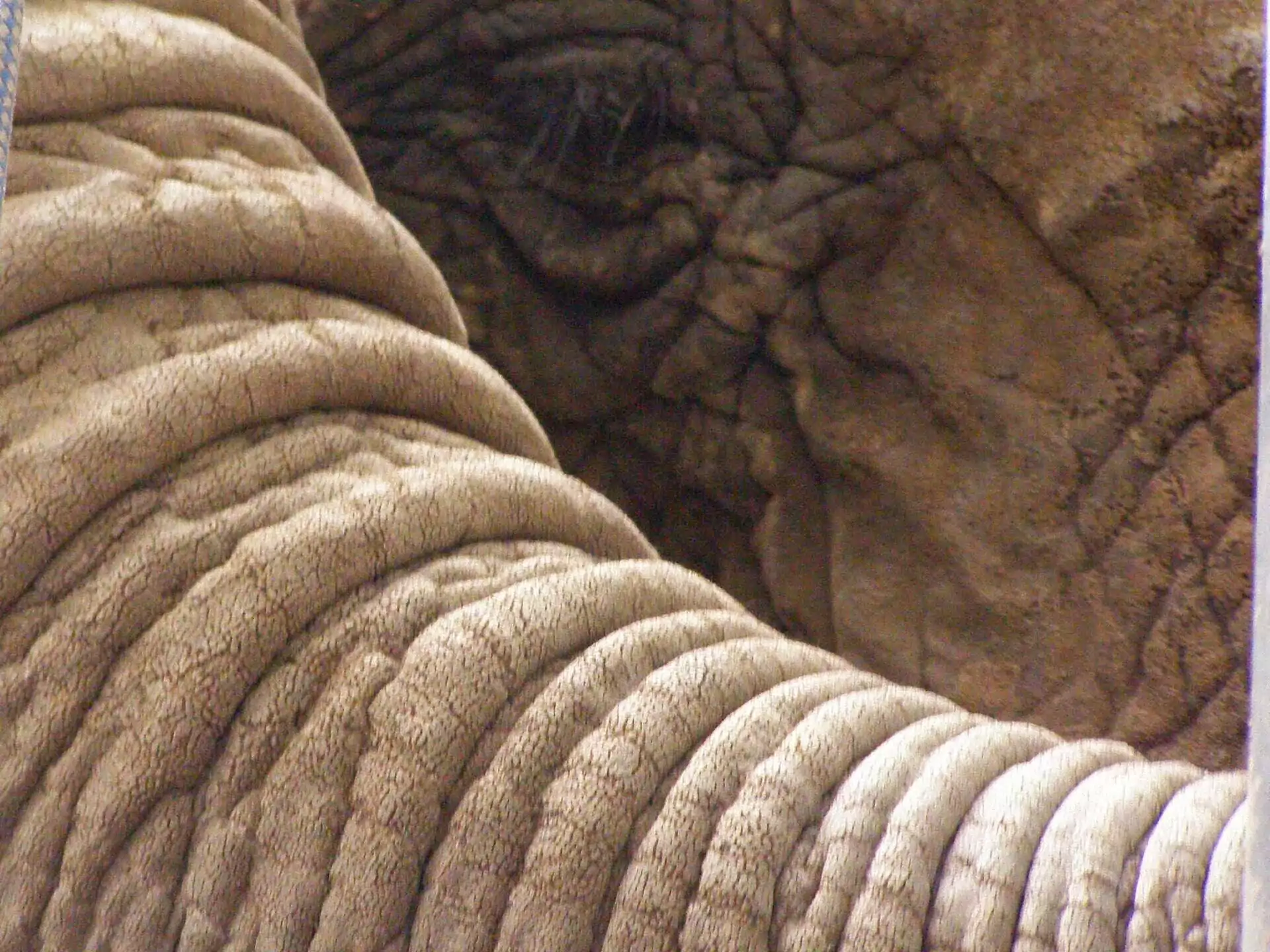
The Elephant Sense of Smell: 1,948 Genes and What They Do With Them
4 min read
A dog is the animal most people name when asked which mammal has the best nose. On the genetic evidence the dog is not close. When the African elephant genome was searched for olfactory receptor genes, the count came back at 1,948 intact ones, roughly twice the dog figure and about five times the human figure. It remains the largest working smell gene set found in any single species.
Where the number comes from
The count comes from a 2014 study by Yoshihito Niimura, Atsushi Matsui and Kazushige Touhara at the University of Tokyo, published in Genome Research. They searched the genomes of 13 placental mammals and pulled out more than 10,000 olfactory receptor genes in total. The African elephant had by far the largest repertoire at 1,948 intact genes.
The same paper found that of the thousands of receptor genes across all 13 species, only three were shared by every one of them. Smell gene repertoires are close to species-specific. A dog, a mouse and an elephant each detect a largely different set of compounds, rather than a stronger or weaker version of the same set.
A caveat worth keeping: gene count is not the same as sensitivity. A large repertoire suggests a wide discriminating range rather than a low detection threshold, and nobody has run the behavioural tests needed to rank species properly. What the elephant number tells you is that olfaction matters enormously to this animal’s evolution.
Counting by nose
In 2019 Joshua Plotnik and colleagues published a result in PNAS that no other animal, humans included, had been shown to manage. Six Asian elephants at the Golden Triangle Asian Elephant Foundation in Chiang Rai, Thailand, were offered two sealed buckets of sunflower seeds with perforated lids. They could smell both. They could not see, hear or touch the contents.
The elephants picked the bucket with more seeds, and their accuracy followed the pattern quantity discrimination always follows: easier when the two amounts were far apart, harder as the ratio closed up. That pattern is well documented for animals judging quantity by sight. This was the first demonstration of it by smell alone.
Telling people apart
In Amboseli, Kenya, Maasai and Kamba communities have very different histories with elephants. Young Maasai men have speared elephants; Kamba farmers rarely do. Lucy Bates and colleagues at St Andrews tested whether elephants had learned the difference, and published the result in Current Biology in 2007.
They presented wild elephants with clothing that had been worn for five days by men from each group. The elephants moved away faster and further from the Maasai-worn garments, and kept going until they reached grass over a metre high, which is cover. They did that on almost every Maasai trial and about half the Kamba trials. Colour was tested separately and worked as an independent cue: red cloth, associated with Maasai dress, drew aggression rather than flight.
The elephants were reading which humans, from a worn garment, and applying a different response to each.
Finding water
Tracking studies in Namibia and Botswana repeatedly record elephants walking a straight line toward water they cannot see, across tens of kilometres of landscape with no visible cue. The working explanation combines memory of the route with airborne detection of humid air and the compounds that come off wet ground.
Memory alone does not explain a herd changing direction toward a pan that filled two days ago, so something is being detected on the wind. In a drought a family needs both, which is part of why the oldest matriarch matters so much.
Sniffing out explosives
The discrimination ability has been tested against a practical problem. A 2015 study in Applied Animal Behaviour Science, run by Stephen Lee of the US Army Research Office with three African elephants at a facility in Bela-Bela, South Africa, reported TNT detection above 99 percent, against the 90 to 95 percent typical of operational bomb dogs. We covered the work and the objections to it in bomb-sniffing elephants. Nobody is sending elephants into minefields, for reasons of weight and welfare, but the result supports what the genome suggests.
How the trunk does it
The trunk is a sampling instrument as much as a limb. An elephant raises the tip and rotates it to sweep the air, then delivers a sample directly to the olfactory epithelium at the top of the nasal passage. It also has a vomeronasal organ in the roof of the mouth, used mainly for pheromones. When a bull touches a female’s urine or genitals with the trunk tip and then presses that tip to the roof of his mouth, he is loading that organ. That is the elephant version of the flehmen response other mammals perform by curling the lip.
Frequently asked questions
How many smell genes does an elephant have?
The African elephant has 1,948 intact olfactory receptor genes, the largest number identified in any species. Dogs have about 800 and humans about 400.
Do elephants smell better than dogs?
They have more than twice as many working olfactory receptor genes, which points to a wider range of distinguishable odours. Gene count is not a direct measure of sensitivity, so “better” depends on the task.
Can elephants count using smell?
They can judge which of two hidden food quantities is larger by smell alone. That is quantity discrimination rather than counting, and it is the only species yet shown to do it without seeing the food.
How far away can an elephant smell water?
Field tracking records elephants moving purposefully toward water over tens of kilometres. The distances quoted vary widely between studies, and memory of the landscape almost certainly contributes alongside scent.
Can elephants recognise individual people by smell?
They can distinguish groups of people by scent. In Amboseli, elephants responded differently to garments worn by Maasai and Kamba men, and treated the two groups as different levels of threat.
Sources
- Niimura, Matsui and Touhara, “Extreme expansion of the olfactory receptor gene repertoire in African elephants”, Genome Research 24, 2014
- University of Tokyo summary of the Niimura study
- Plotnik and colleagues, “Elephants have a nose for quantity”, PNAS 116, 2019
- Bates and colleagues, “Elephants Classify Human Ethnic Groups by Odor and Garment Color”, Current Biology 17, pages 1938 to 1942, 2007
- 100 Elephant Facts: Anatomy, cognition, matriarchal society, the trunk, tusks and diet in one place.
- Elephant Trunk Anatomy: Forty thousand muscle fascicles, and what the finger at the tip is for.
- Elephant Infrasound: The other long-range sense: rumbles below human hearing, and seismic reception through the feet.
- Elephants and the Mirror Test: What self-recognition in an elephant does and does not prove.