Elephants in Indian Culture: Ganesha, War & Festivals
Last updated: October 26, 2026
7 min read
The elephant is woven through 5,000 years of Indian civilization: through religion, royalty, art, war, agriculture, and the everyday symbolism of pottery, jewellery, and architecture. No other wild animal occupies so much of India’s cultural imagination, and few cultures have lived alongside an elephant species as continuously as the people of the Indian subcontinent. This is a tour through the cultural footprint, with the conservation tensions that come with it.
Key cultural threads at a glance
| Religious central figure | Ganesha, the elephant-headed Hindu god of beginnings and obstacles |
| Earliest depictions | Indus Valley seals around 2500 BCE |
| Royal military use | Mauryan and Mughal armies, war elephants for over 2,000 years |
| Major festivals | Thrissur Pooram (Kerala), Mysore Dasara (Karnataka), Sonepur Mela (Bihar) |
| Sacred temple roles | Caparisoned bulls in processions across south India |
| Captive elephants in India | Around 2,500 to 2,700 at the last national count, most privately owned |
| Project Elephant founded | 1992 |
| National Heritage Animal status | Granted by the Government of India in 2010 |
Ganesha: the most widely worshipped elephant
Ganesha, the elephant-headed son of Shiva and Parvati, is one of the most widely worshipped deities in Hinduism, present in family shrines from Tamil Nadu to Nepal. He is the remover of obstacles, the patron of letters and learning, and the divinity with whom most Hindu rituals begin. The most popular origin story has Parvati creating Ganesha from clay or turmeric paste to guard her bath; Shiva, returning home and not recognizing the boy, beheaded him in anger and replaced the head with that of an elephant.
Ganesha and the wider symbolism of elephants in India inspire many body-art designs. Browse our collection of elephant tattoo ideas.
Variants of the Ganesha story exist across Hindu, Jain, and Buddhist traditions. He appears under the name Vinayaka in Buddhist iconography and turns up in temple carving across south and south-east Asia from Sri Lanka to Cambodia. His annual festival, Ganesh Chaturthi, draws millions of devotees across Mumbai and Pune each August or September.
War elephants and royal power
The elephant was the heavy weapon of the Indian battlefield for over two thousand years. The Mauryan emperor Chandragupta fielded thousands against Seleucid forces in the late 4th century BCE, and handed over 500 of them as part of the settlement with Seleucus. The Mughals kept enormous imperial stables, documented in detail by Akbar’s court historian Abu’l Fazl in the Ain-i-Akbari, complete with grading systems, ration scales and dedicated keepers. War elephants carried armoured towers (howdahs) loaded with archers and light artillery, charged enemy formations, and were used to demolish gates and clear field obstacles. The British East India Company kept elephant batteries into the 19th century, mostly for hauling heavy ordnance through hill country.
Royal elephants also functioned as moving thrones. The emperor or maharaja would receive ambassadors, deliver judgements, and conduct processions from a caparisoned bull. The ceremonial role survives in the royal household traditions of Jaipur, Mysore, and a handful of other former princely states, though the practical military role ended with the rifle.
Temple elephants and the south Indian festival tradition
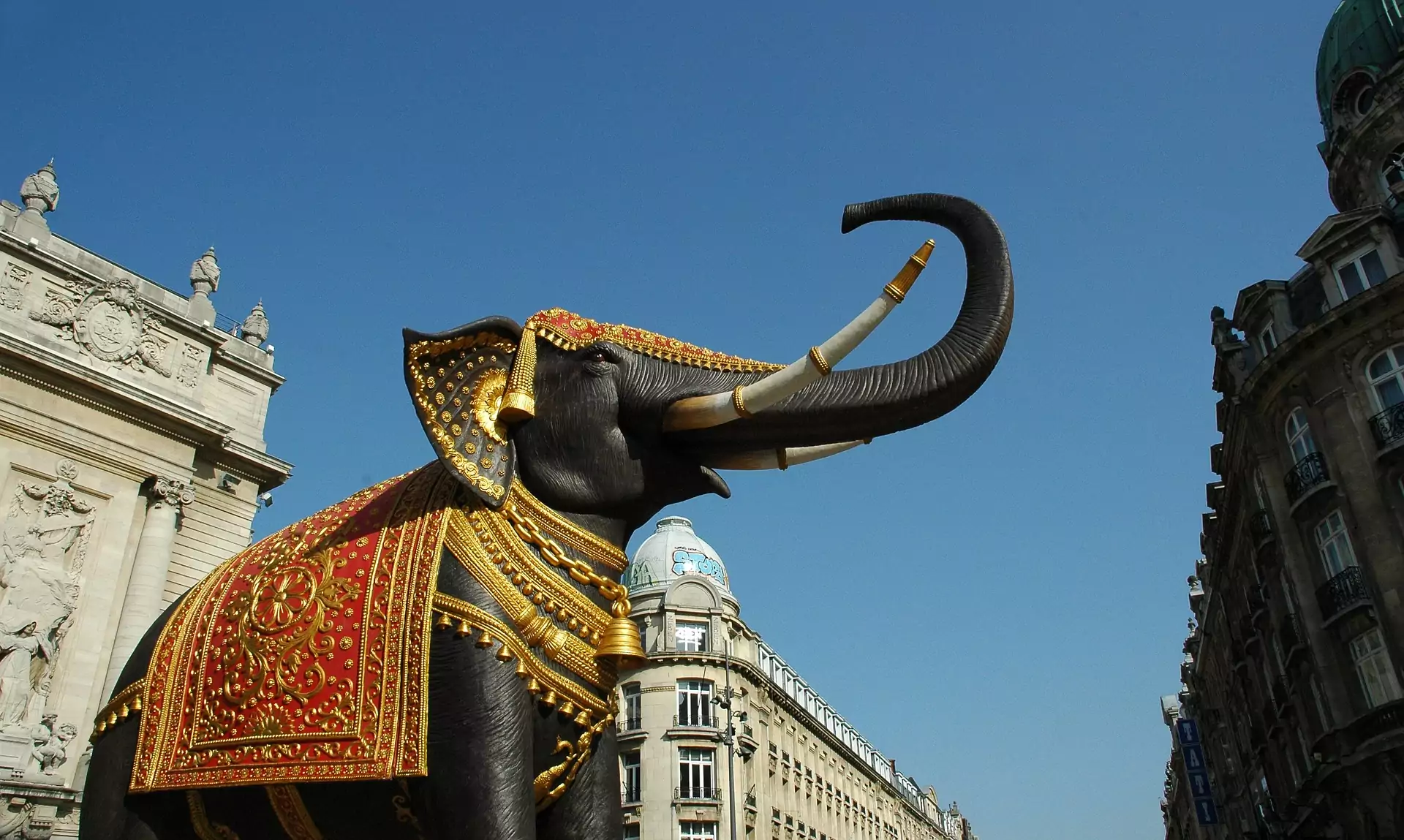
South Indian temples, especially in Kerala and Tamil Nadu, have used captive elephants in processions for many centuries. The annual Thrissur Pooram in central Kerala features dozens of caparisoned bulls in formal procession; the Mysore Dasara in Karnataka centres on the Golden Howdah carried by the lead bull; Sonepur Mela in Bihar is one of the last remaining elephant fairs where captive elephants were traded, now heavily restricted by law.
The temple-elephant tradition has become a major ethical fault line, and the numbers are moving fast. Kerala’s captive population stood at around 408 animals by 2024, of which 369 were privately owned, after roughly 160 deaths in six years cut the total by about a third. The remaining bulls are being worked harder across more festivals as a result. Welfare investigations have documented chronic foot disease, musth-related deaths, and a high captive mortality rate, and animal-welfare groups including Wildlife SOS and the Animal Welfare Board of India have pushed for tighter regulation. Reform is slow because the festivals are immovable cultural fixtures.
Art, architecture, and literature
Elephants populate Indian visual culture across every major period. Indus Valley seals from around 2500 BCE include some of the earliest known elephant depictions in any human art form. At Dhauli in Odisha, a monumental elephant is carved out of the rock directly above Ashoka’s inscription, and at Kalsi in Uttarakhand an elephant is drawn on the edicts boulder and labelled gajatame, “the best elephant”, generally read as a reference to the Buddha. Mughal miniature painting, especially the Akbarnama and the Padshahnama, treats the elephant as visual shorthand for imperial authority. The southern Vijayanagara temples carve elephants into the plinths of nearly every gopuram (gateway tower).
In literature, the elephant appears in the Mahabharata, the Ramayana, the Panchatantra fables, and Kalidasa’s classical Sanskrit poetry. There is also a whole technical literature of its own: the Gajashastra and Hastyayurveda attributed to the sage Palakapya cover capture, training, anatomy, disease and treatment, and the Matanga Lila, a 263-stanza Sanskrit treatise on elephant life and behaviour, is closely associated with Kerala. That body of work is the foundation of the gajashastra tradition still drawn on there today.
Modern symbolism: politics and public life
The elephant is the electoral symbol of the Bahujan Samaj Party, founded in 1984 by Kanshi Ram to advance Dalit and lower-caste interests, and the party has formed state governments in Uttar Pradesh. The choice draws on the elephant’s older association with steady, deliberate power.
Elephants also appear on the abacus of the Lion Capital of Ashoka at Sarnath, alongside a bull, a horse and a lion, separated by wheels. That capital became India’s state emblem and its wheel became the Ashoka Chakra on the national flag. The lions and the wheel, not the elephant, are what those emblems are built around, which is worth saying plainly because the opposite gets repeated a lot.
The conservation tension
India has the world’s largest wild Asian elephant population, estimated at 22,446 by SAIEE 2021 to 2025. Its January 2019 official captive-elephant count was 2,675. It also carries the highest absolute human-elephant conflict toll of any country, running to several hundred human deaths and around a hundred elephant deaths a year. Project Elephant, launched in 1992, now covers 33 elephant reserves, and the Ministry of Environment’s 2023 corridor report ground-validated 150 elephant corridors across 15 range states, up from the 101 identified in the 2005 survey. The challenge is bigger than wildlife management: it sits at the intersection of agricultural expansion, religious obligation, and political will. For a deeper dive on the species, see our Asian elephant species profile and our Indian elephant trivia adventure.
Where to see the cultural side
For temple festivals, attend Thrissur Pooram (late April or early May, Kerala) or Mysore Dasara (October, Karnataka), both of which can be observed without participating in the captive-elephant ride economy. For the artistic legacy, the National Museum in Delhi and the Indian Museum in Kolkata have outstanding Mughal and Mauryan collections. For wild sightings combined with cultural context, Periyar in Kerala is the obvious choice.
Where to go next
For wider context, see our pieces on elephants in Thai culture, the white elephants of Thailand, and a brief history of the human-elephant relationship. For conservation hubs, see elephant conservation and elephant species.
Frequently asked questions
Why is the elephant so important in Indian culture?
Three reasons working together. The species is native and was once abundant across most of historic India, so it has always been a familiar animal rather than a distant exotic. Its size, intelligence, and longevity made it both useful, for war, transport and ceremony, and revered. And Hindu, Jain, and Buddhist traditions each took the elephant into their religious imagery, above all through Ganesha.
Who is Ganesha?
The elephant-headed Hindu god of beginnings, remover of obstacles, patron of letters and learning, and son of Shiva and Parvati. The common origin story has Parvati creating him from clay or turmeric paste; Shiva, not recognizing the boy, beheaded him, then replaced the head with that of an elephant. His festival is Ganesh Chaturthi, held every August or September.
Were war elephants real?
Yes, and they were the heavy weapon of the Indian battlefield for over 2,000 years. Chandragupta fielded thousands and gave 500 to Seleucus under a peace settlement. The Mughals maintained large imperial stables, recorded in Abu’l Fazl’s Ain-i-Akbari. Elephants carried howdahs with archers, charged formations, and demolished gates. Firearms and modern artillery ended the military role, but ceremonial use continued into the 20th century.
What is Thrissur Pooram?
Kerala’s largest temple-elephant festival, held annually in late April or early May at the Vadakkunnathan Temple in Thrissur. Dozens of caparisoned bulls take part in a formal procession with traditional drumming, fireworks, and the Kudamattam parasol-exchange ceremony. It draws hundreds of thousands of visitors and is one of the cultural anchors that has made captive-elephant welfare reform politically difficult.
Why is the elephant the BSP party symbol?
The Bahujan Samaj Party was founded in 1984 by Kanshi Ram and took the elephant as its electoral symbol. The animal’s traditional association with steady, deliberate strength suited a party built on mass mobilisation, and the symbol has been on Indian ballot papers ever since.
Is it ethical to attend a temple elephant festival?
It depends which one and how you take part. Watching a public procession is generally considered acceptable. Paying for a private ride, photo opportunity, or bathing experience puts money into the captive-elephant tourism economy, which has well-documented welfare problems. Kerala’s temple elephants in particular have been the subject of repeated state scrutiny and campaigning by Wildlife SOS and the Animal Welfare Board of India.
What is gajashastra?
The traditional Indian science of elephant management and medicine, set out in Sanskrit texts attributed to the sage Palakapya and in the later Matanga Lila. It covers capture, training, diet, behaviour, anatomy, disease and ceremonial use. The tradition is still drawn on in Kerala, where senior practitioners advise on the care of captive temple elephants alongside modern veterinary medicine.
How many elephants does India have?
SAIEE 2021 to 2025 estimated 22,446 wild Asian elephants in India, the largest national population. India’s January 2019 official captive count was 2,675.
Continue exploring at our store
For books, prints and gifts with an elephant on them, have a look around the We Love Elephants store.
This article is part of our elephant facts guide, which links every post on elephant bodies, minds and family life.
- Elephant Species: Complete Guide to All Living Elephants 2026: The three living elephant species and their subspecies: taxonomy, range, diet.
- Elephants in Indian Tradition: Ganesha, Royal Processions and Modern Conflict: Ganesha, war elephants, Kerala’s temple processions, and the 2025 DNA-based census that put India’s wild elephant population at 22,446 rather than the 27,000 everyone had been quoting.
- Indian Elephant Trivia: Facts, Quiz & 8 Questions: Facts on the Indian elephant, its range, Project Elephant, Ganesha, temple elephants and human-elephant conflict, plus an 8-question quiz with answers.
- Elephants in India: Population, Parks, and Culture: India’s first DNA-based elephant count put the wild population at 22,446.
Updated 14 September 2026: updated India’s wild and captive elephant counts.