
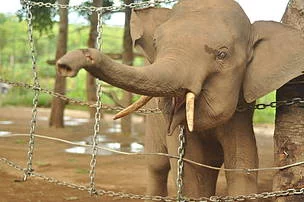
Wild Elephants in Vietnam: Down to the Last Couple of Hundred
Last updated: September 14, 2026
4 min read
Vietnam’s wild elephants are down to somewhere between about 125 and 200 animals, scattered across eight provinces in groups too small to be viable on their own. In the 1980s the country held roughly 2,000. This is what happened, what the current numbers actually are, and what is being tried.
| Species | Asian elephant, mainland subspecies (Elephas maximus indicus) |
| Wild population, 1980s | Around 2,000 |
| Wild population now | Fewer than 200 (agriculture ministry, November 2024); a February 2024 breakdown put it at 124 to 148 |
| Provinces with wild elephants | Son La, Nghe An, Ha Tinh, Quang Nam, Dak Lak, Dak Nong, Dong Nai, Binh Phuoc |
| Largest wild group | Yok Don National Park, Dak Lak, estimated 28 to 60 |
| Domesticated elephants in Dak Lak | 36 in 2023, down from around 502 in the early 1980s |
| IUCN status of the species | Endangered |
From 2,000 to under 200
Wild elephants once ranged across most of Vietnam. Defoliant spraying during the war did lasting damage to forest in the Central Highlands, and the reconstruction period that followed brought fast agricultural and forestry expansion that cut what was left into isolated pockets. Coffee, rubber and cashew took the lowland forest that elephants need.
Three pressures now overlap. Habitat loss is the largest. Poaching still targets the small number of tusked bulls left, and Vietnam remains a regional transit point for ivory. And the surviving elephants, squeezed into fragments, raid crops and get killed in retaliation.
The structural problem shows up in the group sizes. Vietnam’s elephants are fragmented into small, isolated groups. That raises demographic and genetic risks, so the national plan prioritises habitat protection, connectivity and population recovery.
Where they are
Yok Don National Park in Dak Lak province holds the largest single wild population, estimated at somewhere between 28 and 60 animals, and it sits against the Cambodian border in Mondulkiri province. Dong Nai in the south holds the second largest group. Cat Tien and Pu Mat between them hold fewer than 20. The rest are dispersed in fragments across the remaining six provinces.
In 2023 Vietnamese conservationists began building individual identification profiles for the remaining wild elephants, effectively ID cards, so that specific animals can be tracked rather than just counted. When a national population is this small, individual-level data stops being a luxury.
The captive question in Dak Lak
Dak Lak has been the centre of Vietnamese captive elephant keeping for generations, and the decline there is even steeper than in the wild. The province held around 502 domesticated elephants in the early 1980s. By 2023 it held 36. Nationally, around 32 elephants were still being used for tourist riding, 27 of them in Dak Lak.
Animals Asia, the Hong Kong-based NGO best known for its bile bear rescue work, has funded the transition away from riding. In July 2018 it signed an agreement with Dak Lak and gave Yok Don National Park $65,000 to convert its riding operation to elephant watching over five years. In December 2021 it signed a further agreement with the province, committing $231,000 to the provincial Elephant Conservation Center for 2022 to 2026 as part of a larger package reported at around $2.2 million. Dak Lak committed to ending elephant riding entirely by 2026.
What the government has committed to
In November 2024 the Ministry of Agriculture and Rural Development set out a national elephant conservation plan with 33 measures for wild elephants and 21 for captive ones, covering habitat restoration, anti-poaching enforcement, conflict management and a shift to observation-based tourism.
Plans are cheap. The honest position on Vietnam is that the wild population may already be below the size at which it can recover on its own, and that the realistic goal is to hold what is left, stop the retaliatory killing, and keep the Dak Lak border forest connected to Cambodia’s Mondulkiri landscape so that the two populations are not fully cut off from each other.
What will not save them
Captive breeding will not. The remaining domesticated elephants are largely old, and even a successful calf would not become a wild-released animal on any useful timescale. Reintroduction from other range states has been discussed but is a slow, expensive and politically complicated route. The habitat question comes first, and it has not been answered.
How you can help
Support Animals Asia’s Vietnam elephant work, Save the Asian Elephants, or the Wildlife Conservation Society’s Vietnam programme. If you travel to Dak Lak, do not book a riding camp; the operators that have moved to observation-only formats publish their credentials and are where the money should go. Never buy ivory, including the pieces sold as antiques in tourist markets.
Frequently asked questions
How many wild elephants are left in Vietnam?
Fewer than 200, according to the agriculture ministry in November 2024. A more detailed count published in February 2024 put the figure at 124 to 148 across eight provinces.
Where are they?
Yok Don National Park in Dak Lak has the largest group, estimated at 28 to 60. Dong Nai has the second largest. Cat Tien and Pu Mat hold fewer than 20 between them, with the remainder scattered across Son La, Nghe An, Ha Tinh, Quang Nam, Dak Nong and Binh Phuoc.
Are there captive elephants in Vietnam?
Yes, mostly in Dak Lak, which had 36 domesticated elephants in 2023. Around 32 nationally were still used for tourist riding, and the province has committed to ending riding by 2026.
Is the Vietnamese population genetically distinct?
Not as a separate subspecies. Vietnam’s elephants belong to the mainland subspecies Elephas maximus indicus, the same group as those in India, Myanmar, Thailand, Laos and Cambodia.
Can the population recover?
Recovery to historic levels is uncertain. Vietnam’s national plan aims to increase the population through habitat protection, connectivity, anti-poaching and conflict reduction.
Related elephant coverage
- Elephant Species: Complete Guide to All Living Elephants 2026: The three living elephant species and their subspecies: taxonomy, range, diet.
- Elephants in Vietnam: The Last Hundred and the Yok Don Model: Around 100 wild elephants are left in Vietnam.
- Hungry Wild Elephants In Vietnam Go On Rampage: Vietnam has around 100 wild elephants left.
- Elephants in Cambodia: Mondulkiri and the Eastern Plains: Cambodia has 400 to 600 wild elephants and a captive tradition that belongs to the Bunong, which has produced a notably better model of elephant tourism.
Updated 14 September 2026: qualified Vietnam population recovery claims.



Going from 2,000 in 1980 to under 100 in 40 years is a national-level extinction in real time. The Central Highlands fragments are now small enough that demographic stochasticity alone will finish the population without intervention.