
Indian Elephant Trivia: Facts, Quiz & 8 Questions
Last updated: November 18, 2026
7 min read
The Indian elephant (Elephas maximus indicus) is the mainland subspecies of the Asian elephant, the largest single population on Earth, and the most culturally celebrated wild animal in India. This page combines a working primer with an 8-question trivia adventure of rising difficulty.
Key facts at a glance
| Common name | Indian elephant |
| Scientific name | Elephas maximus indicus |
| Family | Elephantidae |
| Range | India, Nepal, Bhutan, Bangladesh, Myanmar, Thailand, Laos, Cambodia, Vietnam, southern China |
| Max shoulder height | Around 3.2 m (10.5 ft) |
| Max weight | Around 5,400 kg (12,000 lb) |
| Wild population | Around 27,000 to 30,000 in India alone |
| Captive population in India | Around 2,500 |
| Tusks | A high proportion of males carry significant tusks, far higher than in Sri Lanka |
| IUCN status | Endangered (assessed at species level, Elephas maximus) |
The mainland Asian elephant
The Indian elephant is one of the recognised subspecies of the Asian elephant, alongside the Sri Lankan elephant (E. m. maximus, the nominate subspecies) and the Sumatran elephant (E. m. sumatranus). The Bornean elephant (E. m. borneensis) is now treated as a fourth, and the IUCN gave it its own Red List assessment in June 2024. The Indian subspecies is the most numerous, the most widely distributed, and the one that most of the working-elephant tradition of Asia is built on.
For the wider species, see our Asian elephant species profile. For the sister subspecies, see the Sri Lankan elephant trivia expedition and the Borneo elephant trivia expedition.
Range and Project Elephant
Wild Indian elephants are concentrated in four landscapes: the Western Ghats (the Nilgiri biosphere reserve straddling Karnataka, Tamil Nadu, and Kerala); the central forests (Odisha, Jharkhand, West Bengal); the north-east (Assam, Meghalaya, Arunachal); and the Himalayan foothills (Uttarakhand). Project Elephant, launched by the Government of India in 1992, now covers 33 notified Elephant Reserves across 14 states. The population has been broadly stable for the past two decades, though conflict mortality is high.
What makes Indian elephants different
Indian elephants are larger on average than Sumatran and Bornean elephants and carry a much higher proportion of tusked bulls than any other Asian elephant population. In Sri Lanka only around 7 percent of males are tuskers, a difference most likely explained by centuries of preferential hunting of tusked bulls there.
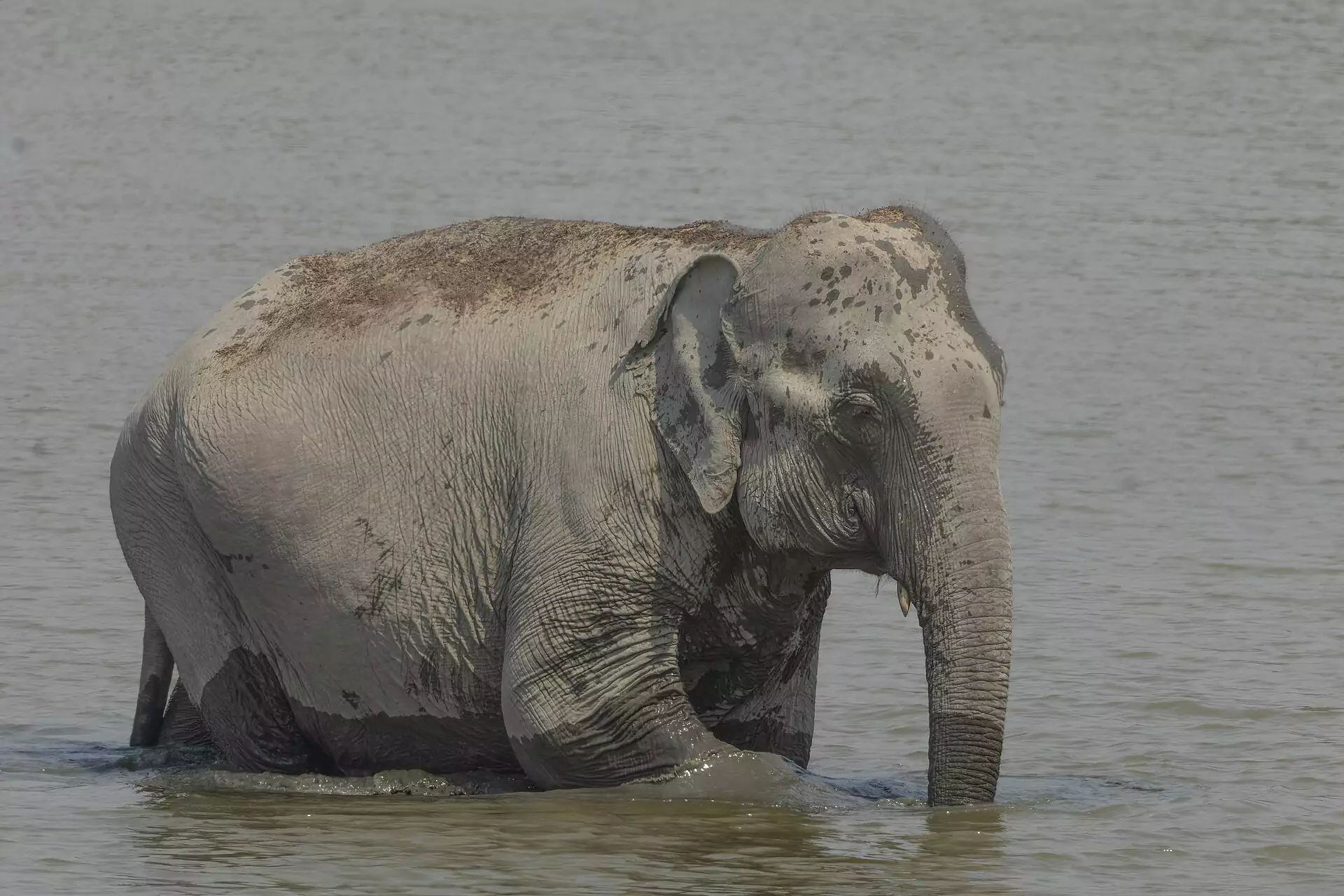
Physically, Indian elephants show the standard Asian field marks: small rounded ears, twin-domed forehead, convex back, single-finger trunk tip, five front toenails and four on the back. They are less heavily depigmented than Sri Lankan elephants.
Diet, social life, and intelligence
An adult Indian elephant eats 100 to 150 kg of vegetation a day and drinks 80 to 200 litres of water. Grasses, bamboo, leaves, fruit, bark, and palm pith are all on the menu, and they forage for 16 to 18 hours a day. Bamboo matters particularly in the north-east, where mass synchronised bamboo flowering can trigger sudden food shortages and push herds onto farmland.
Society is matriarchal, with family groups of around ten individuals led by an old female. Bulls leave at sexual maturity and roam alone or in loose bachelor groups. Asian elephants have demonstrated mirror self-recognition and cooperative problem solving in controlled studies. Infrasonic rumbles below 20 Hz travel several kilometres, and elephants pick up part of that signal through the ground.
Culture: Ganesha, temple elephants, and the Kerala question
Few wild animals are as embedded in a national culture as the Indian elephant is in India. Ganesha, the elephant-headed remover of obstacles, is one of the most widely worshipped deities in the country. Royal elephants appear in Mughal painting, Mauryan rock edicts, the Mahabharata, and every regional festival from Mysore Dasara to Thrissur Pooram. For wider cultural context, see our piece on elephants in Indian culture.
The captive temple elephant population, especially in Kerala, has become an ethical flashpoint. Several hundred captive elephants live in Kerala, mostly in private ownership for use in temple festivals. Welfare investigations by state authorities and animal-welfare NGOs have documented chronic foot disease, musth-related deaths, and one of the highest captive-elephant mortality rates in Asia. Reform is slow, partly because the festivals themselves are immovable cultural fixtures.
Human-elephant conflict and the railway problem
India records roughly 500 human deaths and around 100 elephant deaths a year from conflict, the highest absolute figures in the world. Crop raiding (rice, sugarcane, banana, jackfruit) is the most common trigger, and retaliation by farmers using fire, gunshot, electrocution, or poisoned fruit accounts for most of the elephant deaths. Train collisions kill a further handful to a couple of dozen elephants a year at specific blackspots in Assam, West Bengal, and Uttarakhand where the railway crosses migration corridors.
Conservation responses include train slowing zones, insulated power lines, and corridor protection. The Ministry of Environment’s 2023 report ground-validated 150 elephant corridors across 15 range states. The Wildlife Trust of India and Wildlife SOS have been the most active NGOs on the corridor and captive-welfare fronts respectively, and Wildlife SOS runs the Elephant Conservation and Care Centre in Mathura.
The Indian Elephant Trivia Adventure: 8 questions
Eight questions, rising in difficulty from basic to expert. Make your guess before scrolling to the FAQ for the answer.
- What is the scientific name of the Indian elephant?
- Roughly how many Indian elephants live in the wild in India today?
- Which Asian elephant population has the lowest proportion of tusked bulls?
- Which Hindu god has the head of an elephant?
- How many elephant corridors did India’s 2023 corridor report ground-validate?
- Roughly how many human deaths per year does India record from human-elephant conflict?
- Which biosphere reserve in the Western Ghats holds India’s single largest elephant population?
- What is the name of the elephant-headed deity’s mother in Hindu mythology?
Where to see Indian elephants
The classic option is the Nilgiri biosphere: Bandipur (Karnataka), Mudumalai (Tamil Nadu), and Nagarhole (Karnataka), where dry-season densities make sightings near-guaranteed. Periyar in Kerala is the easy-access option for travellers based in Kochi. Kaziranga in Assam combines wild elephants with one-horned rhino. Corbett in Uttarakhand offers Himalayan-foothill sightings. For sanctuary visits with rescued elephants, see our list of elephant sanctuaries.
Where to go next
For the parent species, see the Asian elephant species profile. For wider hubs, see elephant species, elephant conservation, and elephant facts. For related regional reads, see wild elephants in Vietnam and elephants in Thai culture.
Frequently asked questions
Q1: scientific name of the Indian elephant?
Elephas maximus indicus. It is the mainland subspecies of the Asian elephant. The nominate subspecies is the Sri Lankan elephant, E. m. maximus, with the Sumatran elephant E. m. sumatranus and the Bornean elephant E. m. borneensis making up the rest.
Q2: how many Indian elephants are in the wild today?
About 22,446 in India alone on the 2025 DNA-based estimate, with several thousand more across the other mainland range states. India’s 2017 synchronised census gave 29,964 in its final state totals; 27,312 was the figure released in August 2017. Our India elephant census page sets out both rounds by state.
Q3: which Asian elephant population has the fewest tuskers?
Sri Lanka, where only around 7 percent of males carry tusks, against a much higher proportion on the Indian mainland. Centuries of preferential hunting of tusked bulls is the usual explanation. Tuskless Asian males are called makhnas and can be just as territorial and aggressive in musth as tusked bulls.
Q4: which Hindu god has the head of an elephant?
Ganesha. He is the son of Shiva and Parvati, the remover of obstacles, the patron of letters and learning, and one of the most widely worshipped deities in Hinduism. The origin story varies by tradition. In the most common version, Parvati created Ganesha from clay and set him to guard her bath; Shiva, not recognising the boy, beheaded him in anger, then replaced the head with that of an elephant as restitution.
Q5: how many elephant corridors has India ground-validated?
150, in the Ministry of Environment, Forest and Climate Change’s 2023 corridor report, across 15 elephant range states. An earlier Wildlife Trust of India assessment had identified 101. The corridors connect fragmented protected areas across the four major elephant landscapes, and a large share cross human-dominated land, which is why corridor protection is as much a community-engagement problem as a conservation one.
Q6: human-elephant conflict deaths per year in India?
Roughly 500 human deaths and around 100 elephant deaths per year, averaged over the past decade. The highest-conflict states are West Bengal, Odisha, Jharkhand, and Assam, where agricultural expansion into elephant range and railway corridors crossing migration routes are the main drivers.
Q7: which Western Ghats biosphere reserve holds India’s largest elephant population?
The Nilgiri Biosphere Reserve, straddling Karnataka, Tamil Nadu, and Kerala, which includes Bandipur, Mudumalai, Nagarhole, and Wayanad. It has the highest recorded density of Asian elephants anywhere, and the wider Nilgiri-Mysore-Wayanad landscape it sits inside holds on the order of 8,000 elephants, the largest contiguous block of elephant habitat in Asia.
Q8: name of Ganesha’s mother?
Parvati, the consort of Shiva. In the best-known version of the origin story, Parvati created Ganesha from clay or turmeric paste and set him to guard her chamber while she bathed. Shiva, returning home and not recognising the boy, beheaded him; on learning what he had done he ordered his attendants to fetch the head of the first creature they encountered, which was an elephant.
Continue exploring at our store
If this article sparked your interest, head over to the We Love Elephants merchandise store for related reads and gear.
More about elephants
- Elephant Species: Complete Guide to All Living Elephants 2026: The three living elephant species and their subspecies: taxonomy, range, diet.
- Asian Elephant Trivia: Facts, Quiz & 8 Questions: Asian elephant facts, the four recognised subspecies including the 2024 Bornean assessment, and an eight-question quiz with sourced answers.
- Sri Lankan Elephant: Facts, Trivia & 8-Question Quiz: The Sri Lankan elephant in full: size, the island’s near-total tusklessness, the Gathering at Minneriya, the 2024 survey that put the wild population at 7,451.
- Asian Elephant Species Profile: Facts, Range, Conservation: The Asian elephant in depth: four populations across 13 range countries, size, diet, musth, working elephants, the conflict numbers from India, and what conservation is actually working.
Updated 18 November 2026: updated the India figure to the 2025 estimate of 22,446 and corrected the 2017 figure to the final 29,964.



any chance of a follow-up that dives into the Project Elephant methodology? the 27,000 to 30,000 wild figure for India is the headline but the survey approach varies state to state and the captive 2,500 estimate is probably an undercount. would love a piece on how the dung-pile transect work actually scales across that range.
the China 2017 ivory ban changed the demand side but the trans-border smuggling into northeastern Indian Elephant range states from Myanmar is the bit i don’t think this piece covers. the captive 2,500 figure does not capture the Assam-Kerala temple-elephant lease pipeline either, which leans more on the Indian subspecies than the Sri Lankan one.
the 90 percent tusker rate in Indian bulls is the figure that always lands hard. compare that to the Sri Lankan subspecies where only 7 percent of bulls carry significant tusks and you can see the trophy-pressure selection story playing out in real time. the trunk and the cultural sacredness of Ganesha is the only thing keeping the Indian subspecies bulls intact at that rate.