
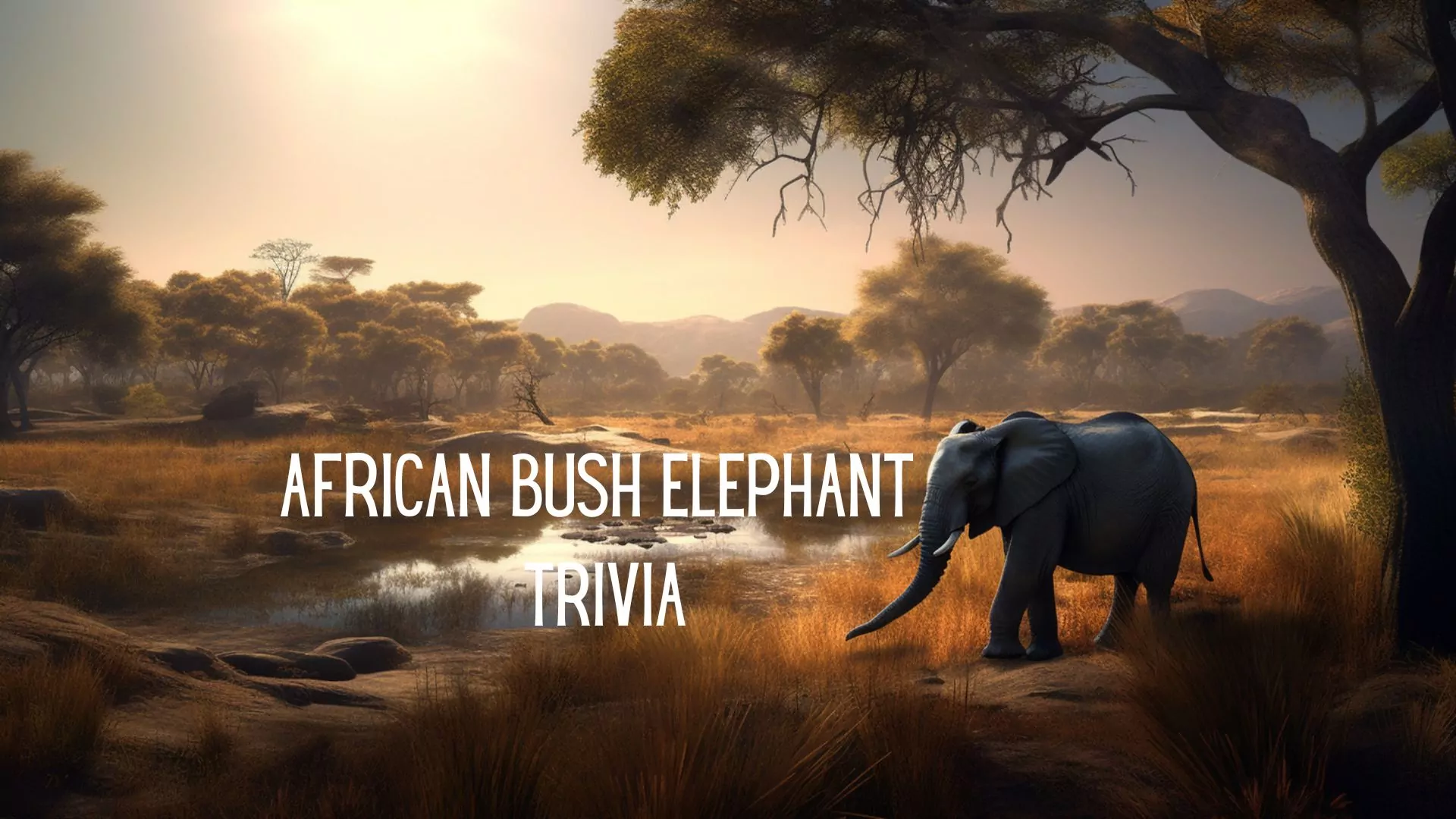
African Bush Elephant Quiz: Facts, Trivia & 8 Questions
Last updated: October 27, 2026
7 min read
Learn more first
Want the full picture before you take the quiz? Read the African Bush Elephant guide for habitat, behaviour, diet, range, and the conservation status in one place.
The African bush elephant (Loxodonta africana) is the largest land animal on Earth, and the icon of the African savanna safari. This page is part species deep-dive, part eight-question trivia challenge: by the time you reach the bottom of the page you will have a working biologist’s grasp of the species, and a score out of eight to compare against your friends.
Key facts at a glance
| Common name | African bush elephant (also: African savanna elephant) |
| Scientific name | Loxodonta africana |
| Family | Elephantidae |
| Max shoulder height | Around 4 m (13 ft) for record bulls |
| Max weight | Around 10 to 11 tonnes for the largest bull on record |
| Lifespan | 60 to 70 years in the wild |
| Diet | Strict herbivore: grasses, bark, leaves, fruit, roots |
| Habitat | Savanna, woodland, desert in southern and eastern Africa |
| IUCN status | Endangered (since 2021) |
| Population | 352,271 counted in 18 countries (Great Elephant Census, surveys 2014 to 2015), most of them in southern and eastern Africa |
| Range states | 23 |
Why the bush elephant matters
The African bush elephant was split from the African forest elephant by the IUCN in 2021, formalising what genetic work had shown for two decades. Of the two, the bush elephant is far more abundant, but it is listed as Endangered all the same. A 2024 analysis found a modelled mean density decline of about 70 percent across the monitored savanna sites. It did not estimate the total continental population decline. It is the iconic Big Five animal, the safari headline, and one of the most studied wild mammals anywhere: the Amboseli Trust for Elephants has followed the same families since 1972.
The closely related species: see our African elephant species profile, the African forest elephant, and the Asian elephant for the full family tree.
Range and habitat
The IUCN lists the African bush elephant across 23 range states. The largest single population is Botswana’s: the 2022 KAZA aerial survey counted 131,909 elephants in the north of the country. Zimbabwe, Tanzania, South Africa and Kenya hold the next largest, and Kenya’s 2025 official estimate was 42,072. They use savanna, woodland, and, surprisingly, desert. The southern African strongholds (Kruger, Hwange, Chobe, Okavango) are where the species has stabilised or grown, in contrast to the still-declining populations of west and central Africa.
How they live
Bush elephant society is matriarchal. A herd of around 10 animals is led by the oldest experienced female, with her adult daughters and their juveniles. Adolescent males leave around age 12 to 15 and form loose bachelor groups or roam solo. Mature bulls enter musth, a hormone-driven aggressive state lasting weeks to months, which is when most bull-on-bull confrontations occur.
Communication uses the full sensory toolkit. Infrasonic rumbles below 20 Hz travel several kilometres and are picked up partly through the feet. Trunk-touching, ear position, and tail-flicking carry second-by-second mood information. Matriarchs recognise the contact calls of many individuals, and elephants react to the bones of dead relatives in a way researchers describe as grief behaviour.
Diet and the role of an ecosystem engineer
An adult bush elephant eats 150 to 300 kg of vegetation a day and drinks 100 to 200 litres of water. They are bulk feeders, switching from fresh grass during the rains to woody browse, bark, and fruit through the dry season. Pushing over trees looks destructive but is part of how bush elephants keep the savanna open and patchy. Lose the elephants and large stretches of savanna convert to dense, low-diversity woodland over a few decades.
Bush elephants also dig water holes with their feet and trunks in dry river beds, which dozens of other species use during droughts. They are a keystone species: not one of many animals in the savanna, but the species the rest of the ecosystem is shaped around.
Threats and the trophy hunting debate
The two main threats are poaching for ivory and habitat loss, with human-elephant conflict as a third. Poaching is no longer the runaway problem it was in the 2000s, particularly since China closed its domestic ivory market in 2017, but it has not stopped. Habitat fragmentation is now the bigger long-term threat: as roads, fences, and farms cut up historical migration corridors, elephant populations get smaller and more isolated, and conflict with people spikes.
Trophy hunting of bush elephants is legal in several southern African countries under CITES export permits. The argument for it is that it generates revenue and gives rural communities a financial reason to tolerate elephants. The argument against is that it removes the oldest, biggest tusked bulls whose genes the population needs most. We treat both arguments seriously in our long piece on elephant trophy hunting.
Where to see African bush elephants
Botswana’s Chobe National Park is the world’s densest dry-season concentration, with large herds crossing the Chobe River at dusk in the late dry season. Kenya’s Amboseli National Park, at the foot of Mount Kilimanjaro, has the most studied bush elephant population on Earth. South Africa’s Addo Elephant National Park is the easy-access option for travellers who want a reliable sighting without long internal flights. For desert-adapted elephants, head to Namibia’s Damaraland.
The African Bush Elephant Quiz: 8 questions
Test yourself with eight short questions. Answers are in the FAQ section below the last question, so do not scroll past until you have made your guesses. Difficulty rises from question 1 to question 8.
- How tall does the largest African bush elephant stand at the shoulder?
- Roughly how many African bush elephants are alive in the wild today?
- Which African country has the largest single population of bush elephants?
- When did the IUCN formally split the African elephant into two species?
- Roughly how many kilograms of vegetation does an adult bush elephant eat each day?
- What is the name of the periodic aggressive hormonal state in adult bull elephants?
- How many finger-like projections are there on an African elephant’s trunk tip, and how many on an Asian elephant’s?
- How far do the Mali desert elephants walk on their annual migration circuit, the longest known for the species?
Take a moment with each before you scroll. If you want a deeper dive into any specific point, see our African elephant species profile and our hub on elephant facts.
Wider context and where to go next
The bush elephant is one of three living elephant species. For the related African forest elephant, see our African forest elephant trivia quest. For the cousin species across the Indian Ocean, see our Asian elephant species profile. For broader hub pages on the family, see elephant species and elephant facts.
Frequently asked questions
Question 1: how tall is the largest African bush elephant at the shoulder?
Around 4 metres. The record specimen is the Fenykovi elephant, shot in Angola in 1955 and mounted in the rotunda of the Smithsonian’s National Museum of Natural History. It stood 13 feet 2 inches, about 4 metres, at the shoulder. Published weight estimates for it vary between roughly 10 and 12 tonnes, so treat any single figure with caution. Most adult bulls are 3 to 3.5 metres at the shoulder; females average about 2.6 metres.
Question 2: how many African bush elephants are alive in the wild?
The best count is 352,271 savanna elephants across 18 countries, from the Great Elephant Census surveys flown in 2014 and 2015 and published in 2016, the most thorough continent-wide aerial survey. Beware of the figure 415,000, which is widely misquoted as a bush elephant number: it comes from the 2016 African Elephant Status Report and covers both African species together. The species is classified as Endangered.
Question 3: which African country has the largest bush elephant population?
Botswana, with around 130,000 individuals concentrated in the Okavango Delta, Chobe National Park, and the Kavango-Zambezi transfrontier area. Zimbabwe, Tanzania, South Africa and Kenya make up the rest of the top five. No other country comes close to Botswana’s total.
Question 4: when did the IUCN split the African elephant into two species?
2021. The IUCN Red List update on 25 March 2021 formally recognised two species: the African bush elephant (Loxodonta africana) and the African forest elephant (Loxodonta cyclotis). The split was based on genetic, morphological, and ecological evidence that the two had been on separate evolutionary tracks for between 2.5 and 5 million years. Both are threatened, with the bush elephant listed as Endangered and the forest elephant as Critically Endangered.
Question 5: how much does an adult bush elephant eat per day?
150 to 300 kg of vegetation a day, plus 100 to 200 litres of water. Diet shifts seasonally: tall grasses during the wet season, woody browse, bark, and fruit during the dry season. They forage for most of their waking hours.
Question 6: what is the periodic aggressive state in bull elephants?
Musth. It is a hormone-driven state in adult bulls, with a large rise in testosterone, fluid secretion from the temporal glands behind the eyes, urine dribbling, and elevated aggression. Musth lasts a few weeks to several months and is when most bull-on-bull fighting occurs. A bull in musth outranks a non-musth bull regardless of body size, which suggests musth works as a reproductive priority signal between males.
Question 7: trunk fingers on the African elephant?
Two. African elephants, both bush and forest, have two finger-like projections at the tip of the trunk that work like a precision pincer for picking up small objects, blades of grass, or fruit. The Asian elephant has one. It is the quickest way to tell an African from an Asian elephant at close range.
Question 8: how far do the Mali desert elephants migrate?
Around 600 km in a single annual circuit, the longest documented elephant migration anywhere in the world. The Gourma elephants of central Mali walk a roughly circular route through the Sahel, tracking seasonal water across a range of more than 32,000 square kilometres, the largest ever recorded for the species. The population is small, with recent estimates ranging from around 250 to 350 animals, and conservation there has been badly complicated by the regional security situation since 2012.
Continue exploring at our store
If this article sparked your interest, head over to the We Love Elephants merchandise store for related reads and gear.
Read next
This article is part of our elephant species guide, which links every species, subspecies and country guide on the site.
Updated 14 September 2026: corrected a population trend denominator.
Updated 27 October 2026: aligned the population figures with the Great Elephant Census and the 2022 KAZA survey.




7,000 kg max weight is the figure but it is also somewhat aspirational now. The really big bulls (over 6 tonnes) are essentially extinct in Eastern Africa due to selective hunting on tusk size. Chad and Kruger still have a handful.