
Asian Elephant Trivia: Facts, Quiz & 8 Questions
Last updated: September 14, 2026
7 min read
The Asian elephant (Elephas maximus) is the largest land animal in Asia, the cousin of the African elephants, and one of the most culturally intertwined wild mammals on Earth. This page combines a structured deep-dive with an 8-question trivia adventure: get the facts first, then test yourself in rising difficulty before the answers.
Key facts at a glance
| Common name | Asian elephant |
| Scientific name | Elephas maximus |
| Family | Elephantidae |
| Range | 13 countries: India, Sri Lanka, Nepal, Bhutan, Bangladesh, Myanmar, Thailand, Laos, Cambodia, Vietnam, China, Malaysia, Indonesia |
| Max shoulder height | 3.2 m (10.5 ft) for Indian bulls |
| Max weight | 5,400 kg (12,000 lb) |
| Diet | Strict herbivore: grasses, bark, leaves, fruit, bamboo |
| IUCN status | Endangered. The Sumatran subspecies is Critically Endangered and the Bornean subspecies was assessed as Endangered in June 2024 |
| Wild population | Around 40,000 to 50,000 |
| Captive population | Around 15,000, mostly in range states |
| Gestation | 20 to 22 months |
Why the Asian elephant matters
Asian elephants are smaller than African bush elephants, but they hold a cultural weight no other wild animal can match in their range states. The Hindu god Ganesha, the Buddha’s mother Maya’s elephant dream, the Thai royal white elephant, the elephant motifs on Mughal coinage, and the Sri Lankan Esala Perahera procession all derive from the same species. They are simultaneously sacred, working animals, neighbours, and a problem for the farmers whose crops they raid.
For full species context, see our Asian elephant species profile. For the closest related species, see the African elephant species profile.
Range and the four subspecies
Asian elephants once ranged from the Tigris to the Yangtze. Today their distribution is fragmented across 13 range states, with India holding around 60 percent of the global total. Four subspecies are now recognised, the Bornean elephant having been assessed by the IUCN in its own right for the first time in June 2024.
- Indian elephant (E. m. indicus): the mainland subspecies from India east to Vietnam.
- Sri Lankan elephant (E. m. maximus): the largest of the four, endemic to Sri Lanka.
- Sumatran elephant (E. m. sumatranus): smallest, Critically Endangered since 2011.
- Bornean elephant (E. m. borneensis): assessed as Endangered in 2024, with roughly 1,000 left, of which about 400 are breeding adults. Almost all are in Sabah, with a small number in Kalimantan.
For deeper regional dives, see our Indian elephant trivia adventure, the Sri Lankan elephant trivia expedition, and the Borneo elephant trivia expedition.
How to tell an Asian elephant from an African elephant
The three living elephant species look more different than most people realise. Asian elephants are smaller, with small rounded ears, a twin-domed forehead, a convex (humped) back, and only one finger-like projection at the tip of the trunk. African elephants are larger, with huge flared ears shaped like the African continent, a smoothly rounded head, a concave back, and two finger-like projections on the trunk tip. Most Asian elephant females and many Asian males carry no tusks; African elephants of both sexes usually do.
Asian elephant field marks
- Shoulder height 2 to 3.2 m (males larger than females)
- Small, rounded, less-mobile ears
- Twin-domed (bilobed) forehead
- Convex back when seen from the side
- One finger-like projection at the trunk tip
- Five toenails on the front foot and four on the back
- Pink or depigmented skin patches on trunk, ears, and forehead (especially older individuals)
Diet, foraging, and musth
An adult Asian elephant eats 100 to 150 kg of vegetation a day and drinks 80 to 200 litres of water. Grasses are the staple, supplemented by bamboo, leaves, fruit, bark, and palm pith. They forage 16 to 18 hours a day. Adult bulls enter musth, a periodic state with a large rise in testosterone, secretion from glands behind the eyes, and elevated aggression. Musth bulls outrank non-musth bulls regardless of body size and are responsible for most bull-bull and bull-on-human aggression.
Working elephants and the ethics question
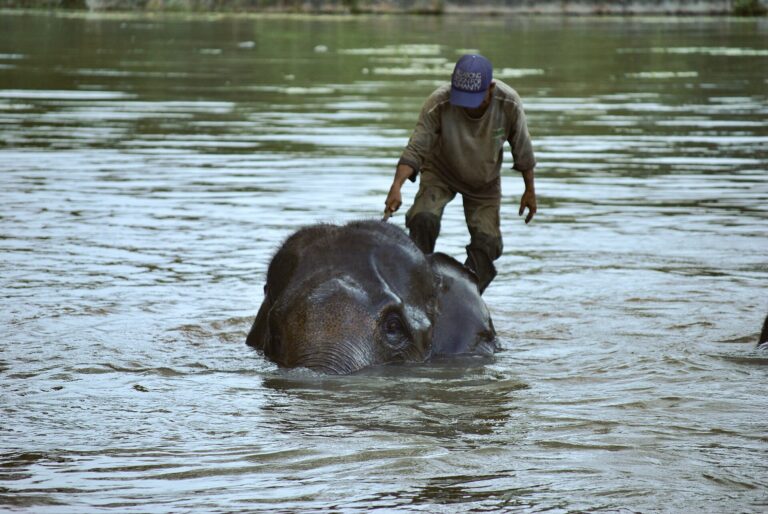
Asian elephants are the only elephant species that has been used as a working animal at scale, with thousands of years of recorded logging, transport, war, and ceremonial use. The estimated 15,000 captive Asian elephants today (mostly in Myanmar, Thailand, India, and Sri Lanka) are not domesticated in the strict biological sense: each generation is captured wild or trained from a young age, and the population has historically been topped up from the wild. Modern conservation has shifted decisively against riding, performance, and entertainment use.
For wider context, see our pieces on elephants in Indian culture, elephants in Thai culture, the white elephants of Thailand, and our piece on the elephant entertainment industry.
Conservation: habitat loss is bigger than poaching
Unlike the African elephant, the Asian elephant is not driven mainly by ivory poaching. Most Asian females carry no tusks and many males carry small ones. The dominant threats are habitat loss to agriculture (especially oil palm in Sumatra and Borneo), infrastructure, and the resulting human-elephant conflict. Indian government figures recorded 629 human deaths in 2023/24. In the same year, train collisions killed 17 elephants and electrocution killed 94. Other recorded causes included poaching and poisoning.
Vietnam’s wild population has fallen below 100 individuals and is on the brink, a story we cover in wild elephants in Vietnam could be extinct soon.
The Asian Elephant Trivia Adventure: 8 questions
Eight questions in rising difficulty. Make your guess before you scroll to the FAQ. Difficulty climbs from question 1 (basic) to question 8 (hard).
- What is the scientific name of the Asian elephant?
- Roughly how many Asian elephants live in the wild?
- Which country holds around 60 percent of all wild Asian elephants?
- How many finger-like projections are at the tip of an Asian elephant’s trunk?
- What is the smallest subspecies of the Asian elephant?
- What is the periodic hormonal state in adult bulls called?
- What is the gestation period of an Asian elephant?
- Roughly how many captive Asian elephants are there in the range states today?
Where to see Asian elephants in the wild
India: Bandipur, Nagarhole and Mudumalai in the Nilgiri biosphere, Kaziranga in Assam, Periyar in Kerala. Sri Lanka: Minneriya for the Gathering. Indonesia: Way Kambas. Malaysia: Kinabatangan river cruises in Sabah for Bornean elephants. Thailand: Khao Yai and Kui Buri. For sanctuary visits, see our list of elephant sanctuaries.
Where to go next
For the full species write-up, see the Asian elephant species profile. For broader hubs, see elephant species, elephant conservation, and elephant facts.
Frequently asked questions
Q1: scientific name of the Asian elephant?
Elephas maximus, named by Linnaeus in 1758. Four subspecies are recognised: Indian, Sri Lankan, Sumatran and Bornean. The species split from the African elephant lineage roughly 7 million years ago and is more closely related to the extinct woolly mammoth than to the African elephant.
Q2: how many Asian elephants live in the wild?
The IUCN used about 40,000 wild Asian elephants across 13 range states in 2024. India’s 2021 to 2025 estimate was 22,446. Other national figures use different years and methods. The total is down from far higher numbers a century ago.
Q3: which country holds around 60 percent of all Asian elephants?
India. The Indian elephant subspecies (E. m. indicus) is concentrated in the Western Ghats, the Nilgiri biosphere reserve, north-east India, and the central forests. Project Elephant, launched in 1992, manages a network of more than 30 elephant reserves covering around 80,000 square kilometres.
Q4: how many finger-like projections on an Asian elephant’s trunk?
One. African elephants have two. The single projection on the Asian elephant’s trunk tip is fully prehensile and can pick up objects as small as a coin or a single blade of grass. It is one of the easiest in-the-field ways to tell the species apart in a captive setting.
Q5: smallest subspecies of Asian elephant?
The Sumatran elephant (E. m. sumatranus). Adult bulls rarely exceed 2.6 m at the shoulder and 3,500 kg. It has been listed as Critically Endangered since 2011, when the IUCN judged the population to have fallen by at least 80 percent over three generations. Current numbers are genuinely uncertain: the widely quoted WWF range is 2,400 to 2,800, while an unreleased 2019 Indonesian conservation plan put it closer to 900 to 1,400, and no recent national count has been published. Most survive in Way Kambas, Bukit Barisan Selatan and Gunung Leuser. Habitat loss to oil palm and pulpwood plantations has been the main driver.
Q6: periodic hormonal state in bulls?
Musth. Adult male elephants of both Asian and African species enter musth for periods of weeks to several months. Testosterone rises sharply, temporal glands behind the eyes secrete fluid, urine dribbles continuously, and aggression rises. A bull in musth outranks a non-musth bull regardless of body size, suggesting musth is a reproductive priority signal.
Q7: gestation period of an Asian elephant?
20 to 22 months, the longest of any land mammal alongside the African elephant. A single calf weighs around 90 kg at birth and nurses for at least two years, often longer. Females reach sexual maturity at 10 to 12 and typically give birth every 4 to 6 years for the rest of their reproductive life.
Q8: captive Asian elephant numbers?
Around 15,000, almost all in range states, with Myanmar, Thailand and India holding the largest working herds. Captive populations are not self-sustaining: gestation is around 22 months and captive breeding is rare, so historic numbers have been replenished from wild capture, which is now illegal or restricted in most range states.
Continue exploring at our store
If this article sparked your interest, head over to the We Love Elephants merchandise store for related reads and gear.
Elsewhere on We Love Elephants
- Elephant Species: Complete Guide to All Living Elephants 2026: The three living elephant species and their subspecies: taxonomy, range, diet.
- Indian Elephant Trivia: Facts, Quiz & 8 Questions: Facts on the Indian elephant, its range, Project Elephant, Ganesha, temple elephants and human-elephant conflict, plus an 8-question quiz with answers.
- Asian Elephant Species Profile: Facts, Range, Conservation: The Asian elephant in depth: four populations across 13 range countries, size, diet, musth, working elephants, the conflict numbers from India, and what conservation is actually working.
- Sri Lankan Elephant: Facts, Trivia & 8-Question Quiz: The Sri Lankan elephant in full: size, the island’s near-total tusklessness, the Gathering at Minneriya, the 2024 survey that put the wild population at 7,451.
Updated 14 September 2026: updated Asian elephant and India mortality figures.




some places marketed as asian elephant sanctuaries in chiang mai and luang prabang still allow bathing and contact. the line between welfare-grade and tourist-grade is blurrier than the 15,000 captive figure suggests, a lot of those individuals are in mid-tier camps that rebrand every couple of years to dodge the welfare audits. would love a separate piece auditing the operators.
would genuinely love a follow-up on the methodology behind the 40,000 to 50,000 wild population estimate. the 13 range states all use different survey methods and the Myanmar number especially feels like it has been guessed at since 2018. Sri Lankan dry-zone counts are probably the most reliable, the Sumatran and Bornean numbers feel softer.
worth noting the demand side has shifted a lot since the China 2017 ban. ivory pressure on Asian bulls is technically lower because only the Indian subspecies carries significant tusks at scale, but live-elephant trafficking into the Thai and Vietnamese tourism markets has filled the gap. the 15,000 captive figure does not reflect how fast individuals churn between camps.