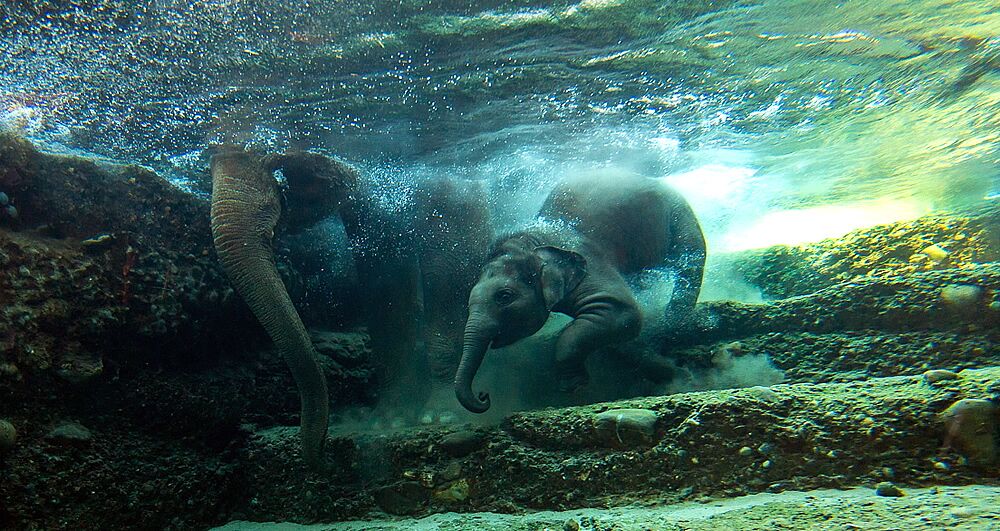
How Come Elephants Swim So Well?
Last updated: October 26, 2026
3 min read
Yes, elephants swim, and they are good at it. Here is what is actually known about how they do it, and what gets repeated about it that we could not stand up.
How elephants swim
An elephant swims with all four legs paddling, body mostly submerged, head at or just under the surface. The trunk does the rest of the work: held up clear of the water, it lets the animal keep breathing while the mouth and nostrils stay under. No other large land mammal carries a built-in snorkel.
They are unsinkable in the ordinary sense because they are close to neutrally buoyant in fresh water, with large lungs and a lot of low-density tissue. Size is not what keeps them up. Plenty of heavy animals sink.
How far can they go?
Elephants cross rivers and channels routinely, and there are well-documented long open-water swims. In July 2017 a Sri Lanka Navy patrol boat found an elephant about 16 km off the north-east coast near Kokkilai, apparently swept out to sea by a current while crossing the Kokkilai lagoon. Divers roped the animal and towed it back to shallow water over a 12-hour operation. Wildlife officials said afterwards that swimming 15 km from shore is not in itself unusual for an elephant, but that this one would probably not have lasted much longer unaided.
You will also see a widely repeated claim that an elephant once swam 48 km in a single six-hour stretch. We have not been able to trace that back to a primary source, so we are not going to state it as fact.
Why elephants like water
Cooling is the main reason. An elephant has an enormous body and, relatively speaking, not much surface to shed heat through. Wallowing, spraying water over the back and caking on mud all help, and the mud doubles as sun protection and insect repellent long after the water has gone.
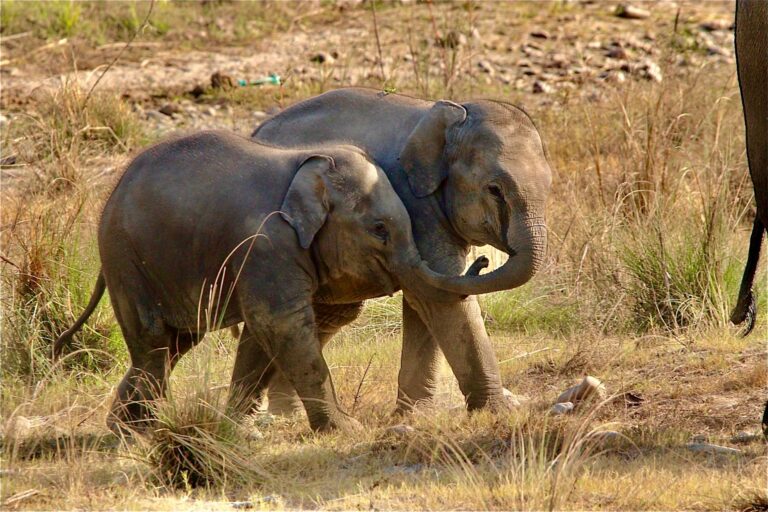
Calves play in water constantly, climbing over each other and over the adults, going under and surfacing again. It looks like nothing but fun, and it is also where they learn to handle the trunk in water.
There may be something deeper in it too. The closest living relatives of elephants are the sirenians, the dugongs and manatees, and the two groups share a common ancestor. Some of the early proboscideans, Moeritherium among them, lived semi-aquatic lives on the shores of the proto-Mediterranean. That is not proof that a modern elephant enjoys a swim for ancestral reasons, but the family has form around water.
Zoo Zurich’s Kaeng Krachan Elephant Park has an underwater viewing window onto the elephant pool, which is one of the few places anyone can watch the legs working from below.
What we could not verify
An earlier version of this article said that Sri Lanka’s elephants got there by swimming from the south Indian coast. We could not find support for that. India and Sri Lanka were joined by dry land whenever sea levels fell during the ice ages, which is the simpler explanation, and genetic work suggests the Sri Lankan population is an old and distinct lineage rather than a recent arrival.
We do not have a great deal of hard data on elephant swimming: most of what circulates online traces back to the same handful of unsourced numbers. If you know of a published study or a documented long-distance swim we have missed, leave a comment and we will add it.
Read next
- Elephant Species: Complete Guide to All Living Elephants 2026: The three living elephant species and their subspecies: taxonomy, range, diet.
- Elephants and Water: Swimming, Drinking, and Trunks as Snorkels: How elephants drink, why they float, what the trunk-as-snorkel actually requires of the chest, and what the record really says about how far an elephant can swim.
- Elephants and Water: Drinking, Swimming, Digging and Bathing: How elephants drink at 540 km per hour, dig wells other animals then use, swim with the trunk as a snorkel, and why water access decides where a herd spends its year.
- Why Elephants Love Mud Baths: Cooling, Sunscreen, and Skin Care: Mud cools, blocks UV and smothers parasites, and the cracks in elephant skin hold five to ten times more water than a flat surface.
This article is part of our elephant facts guide, which links every post on elephant bodies, minds and family life.