
Elephants and Water: Drinking, Swimming, Digging and Bathing
Last updated: September 14, 2026
3 min read
An adult elephant drinks something like 100 to 200 litres of water a day. Getting hold of that much water shapes almost everything else: where a herd goes in the dry season, what it digs, how it cools itself, and how often it ends up in a farmer’s field on the way.
Drinking is a suction problem
An elephant does not drink through its trunk. It sucks water up into the trunk, then squirts it into its mouth, and repeats.
Andrew Schulz and colleagues at Georgia Tech measured how that works in a 2021 paper in the Journal of the Royal Society Interface. An elephant inhales at up to 150 metres per second, roughly 540 km per hour, which is about 30 times the speed of a human sneeze. It does it by dilating the nasal passages inside the trunk by up to 30 percent, which increases the trunk’s internal volume by 64 percent. In their measurements the trunk drew about 5.5 litres in 1.5 seconds, at 3.7 litres per second.
Well digging
When surface water goes, elephants go looking for it underground. In dry sandy riverbeds they excavate wells, often a metre or two deep, down to where water is still moving through the sand.
They are not the only ones who use them. Elephant-dug wells get reused by baboons, warthogs, antelope and birds, which is the clearest everyday example of the ecosystem engineering argument for elephants in arid landscapes. An animal that can reach water nothing else can reach ends up watering everything else.
Swimming
Elephants swim well. The body is buoyant and the trunk works as a snorkel, so a herd crossing a broad river is unremarkable behaviour rather than a stunt. Borneo’s pygmy elephants cross stretches of the Kinabatangan as part of ordinary range use.
The limits show up when a crossing goes wrong. In July 2017 a Sri Lankan navy patrol found an elephant about 16 km off the north east coast near Kokkilai, apparently swept out to sea while crossing the lagoon. It took divers and a boat roughly twelve hours to get it back to shore. Long-distance open water is survivable for a while, but it is not where an elephant means to be.
Mud and dust
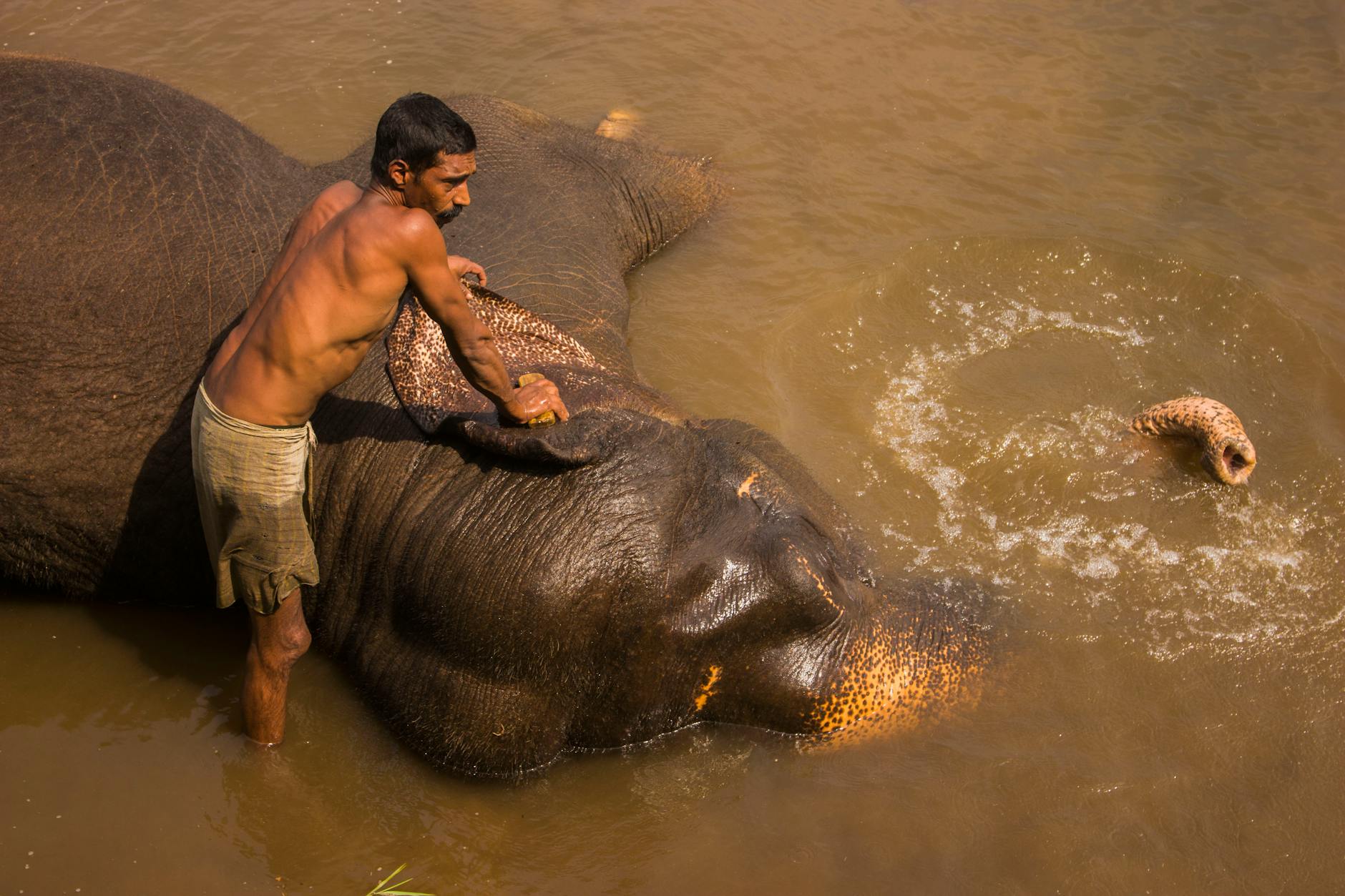
Mud bathing does three jobs at once: it cools, it screens the skin from sun, and the drying layer traps and removes biting insects. Dust bathing does the parasite job where there is no mud. Calves start copying both within their first months.
Why water access is a conservation question
Permanent water dictates dry-season range, and the location of permanent water increasingly comes down to human decisions. Boreholes and pumped waterholes are now a normal part of the landscape in drought-prone parts of northern Kenya and southern Africa, and drilling one permanently changes where a herd spends its year. That can relieve pressure in the short term and create a new conflict corridor at the same time.
Climate stress reaches elephants mostly through this channel. The drought that gripped the Horn of Africa from 2020 into 2023 was the region’s worst in decades, and its effect on wildlife came through the collapse of seasonal water rather than through heat directly. Where riverbeds dry deeper than an elephant can dig, the well-digging strategy simply stops working and the herd has to walk further.
Frequently asked questions
How much water do elephants drink?
Roughly 100 to 200 litres a day for an adult.
How fast can an elephant suck up water?
The measured water flow was about 3.7 litres per second. The study’s modelled peak air speed was 150 metres per second.
Can elephants swim?
Yes, comfortably, using the trunk as a snorkel. River crossings are routine. Open sea is not: the 2017 Kokkilai elephant needed a navy rescue after being swept about 16 km offshore.
Why do elephants take mud baths?
Cooling, sun protection and parasite control, all from the same layer of mud.
Do elephants really dig wells?
Yes, a metre or two down into dry sandy riverbeds, and other species drink from what they open up.
More in our elephant facts guide.
Updated 14 September 2026: corrected the water-flow measurement.


The 48 km offshore swim is the one that always blows my mind. Sri Lankan navy footage of an elephant swimming in open ocean is hard to process.
Well digging by elephants benefitting baboons and warthogs is exactly the ecosystem engineer framing this deserves.
540 km per hour through the nasal passage is the kind of fluid dynamics fact I will not forget. Schulz’s paper sounds worth reading.
Yes, the borehole point is the one ranger I spoke to in Kenya kept coming back to. Good intentions, complicated outcomes.
Mud as sun screen plus parasite control plus thermoregulation in one is such an elegant evolved trick.
200 litres a day for an adult is the number people underestimate. That alone shapes dry-season range planning.