How an Elephant Calf Grows Up, Stage by Stage
4 min read
An elephant calf arrives after about 22 months of pregnancy and then spends years being carried, shadowed and corrected by a crowd of relatives. Field researchers have followed calves long enough to describe the stages, and the numbers show how much rides on the first two years.
This post walks through those stages, who does the raising, and what the studies say happens when a calf loses its mother. The pregnancy itself is covered in our piece on why gestation lasts 22 months.
A calf is raised by the whole family
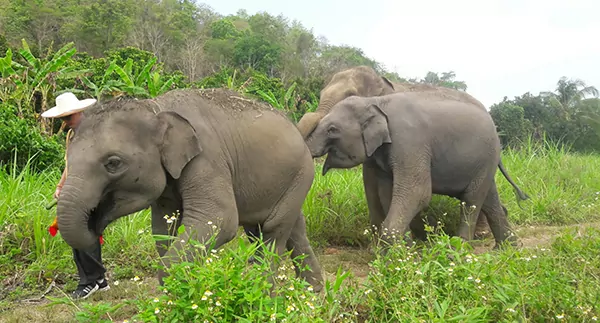
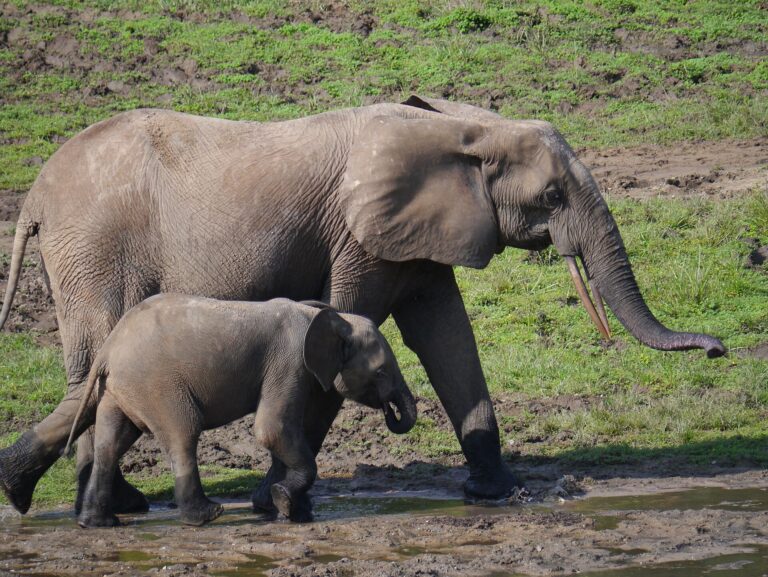
A study of African elephant calves in the wild and in zoos notes that calves are born into stable families and cared for by their mothers, other females called allomothers, and older siblings (Hoerner et al. 2023). The mother stays the anchor. Long-term data from Amboseli in Kenya, cited in that paper, show calves spending about 56% of their time in close contact with their mothers during the first two years.
Contact with the rest of the family is steady too. The same paper reports that calves spent around 20% of their time within physical contact distance of another family member, and only about 10% of their time more than five metres from their nearest neighbour. A young calf is rarely alone.
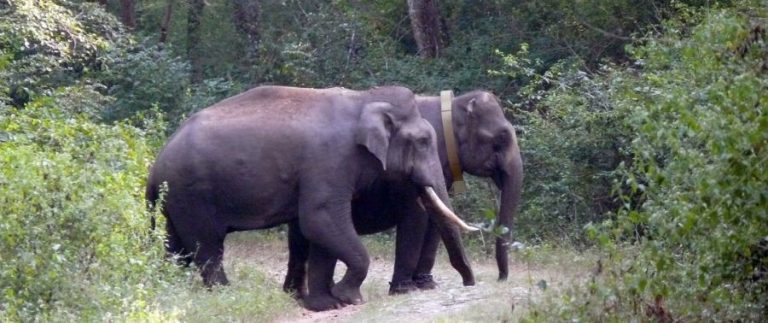
That fits the wider family layout. Females stay in the same herd all their lives, while males leave at around 12 to 13 years old, according to Save the Elephants. Our guide to matriarchs, bond groups and bulls covers who the allomothers are.
The stages of calf development
The same paper pulls together earlier field work into a table of stages. In outline:
- 0 to 6 months: the calf learns to walk steadily and to use its trunk for suckling.
- 7 to 12 months: the trunk starts to be used for foraging, and the main source of food shifts from milk to solid food.
- 13 to 24 months: contact with the mother decreases for the first time and play behaviour appears.
- 25 to 36 months: play peaks, rivalry-style behaviour begins and differences between males and females grow.
- 49 to 60 months: social play such as climbing and chasing others increases sharply.
- Beyond 60 months: the animal counts as a young adult. Males may already be leaving for bachelor groups.
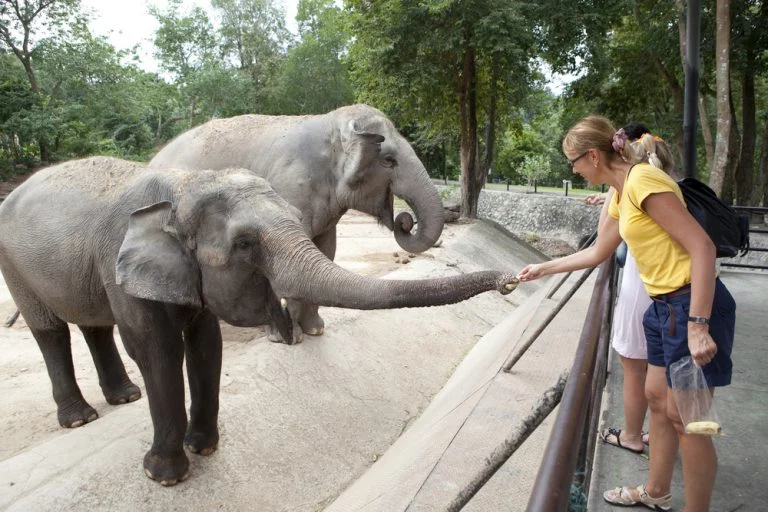
The trunk is a good example of why this takes so long. A calf has to learn to use an organ with a huge number of muscle bundles, first to drink and later to gather food. Our post on trunk anatomy shows how much machinery is involved.
When the bond loosens
According to the same study, the close bond is held by both mother and calf for the first two years. After that it loosens, and it is then pursued more by the mother, who is still responsible for the calf’s safety (Hoerner et al. 2023).
Growing up is slow even after the bond loosens. In the wild, first births to females are mostly reported between 12 and 16 years of age, and the earliest reported was at 9 years. Males reach musth for the first time at around 12 to 14 years, according to the data cited in that paper. A young animal has more than a decade of family life before it breeds.
The same study also compared wild calves with calves in zoos. The zoo calves spent significantly less time near their mothers. The authors read this as a sign of faster development in a safe setting. It is one study of a small zoo sample, so treat it as a pointer and not a rule.
What happens when a calf loses its mother
The clearest numbers come from Asian elephants in the timber camps of Myanmar, where researchers had long records of individual animals. Calves that lost their mother had a 10-fold higher mortality risk in their first year, and the extra risk fell to 1.1-fold by the fifth year (Lahdenpera et al. 2016). The harm did not vanish for early orphans. They still faced a higher risk at ages 3 to 4 and in adolescence.
Growth is affected as well. In Samburu and Buffalo Springs National Reserves in Kenya, researchers measured the height of known individual females with a rangefinder. Orphans were shorter for their age than non-orphans, though those orphaned for longer were closer in height, which suggests partial catch-up. Having more age mates in the family went with taller height (Conservation Physiology, 2022). The authors describe this stunting as an indirect effect of ivory poaching on African elephants.
What calves learn from the family
Calves are not only fed and protected. A 2025 review in the Royal Society journal Philosophical Transactions B notes that elephants in all three species tend to gather around older animals, which creates chances to learn from them (Royal Society review). The authors are careful to add that direct evidence of social learning and cultural traditions in elephants is scarce.
Their review of 95 papers found that heavily disrupted populations were less cohesive, sometimes had lower calf survival and responded poorly to threats and predators. That is indirect evidence, and the authors say so. It is still a reason why protecting older females matters beyond their own numbers. Our page on elephant conservation covers the wider picture.
What we do not know
Most of the detailed calf data come from a few long-running populations such as Amboseli and the Myanmar timber camps. How the stages play out in forest elephants, or in places with heavy poaching, is less well measured. Treat the age bands above as typical patterns, not fixed dates.
Sources
- Hoerner et al., Differences in Mother-Infant Bond and Social Behavior of African Elephant Calves Living In Situ and Ex Situ (Animals, MDPI, 2023)
- Short-term and delayed effects of mother death on calf mortality in Asian elephants (Behavioral Ecology, Oxford University Press, 2016)
- Orphaning stunts growth in wild African elephants (Conservation Physiology, Oxford University Press, 2022)
- Knowledge transmission, culture and the consequences of social disruption in wild elephants (Philosophical Transactions of the Royal Society B, 2025)
- Elephant Facts (Save the Elephants)
Have you watched a calf learn to use its trunk, or seen a family look after a young one? Add what you know in the comments.
Photo: Bernard Dupont, CC BY-SA 2.0, via commons.wikimedia.org.