Elephant Intelligence: Brains, Memory, Tools and Empathy
6 min read
Ask what makes elephants clever and you usually get a list: big brains, mirrors, tools, long memories, grief. Each item on that list traces back to a handful of specific studies, and the studies are more interesting (and more careful) than the list. Here is what each one actually found, and where the evidence is thinner than the reputation.
What is inside an elephant’s head
An African elephant brain weighs around 5 kg. The specimen in the best-known neuron count, published by Suzana Herculano-Houzel and colleagues in 2014, came in at 5,250 g, about three times the mass of a human brain. Their count found 257 billion neurons in total, roughly three times the 86 billion in an average human brain.
The surprise was where those neurons sit. About 97.5 percent of them, some 251 billion, are in the cerebellum, the structure at the back of the brain best known for coordinating movement. Elephants have relatively the largest cerebellum of any mammal. The authors suggest this may be linked to the trunk, a single limb with no bones that needs an enormous amount of sensory and motor processing.
The cerebral cortex tells a different story. It is twice the mass of the human cortex but holds only 5.6 billion neurons, about a third of the human figure of around 16 billion. The authors read this as support for the idea that the number of cortical neurons, rather than brain size, best tracks the kind of reasoning humans do. So a big brain is part of the elephant story, but it does not on its own explain what elephants can do. The behavioural studies below do more of that work.
Recognising themselves in a mirror
In 2005 Joshua Plotnik, Frans de Waal and Diana Reiss gave three adult female Asian elephants at the Bronx Zoo, Happy, Maxine and Patty, a mirror 244 cm square. All three spent far more time at the uncovered mirror than the covered one and used it to inspect themselves, in a sequence the authors compared to the one seen in apes and dolphins. In the mark test that followed, published in PNAS in 2006, Happy repeatedly touched a white X painted on her head that she could only see in the mirror. Maxine and Patty did not touch their marks more than usual.
Before that paper, the authors note, mirror self-recognition had been shown only in humans, great apes and, in one report, bottlenose dolphins. One pass out of three is a modest headline, and the authors themselves called for further testing of Asian elephants. We cover the method and its limits in more detail in our piece on elephants and the mirror test.
Tools and insight
Asian elephants pick up branches and swish them at the biting flies that target the thin skin on the belly, behind the ears and under the forelegs. In an experiment on captive elephants in Nepal, a branch to use as a fly switch cut fly numbers by 43 percent. In a later study, when the branch on offer was too long or too bushy, the elephants trimmed it to a better size first. Benjamin Hart, who led that work, summarises both studies in a 2018 review of how mammals avoid parasites. Changing an object to make it work better is the part that counts as tool making, not just tool use.
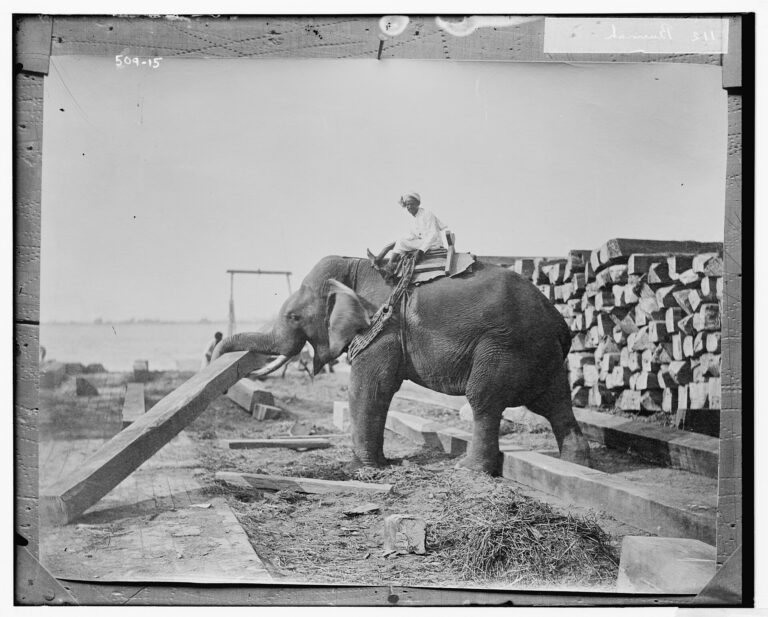
Insight is harder to show. Earlier experiments that offered elephants sticks to rake in food had failed. In a 2011 PLOS ONE study, Preston Foerder and colleagues hung fruit out of reach at the Smithsonian National Zoo in Washington. Kandula, a 7-year-old male Asian elephant, without any obvious trial and error, moved a large plastic cube under the food, stood on it and took the fruit. He then fetched the cube from different spots in the yard, used other objects when the cube was missing, and stacked smaller blocks to gain height, though the stack never got him quite high enough. The authors suggest earlier tests failed partly because holding a stick in the trunk stops an elephant smelling and feeling the food it is reaching for. For more examples, see our guide to elephant tool use.
Memory: what has actually been measured
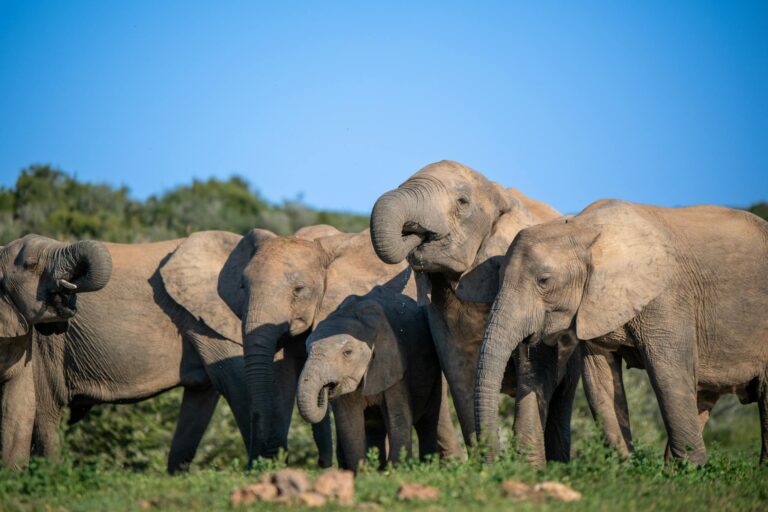
“Elephants never forget” is folklore, but several parts of it have been tested. In Amboseli, Kenya, Karen McComb and colleagues played recorded contact calls to adult females and watched how they responded. They estimated that each female would need to know the calls of around 14 families, about 100 adult females in total, to make the distinctions they made. That is an unusually large network of voices to keep in memory.
Smell works the same way. Lucy Bates and colleagues put earth mixed with urine from known females in the path of Amboseli families. The elephants reacted most strongly when the scent belonged to a relative who should not have been there, for example one who was walking behind them. From those reactions, the team concluded that elephants keep track of up to 17 females, and possibly up to 30 family members, and of where each one is in relation to themselves.
Long-term memory is harder to test in the wild, and the best evidence is indirect. During the severe 1993 drought in Tarangire National Park, Tanzania, researchers followed 81 calves in 21 families. Sixteen calves died. The clan that stayed in the park lost 11 of its 27, while the two clans whose families mostly left lost 5 of 54 between them. The last drought of that scale had been in 1958 to 1961, and the two clans that left were the only ones with members old enough to have lived through it. The authors suggest that older matriarchs in the other clans led their families to water and food outside the park from that earlier experience. Our piece on the matriarch’s memory goes through that study and the Amboseli work in more depth.
Elephants also sort humans by threat. In a 2014 study, McComb’s team played the same phrase spoken by Maasai men, whose community has a history of spearing elephants, and by Kamba men, whose community poses far less of a threat. Families bunched together defensively and smelled the air more after Maasai voices. They responded less to Maasai women and boys, who pose little threat. The popular claim that an elephant remembers one particular person for decades has stories behind it, but we could not find a controlled test of it.
Reassurance and reactions to the dead
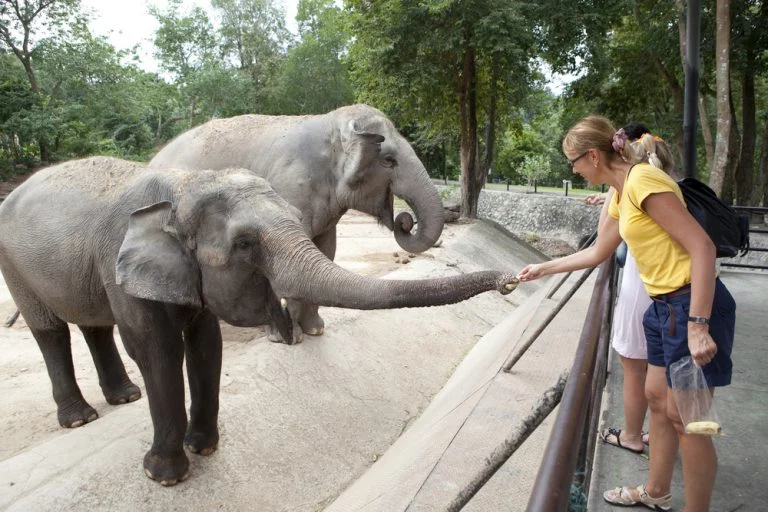
At the Elephant Nature Park in northern Thailand, Plotnik and de Waal recorded what 26 elephants did after one of them showed distress. Bystanders moved in, touched the upset animal with their trunks, most often around the mouth or the genitals, and chirped. Their 2014 paper notes that consolation of this kind had previously been shown only in great apes, dogs and their relatives, and members of the crow family. The authors are careful: most distress started from something ambiguous, so they could not always tell whether bystanders were responding to the upset elephant or to the same disturbance.
Responses to the dead are equally well known and equally easy to overstate. In a 2006 Amboseli experiment, McComb, Lucy Baker and Cynthia Moss laid out objects in front of wild families. The elephants spent more time on elephant skulls and ivory than on natural objects or the skulls of other large mammals. They did not, however, pick out the skulls of their own relatives. Visits to dead relatives probably come from a general pull toward elephant remains, not from recognising a particular individual. Our piece on elephant mourning covers what else is known.
Why any of this matters for elephants
The cognitive evidence has practical weight. Poaching does not take elephants at random: the Tarangire paper notes that heavy poaching in the 1970s and 1980s selectively removed older animals with larger tusks, which are exactly the animals carrying the longest memory of where to go in a crisis.
It has also reached the courts. The Nonhuman Rights Project filed affidavits from elephant cognition experts in its habeas corpus case for Happy. In 2022 New York’s Court of Appeals became the first US state high court to hear an animal rights case of this kind, and the majority ruled against her, with two judges dissenting. Our piece asking whether elephants should have human rights follows the case from start to finish.
Most of the abilities above are social ones: knowing voices, smells, routes, threats and the state of the animals nearby. McComb’s team made the same point in 2000, suggesting that large recognition networks may be typical of long-lived animals with fluid social lives and long-distance calls.
If you have watched elephants solve a problem or recognise someone, tell us about it in the comments.
Sources
- Herculano-Houzel and colleagues (2014), The elephant brain in numbers
- Plotnik, de Waal and Reiss (2006), Self-recognition in an Asian elephant
- Hart and Hart (2018), How mammals stay healthy in nature
- Foerder and colleagues (2011), Insightful problem solving in an Asian elephant
- McComb and colleagues (2000), Unusually extensive networks of vocal recognition in African elephants
- Bates and colleagues (2008), African elephants have expectations about the locations of out-of-sight family members
- Foley, Pettorelli and Foley (2008), Severe drought and calf survival in elephants
- McComb and colleagues (2014), Elephants can determine ethnicity, gender, and age from acoustic cues in human voices
- Plotnik and de Waal (2014), Asian elephants reassure others in distress
- McComb, Baker and Moss (2006), African elephants show high levels of interest in the skulls and ivory of their own species
- Happy: case history