

The Matriarch’s Memory: How Older Females Lead Elephant Herds
Last updated: September 14, 2026
6 min read
Elephant herds are run by matriarchs. They are the oldest animals in the group, not the strongest, with decades of memory for water holes, migration routes, predator behaviour and the individual calls of hundreds of other elephants. Losing a matriarch costs a herd more than losing any number of younger members.
Key facts at a glance
| Who leads | The oldest female in the family |
| Family size | Usually a handful of related adult females and their calves |
| Key knowledge | Migration routes, dry-season water, danger zones, hundreds of individual calls |
| Survival effect | Families with older matriarchs handle strangers and droughts better |
| Decision domain | Where to feed, where to rest, when to flee, when to confront |
| Succession | Usually her eldest sister or her oldest adult daughter |
| Source of authority | Knowledge and social bonds, not size or aggression |
What a matriarch is for
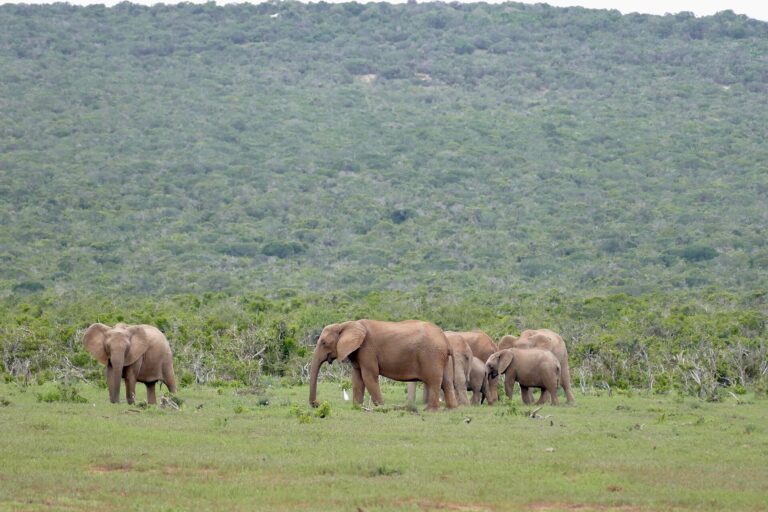
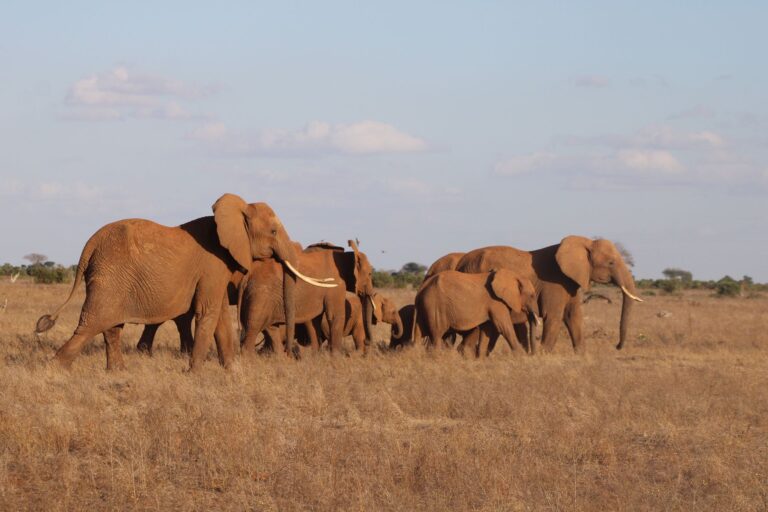
An elephant family is a tight matriline. The matriarch is the oldest living female, surrounded by her adult daughters and their calves. Adolescent males leave at around 12 to 14, so the working group is almost entirely female. Nothing visible marks her selection. She rises through age and accumulated experience. After her death, a related adult female may lead, but families can split and the next-oldest female does not always succeed.
Her job, in practical terms, is institutional memory. Where is water in a drought year? Which corridor crosses a road that did not exist when she was a calf? Which rumble belongs to a stranger and which to a long-absent cousin? In open savanna and dense forest alike, the matriarch is the database the rest of the family relies on.
The Amboseli evidence
The longest-running elephant study on Earth is the Amboseli Elephant Research Project, founded by Cynthia Moss in 1972, which has tracked individual families for over five decades. Karen McComb and colleagues published a landmark paper from that population in Science in 2001, showing that families with older matriarchs were measurably better at telling the contact calls of familiar elephants from unfamiliar ones. Better discrimination meant better decisions when strangers appeared, and those families had higher reproductive success.
The finding mattered because it put a number on something field observers had long suspected: matriarch age affects everyone in the family, not just the matriarch. The conservation implication was unwelcome and obvious. Poaching preferentially removes the oldest animals, because they carry the largest tusks, which means it strips out exactly the individuals whose knowledge the rest of the herd depends on.
The drought test
The clearest test came from Tanzania. Charles Foley, Nathalie Pettorelli and Lara Foley studied calf mortality in Tarangire National Park during the 1993 drought, the worst in that region for 35 years, and published the results in Biology Letters in 2008. Over nine months, 16 of the 81 calves in the three clans they followed died.
The interesting part is how unevenly that fell. Most families in two of the clans left the park during the drought and lost four of 39 calves and one of 15. The third clan stayed in the north of the park and lost 11 of 27. Calf loss was also higher among young mothers than experienced ones. The authors’ reading was that the families which left were led by females old enough to remember the drought of 1958 to 1961 and to know where the resources outside the park were. For more on the slow biology of elephant reproduction, see our piece on elephant gestation.
How matriarchs decide
- Reading wind for distant scent of water or of other herds
- Listening to long-distance rumbles and seismic vibration through the feet
- Coaxing particular calves across a difficult crossing first, with the rest following
- Cutting a feeding session short and moving the family on when predator scent appears
- Stopping the herd flat in the presence of a stranger and standing tall to assess
- Forming a defensive ring around calves and birthing mothers
Watch any close field footage of Amboseli or Samburu elephants and you will see this play out. The matriarch is rarely the one doing the most. She stands, watches, signals, and the family responds. Her authority runs on relationships and shared history rather than physical dominance.
Recognition at scale
Matriarchs recognise large numbers of individual elephants by call alone. McComb’s work with the Amboseli population found that older matriarchs discriminated family from non-family contact rumbles more reliably than younger females did, including calls from animals they had not heard for a long time. This is a skill that takes decades to build, which is precisely why it cannot be replaced quickly. For more on the systems underneath it, see our piece on how elephants communicate.
Why poaching damage lasts a generation
A family that loses its matriarch to poaching is not simply one elephant short. It loses its decision-making centre. Younger females step up with thinner knowledge and weaker social authority. Families fragment into smaller, younger groups that move less coherently. Calf survival drops. The recovery time after the killing stops is not a year or two, because the knowledge has to be rebuilt from experience rather than inherited.
That is why conservationists argue that the social damage in heavily poached regions keeps playing out long after the poaching rate falls. For the long arc of the trade, see our ivory trade explainer.
Captivity breaks the structure
Captive settings rarely reproduce a natural matriline. Zoos and camps typically hold a small number of adult females, often unrelated, with no established matriarch and no allomothering apprenticeship for young females. The result is a social environment without the long-term knowledge transfer that defines wild elephant society. Accreditation standards in the United States have pushed zoos toward larger, more socially complete groups since the early 2010s, but anything resembling a genuine wild matriline is still rare in captivity.
Sanctuaries taking in rescued elephants often report older females stepping into a matriarchal role over groups of unrelated animals. The instinct survives captivity. The accumulated knowledge does not, and instinct alone does not substitute for it.
What this means for policy
Two things follow from the matriarch literature. First, protection aimed at the oldest females, not only at big-tusked bulls, protects disproportionately more value per animal. Second, corridor and protected-area design should preserve the traditional routes that matriarchs can still lead families along. Cut the corridor and you cut the next generation off from knowledge they would otherwise have inherited.
Frequently asked questions
What is a matriarch in an elephant herd?
The oldest living female in a family group, who leads through decision-making rather than physical dominance, drawing on decades of memory for water, routes, predators and the calls of other elephants.
How old do matriarchs get?
Into their fifties and sixties. Echo, the best known matriarch in the Amboseli study and the subject of two Nature documentaries, died of old age in May 2009 at about 65. Lifespan is limited largely by the wearing down of the last of six successive sets of molars.
How do matriarchs make decisions?
By reading wind and scent, feeling seismic vibration through their feet, listening to long-range rumbles, and setting all of it against memory of how similar situations played out years earlier. The family defers to her through social bond rather than coercion.
What happens when a matriarch dies?
A related adult female may lead, but succession varies and families can split. The transition is often visible in the field as the family reorganises, and calf survival can drop during it, especially if the new matriarch is much younger.
Are matriarchs the largest elephants?
No. They are the oldest, not the biggest. Bulls are larger but live apart from the family group from adolescence onward.
Why are matriarchs important for conservation?
Because what they know affects the survival of every elephant around them. Poaching aimed at big tusks removes them disproportionately, and rebuilding that knowledge takes far longer than stopping the killing does.
The matriarch is the centre of elephant society, and one of the strongest arguments for treating elephants as a species defined by culture as much as by biology. For more on social behaviour, browse our elephant facts hub or read our species profiles.
Read next
- 100 Elephant Facts: Everything to Know About Earth’s Largest Land Animal: Our master elephant fact sheet: anatomy, cognition, matriarchal society, infrasound, the trunk, tusks and ivory, diet.
- Elephant Matriarchs: Why the Oldest Female Runs the Herd: Older matriarchs read lion roars better, remember where water was thirty five years ago, and keep more calves alive through drought.
- Elephant Family Structure: Matriarchs, Bond Groups and Bulls: What fifty years of continuous records at Amboseli show about elephant families: who leads, when bulls leave, and the experiments that proved older matriarchs really do know more.
- Elephant Mourning: What Science Knows About Elephant Grief: Elephants investigate elephant bones far more than any other remains, but not their own relatives’ in particular.
Updated 14 September 2026: corrected a claim about matriarch succession.



The drought test is the strongest argument for protecting older matriarchs. The Tanzania 1993 data is harrowing but clear.
Karen McComb’s recognition study still holds up beautifully. The herd-level effect of matriarch age is one of the cleanest behavioural-ecology results I have read.
Agreed, and the follow-up work on call discrimination has only reinforced it. Older matriarchs are doing computational work the rest of the herd cannot replace.
Spent three weeks in Amboseli on a research assistant placement and the difference between herds with old matriarchs and younger ones was visible day to day. The older-led herds moved with confidence.
The point about ivory poaching preferentially removing matriarchs is one of those compounding effects that takes decades to play out. The Amboseli population is recovering well but the social damage in Selous is still visible.
Sanctuary observations of unrelated females asserting matriarchal roles are fascinating. The instinct survives captivity even when the knowledge does not.
McComb 2001 work on matriarch age and herd response to playback calls is the cleanest evidence. Older matriarchs distinguish friendly vs aggressive bulls by call signature in a way younger leaders cannot. Losing them is genuinely irreversible.