
Elephants in the DRC: Forest Elephants of the Congo Basin
Last updated: October 26, 2026
5 min read
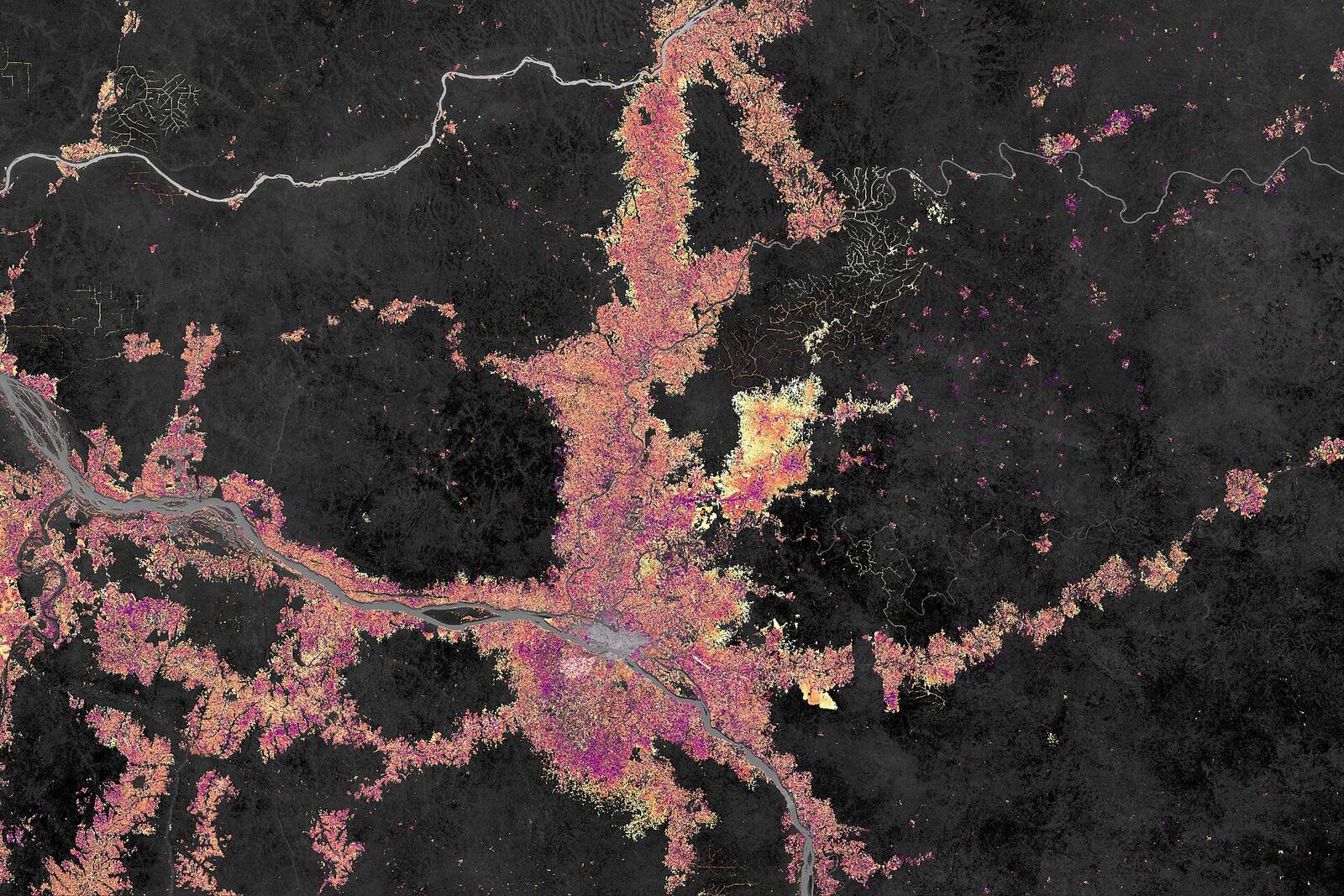
DR Congo Kisangani forest loss oli 2024 lrg, by NASA Earth Observatory images by Wanmei Liang, using forest change data from the University of Maryland, Public domain, via Wikimedia Commons.
The Democratic Republic of the Congo contains more of Central Africa’s forest than any other country and almost none of the forest elephants. That sentence is the whole story. Nobody can give you a confident national total, because most of the country has never been properly surveyed, but the surveys that do exist point to a population in the low thousands scattered across a handful of protected areas, down from a far larger figure in the 1970s.
How many are left, honestly
The last published national figure comes from the IUCN’s 2016 African Elephant Status Report, which put the DRC at roughly 1,800. That number reflects how little ground has been counted rather than a full census, and site surveys since then have found more than it implies.
The wider picture is clearer. The 2024 African Forest Elephant Status Report, released by the IUCN’s African Elephant Specialist Group, estimated 135,690 African forest elephants across the range, a 16 percent uplift on the 2016 figure driven by DNA-based survey methods rather than by any recovery. Around 96 percent of them are in Central Africa, but roughly two thirds are in Gabon and about 19 percent in the Republic of Congo. The DRC, with the largest share of the forest, holds a small fraction of the elephants.
Treat any single “DRC has X elephants” figure with suspicion, including ones you will find on conservation sites. The site-level counts below are the numbers with actual fieldwork behind them.
Where they live
Salonga National Park
At around 36,000 square kilometres, Salonga is the largest tropical rainforest national park in Africa and holds the DRC’s most important forest elephant population. Surveys run between 2015 and 2018 by ICCN with LMU Munich, the Max Planck Institute for Evolutionary Anthropology, WCS, WWF and the Zoological Society of Milwaukee estimated around 1,400 elephants, with a confidence range of 900 to 2,300. The park has been co-managed by ICCN and WWF since 2015.
Garamba National Park
Garamba sits in the northeast on the South Sudan border, in the transition zone between Congo Basin rainforest and Guinea-Sudanian savanna. Its elephants are unusual: a mix of forest and savanna animals, with savanna body size and forest-style straight tusks. African Parks has co-managed the park with ICCN since 2005 and puts the current population at around 1,200, with a 2023 demographic survey showing it stable. Poaching fell by roughly 90 percent after the law enforcement system was overhauled in 2016.
Getting there took a decade of losses that included elephants shot from a helicopter, in at least two separate incidents involving fifteen animals. Garamba also lost rangers to Lord’s Resistance Army incursions during the same period.
Okapi Wildlife Reserve and Maiko
Okapi was once the country’s forest elephant stronghold and is often described as its best-protected reserve. That did not save it. A WCS survey published in 2013 found around 1,700 elephants remaining, a 37 percent fall in five years, with roughly 5,100 killed over the preceding fifteen. Maiko holds forest elephants too, and has been surveyed even less.
Virunga National Park
Virunga is home to both forest elephants and savanna elephants across a park that contains both forest and savanna habitat. They are entirely separate from the mountain gorillas the park is known for.
The Congo Basin crisis
Two studies frame the scale of what happened. Maisels and colleagues, publishing in PLOS ONE in 2013 under the title “Devastating Decline of Forest Elephants in Central Africa”, found a 62 percent population decline between 2002 and 2011 alongside a 30 percent loss of range. Extended data coordinated by WCS across 80 sites in five countries put the loss at 65 percent between 2002 and 2013, a killing rate of roughly 9 percent a year.
Forest elephants cannot absorb that. Turkalo and colleagues, working from the Dzanga bai record, found that females do not give birth until around 23 years old and then calve only every five to six years. A savanna elephant population can rebuild from heavy losses within a few decades. A forest elephant population takes closer to a century, which is why the species is listed as Critically Endangered while the savanna elephant is listed as Endangered.
What makes the DRC different
Insecurity, above everything else. Human Rights Watch counted more than 100 armed groups still active across Ituri, North Kivu, South Kivu and Tanganyika provinces as of 2024, which means ICCN rangers are working in conditions closer to combat than to wildlife enforcement. Virunga National Park alone has lost more than 200 rangers since the war began in 1996.
Habitat pressure runs second and is accelerating. Logging, small-scale agriculture and the artisanal mining boom for cobalt and coltan have all pushed into remaining forest range in the eastern provinces. Neither pressure has an obvious technical fix, which is the honest reason the DRC’s trajectory is worse than that of its neighbours.
Who is doing the work
ICCN is the national park authority and does the actual ranger work. WCS, African Parks, WWF and the Virunga Foundation are the main international partners, each tied to specific sites: African Parks at Garamba, WWF at Salonga, WCS across several landscapes, the Virunga Foundation at Virunga. Frankfurt Zoological Society also works in the DRC, at Lomami.
Visiting, and whether you should
The DRC is the hardest country in Central Africa to visit responsibly for elephants, and the honest answer for most people is that you cannot, at least not with elephants as the reason.
Virunga opens and closes with the security situation and its draw is mountain gorillas. Elephants there are an occasional sighting, not a plan. Garamba has run limited visitor access under African Parks, but availability moves with conditions and you should check directly rather than trust a figure in an article. Neither is a place to turn up speculatively.
If you want to help and cannot go, give to the organisations named above that publish field reporting for the specific site you care about. That is a more reliable contribution than a trip that may not happen.
Frequently asked questions
How many elephants are in the DRC?
There is no reliable national total. The IUCN’s 2016 African Elephant Status Report listed roughly 1,800, covering surveyed areas only. Site counts give around 1,400 in Salonga, around 1,200 in Garamba and around 1,700 recorded in the Okapi Wildlife Reserve as of a 2013 survey.
Why are forest elephants in such trouble?
Ivory poaching removed 65 percent of them between 2002 and 2013, and they reproduce too slowly to replace those losses. Females first calve at around 23 and then only every five to six years.
Are forest elephants the same as bush elephants?
No. The African forest elephant (Loxodonta cyclotis) and the African bush or savanna elephant (Loxodonta africana) are separate species, assessed separately by the IUCN since 2021. Never quote a single combined “African elephant” number without saying which one you mean.
Does Garamba have forest elephants?
Not straightforwardly. Garamba’s elephants are a mix of forest and savanna animals, carrying savanna size with forest-type straight tusks, which is part of what makes the park unusual.
Who is fighting elephant poaching in the DRC?
ICCN, the national park authority, supported by WCS, African Parks, WWF and the Virunga Foundation depending on the site. Virunga alone has lost more than 200 rangers since 1996.
This article is part of our elephant species guide, which links every species, subspecies and country guide on the site.
Carry on reading
- Elephant Conservation 2026: How to Save the Last Giants: Poaching trends, the 1989 ivory ban, the zoo and sanctuary debate, trophy hunting.
- African Forest Elephant: Facts, Trivia & 8-Question Quest: The African forest elephant was recognised as its own species in 2021 and remains Critically Endangered.
- African Forest Elephant: The Critically Endangered Rainforest Species: A full species since the genetic split, Critically Endangered since 2021, and the tree-planter the Congo Basin cannot replace.
- Elephants in Cameroon: Forest and Savannah, Both Endangered: What the surveys actually show for Cameroon’s forest and savannah elephants, and what happened at Bouba Ndjida in 2012.
Updated 14 September 2026: corrected the elephant species found in Virunga.


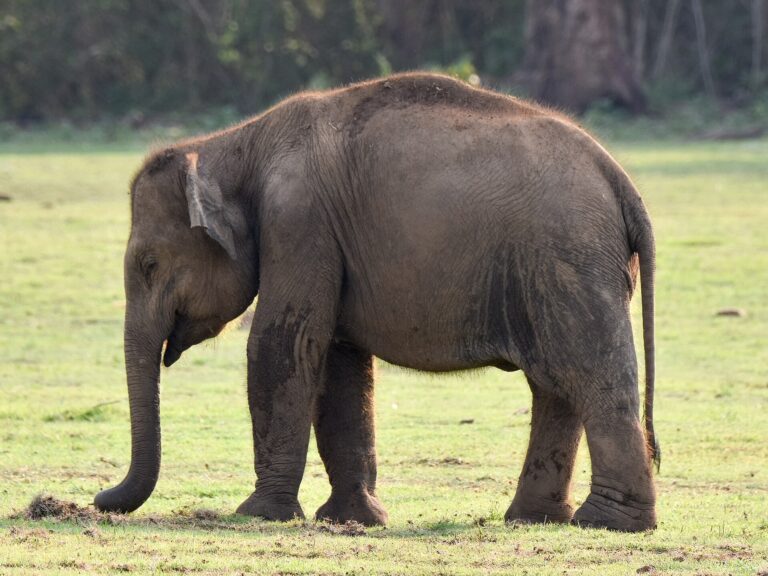
Salonga National Park is officially the largest tropical rainforest park in Africa but governance has been a struggle. The European Union pulled funding briefly over ranger conduct issues in 2020. The elephants pay for those failures.