

Pygmy Elephants of Borneo: The Smallest Asian Elephant
Last updated: October 27, 2026
6 min read
The Bornean elephant (Elephas maximus borneensis) is the smallest Asian elephant and, since 2024, a formally Endangered one. Around a thousand survive in fragmented forest, almost all of them in the Malaysian state of Sabah, with a small number over the border in Indonesian Kalimantan.
Key facts at a glance
| Scientific name | Elephas maximus borneensis |
| Common names | Bornean elephant, Bornean pygmy elephant, Borneo elephant |
| Range | Sabah in Malaysian Borneo, plus a small population in Kalimantan, Indonesia |
| Population | Around 1,000, of which roughly 400 are breeding adults (IUCN, 2024) |
| IUCN status | Endangered, assessed 2024 |
| Shoulder height | Around 2 to 2.5 m |
| Distinctive features | Rounder, more juvenile-looking face, large ears, very long tail, straighter tusks |
| Habitat | Lowland rainforest, river floodplains, oil palm fringes |
| Main threats | Habitat fragmentation from oil palm, human-elephant conflict, poisoning |
What makes a Bornean elephant different
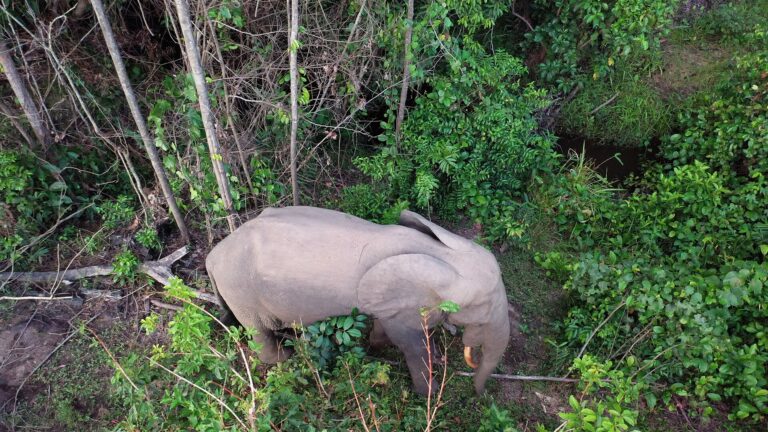
They are smaller and more lightly built than mainland Asian elephants, with adults typically standing 2 to 2.5 m at the shoulder. The pygmy label oversells the gap, though. Skull measurements from Sabah animals come out at roughly 72 to 90 percent of Sumatran equivalents, and adult heights are not far off elephants in Peninsular Malaysia. What people actually notice is the shape: a rounder, more juvenile-looking face, oversized ears for an Asian elephant, and a tail long enough to trail on the ground. Bulls carry straighter tusks than mainland tuskers.
Their temperament is described consistently as calmer than that of mainland Asian elephants by field researchers and Sabah Wildlife Department staff, with more standing off and less charging in encounters with people. That is a field impression rather than a measured trait, and it does not make them safe: a bull in musth or a stressed mother with a calf is dangerous anywhere.
Are they really native to Borneo?
This was argued over for a century. The old view, inherited from colonial-era naturalists, held that Borneo’s elephants descended from a domesticated herd on Sulu Island that the Sultan of Sulu gave to Sabah, with Java or the mainland as the original source. If that were true they would be an introduced population with no special claim on conservation funding.
DNA work published in 2003 by Prithiviraj Fernando and colleagues, a team that included Don Melnick of Columbia University, showed the opposite. Bornean elephants are genetically distinct from other Asian elephant populations, and the authors concluded that they reached Borneo naturally in the Pleistocene and were cut off when the land bridges flooded. A commentary published alongside the paper in PLoS Biology put the split at about 300,000 years ago, an estimate rather than a measured date. A 2018 study in Scientific Reports led by Reeta Sharma also found the population native, but suggested a later natural arrival, roughly 11,000 to 18,000 years ago. They are a natural population and the only Asian elephants in island South East Asia, which makes them one of the highest priority populations for the species as a whole.
Range and habitat
Most Bornean elephants live in Sabah, at the northern end of the island. The core ranges are the Kinabatangan River floodplain, the Tabin Wildlife Reserve, and the surrounding fragments of lowland rainforest. A smaller population persists in northern Kalimantan, and its numbers are poorly known. The Kinabatangan animals are the most studied and by far the most visible.
Habitat is the central problem. Bornean lowland rainforest is among the most heavily converted ecosystems on the planet, and what survives is a scatter of patches and corridors. Elephants follow seasonal fruit and bamboo through those fragments, which means walking through plantations to get from one patch to the next.
Oil palm and the conflict zone
Oil palm defines Bornean elephant conservation. Plantations have replaced a large share of Sabah’s lowland forest since the 1980s. The elephants have not simply vanished from those areas, partly because young palm fronds are edible and plantation edges are productive feeding ground. The result is constant low-level conflict: elephants enter plantations at night, break young palms and damage equipment, and plantations retaliate with snares, fences and, at worst, poison.
The clearest example came in January 2013, when fourteen elephants were found dead in the Gunung Rara Forest Reserve, with digestive tract damage consistent with poisoning and all of them in forest being converted to plantation. A three-month-old orphan from that group was taken to Lok Kawi Wildlife Park. Fourteen animals was roughly one percent of the entire subspecies.
HUTAN, the Sabah Wildlife Department, WWF Malaysia and the Kinabatangan Orangutan Conservation Programme have spent years working with plantation companies on corridors that let elephants pass through without raiding. Progress is real and slow, and single incidents can undo years of it.
Seeing them
The Lower Kinabatangan Wildlife Sanctuary is the protected core, and the river lodges around Sukau and Bilit are the usual base. River cruises produce sightings fairly regularly, especially in the dry season when elephants concentrate near the water. These are wild animals, not sanctuary residents. The only reason they are easy to see is that their remaining habitat happens to be a narrow strip along a tourist river.
If you want the trip to be worth something, choose operators that pay a per-bed-night fee into local conservancies and use guides trained in elephant behaviour rather than boat drivers who will push a bow into a feeding herd for a photograph.
Population status
The IUCN assessed the Bornean elephant for the first time in June 2024 and listed it as Endangered, with about 1,000 animals remaining and roughly 400 of them breeding adults. The assessment recorded a decline of at least half over the last three generations, driven initially by extensive logging and now by conversion of what remains.
Sabah holds a small captive population across several facilities. Lok Kawi Wildlife Park has included captive breeding among its activities, while habitat protection remains central to wild elephant conservation. A few orphans, including the 2013 calf, are held at Lok Kawi Wildlife Park near Kota Kinabalu.
Why they matter
Genetically they are a native island population, isolated from mainland elephants for thousands of years at least, and there is no equivalent population anywhere. Ecologically, elephants are the largest fruit-eaters on Earth, and a 2011 review by Ahimsa Campos-Arceiz and Steve Blake found that Asian elephants disperse many seeds, though they eat less fruit than African forest elephants. How much Bornean elephants move seeds has not been studied in detail. Commercially they are one of the animals Sabah’s ecotourism is built on.
None of that is the sort of argument that raises money internationally the way ivory poaching does for African elephants. The Bornean elephant is a slow story that depends on Malaysian and Indonesian decisions about land, not on global campaigns.
Frequently asked questions
How big are Bornean elephants?
Adults stand roughly 2 to 2.5 m at the shoulder. The name pygmy is comparative within the Asian elephant, not absolute, and it overstates the difference: Sabah adults are not far off the size of elephants in Peninsular Malaysia.
Where do they live?
Mostly in Sabah, in northern Malaysian Borneo, with a small population in northern Kalimantan. The core ranges are the Kinabatangan floodplain and the lowland forest fragments around it.
How many are left?
About 1,000, with roughly 400 breeding adults, according to the 2024 IUCN assessment that listed them as Endangered.
Are they a separate species?
No, a subspecies of the Asian elephant, Elephas maximus borneensis. Genetic studies in 2003 and 2018 show they are native to Borneo, which refuted the older idea that they were introduced from Java or Sulu a few centuries back. Estimates of when they arrived range from about 300,000 years ago to about 11,000 to 18,000 years ago.
What is the main threat?
Habitat loss to plantations, with human-elephant conflict in the fragmented remainder as the immediate cause of most deaths. Snares, poisoning and retaliatory shooting have killed groups of elephants in single incidents.
Where can I see them?
The Lower Kinabatangan Wildlife Sanctuary in Sabah, usually from a river lodge at Sukau or Bilit. Sightings are best in the dry season. Choose operators that pay into local conservancies and use trained local guides.
Related elephant coverage
- Elephant Species: Complete Guide to All Living Elephants 2026: The three living elephant species and their subspecies: taxonomy, range, diet.
- Bornean Pygmy Elephant: Borneo’s Small, Endangered Elephant: About 1,000 Bornean elephants remain in the wild, including roughly 400 breeding adults.
- Borneo Elephant: Facts, Trivia & 8-Question Quiz: The Bornean pygmy elephant, listed Endangered by the IUCN in 2024, with around 1,000 animals left.
- Elephants in Borneo: The Pygmy Subspecies of Sabah: Where to find Borneo’s 1,500 remaining elephants, why the Kinabatangan is the reliable site, and how oil palm squeezed the herds onto a ribbon of riverbank forest.
Updated 14 September 2026: updated Bornean elephant figures and captive breeding information.
Updated 27 October 2026: presented the 300,000-year divergence figure as an estimate, added the 2018 genetic study, and replaced an unsourced seed dispersal claim.


Bornean pygmy elephants are the most under-covered elephant population in conservation media. The long isolation story changes how the conservation argument should be framed.
Spent two weeks in Sukau and saw the Kinabatangan herd cross the river twice. The babyish face description is exactly right. The proportions are different in a way you notice immediately.
Glad you got to see them in the Kinabatangan corridor. That stretch is one of the better contexts to observe pygmy elephants. The conservation work HUTAN does there is excellent.
Oil palm is the central problem and it is not getting smaller. The corridor work between plantations is impressive but it is fighting an uphill battle.
The 2013 and 2018 poisoning incidents in Sabah were a wake-up call. Single events can take out significant fractions of a small population.
The Don Melnick genetic work resolving the introduction-from-Java question was beautifully done. Hard to settle a 300-year-old debate with one careful analysis.