Understanding The Dangers Of The Musth Stage In Bull Elephants
Last updated: September 14, 2026
3 min read
Musth is a condition bull elephants go through, and it poses serious risks to animals and humans alike.
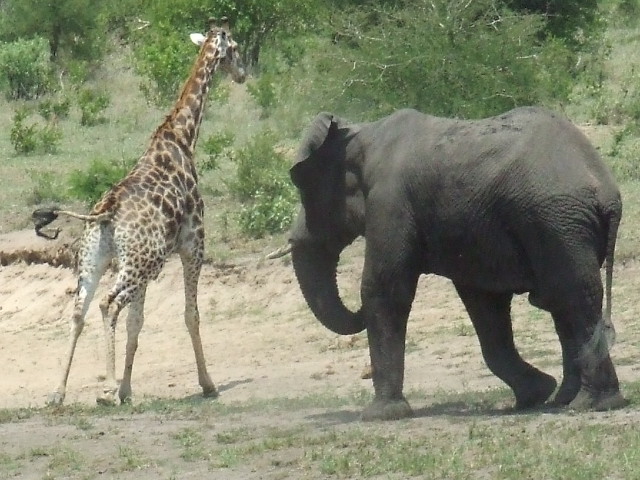
A wild bull elephant in musth chasing a bull giraffe (Photo: Jacques S Gerber/Wikimedia Commons, CC BY 2.0)
In modern usage across several Indian languages, the root of the word means intoxicated or elated. That is not much help as a description of what is happening to the animal.
Musth is a periodic state, lasting days to months depending on the bull’s age, in which behaviour changes sharply. It happens only in males, and in both Asian and African elephants.
What is musth in bull elephants?
The driver is hormonal. Testosterone rises sharply during musth and varies widely by individual. In that state the animal becomes aggressive and highly reactive to anything happening around it.
First musth arrives at roughly 20 years of age in Asian bulls and around 25 in African ones, and the early episodes are usually short and weak. The intensity and duration build over subsequent cycles, peaking in a bull’s forties, when an episode can run for months, before tailing off again with age. A bull in his prime in full musth outranks larger non-musth bulls, which is the point of the whole system.
Common signs of musth
- Continuous urine dribbling, strong-smelling, leaving a scent trail as the bull walks. Published musth studies describe urine dribbling but do not establish a 300-litre daily loss. The flow varies from a drip when standing still to a stream when walking or confronting a rival.
- Body odour and sweat that carry the same signal.
- The sheath of the penis takes on a greenish-white cast.
- Thick, tarry secretion from the temporal glands, which sit on each side of the head between the eye and the ear. The glands swell, and the swelling is thought to be painful.
- A distinctive low-frequency call, the musth rumble, audible to other elephants at long range and functioning as a broadcast warning.
- Swelling at the base of the trunk alongside the temporal swelling, which adds to the animal’s sensitivity.
Field study of musth remains limited for the obvious reason that getting close to a bull in that state is dangerous.
Effects of musth
Temporal secretion from a bull in musth (Photo: Yathin S Krishnappa/Wikimedia Commons, CC BY-SA 3.0)
- Bulls in musth fight other bulls, threaten or attack other animals that come near, and take out their state on inanimate objects.
- Fights between two bulls in musth are the most serious elephants get. Both animals can end up badly injured, and these encounters do kill.
- They react violently to noise and to sudden movement.
- Aggression is not reserved for other males. Bulls in musth have injured and killed people, and are the cause of a disproportionate share of elephant attacks on humans.
A bull in musth needs to be given room, wild or captive.
Managing elephants in musth
Musth is often described as an elephant version of rut or heat, and that is not quite right. Bulls in musth will threaten females as readily as males, and musth does not sync to a breeding season. It is better understood as a signal of competitive rank between bulls, which incidentally makes the bull more attractive to females.
What triggers the cycle is still not fully settled. The testosterone surge is the mechanism, but what sets it off, and why it lands when it does in a given animal, is not resolved.
Captive management is where the real problems start. Bulls in musth have killed keepers, and an otherwise even-tempered animal can change fast. Historically, handlers in South Asia managed musth by chaining the bull to a tree and restricting food and water, sometimes to the point of starvation, on the theory that this shortened the episode. That practice is documented in the older literature and is still used in places. It is not defensible on welfare grounds and modern veterinary guidance does not support it.
The accepted approach now is to keep the bull safely separated in secure housing, maintain food and water, minimise disturbance, and wait the episode out, with sedation used only where a vet judges it necessary. Nobody works in close contact during that period.
Musth is a hard period for the bull, for the elephants around him, and for anyone responsible for his care. It is part of why many zoos never kept male elephants at all, and part of why the ones that do need facilities built for it.
Related elephant coverage
- 100 Elephant Facts: Everything to Know About Earth’s Largest Land Animal: Our master elephant fact sheet: anatomy, cognition, matriarchal society, infrasound, the trunk, tusks and ivory, diet.
- Elephant Family Structure: Matriarchs, Bond Groups and Bulls: What fifty years of continuous records at Amboseli show about elephant families: who leads, when bulls leave, and the experiments that proved older matriarchs really do know more.
- Asian Elephant Trivia: Facts, Quiz & 8 Questions: Asian elephant facts, the four recognised subspecies including the 2024 Bornean assessment, and an eight-question quiz with sourced answers.
- When Elephants Attack: Around 500 people a year are killed by elephants in India and about 150 in Sri Lanka.
Updated 14 September 2026: removed unsupported musth figures.