Elephants in Sri Lankan Culture: Temples, Ceremony and Conflict
Last updated: September 14, 2026
4 min read
Sri Lanka has lived alongside its elephants for more than two thousand years. The relationship runs through Buddhist iconography, royal symbolism, temple processions and pre-colonial state administration, and it now runs into a conflict that kills hundreds of elephants and well over a hundred people every year. Reverence and casualty figures sit side by side on the same island.
In Buddhist iconography
Buddhist tradition holds that a white elephant appeared to Queen Maha Maya in a dream on the night the Buddha was conceived. White elephants, which are pale or depigmented rather than truly white and are very rare, have been treated as sacred across the Buddhist world ever since, and a white elephant in royal possession was read as a sign of legitimate kingship.
The Mahavamsa, the great Sri Lankan chronicle, returns to elephants repeatedly in the founding stories of the island’s Buddhist kingdoms. Royal elephants carried relics in processions, appeared at coronations, and travelled as diplomatic gifts to mainland Asian courts.
Esala Perahera
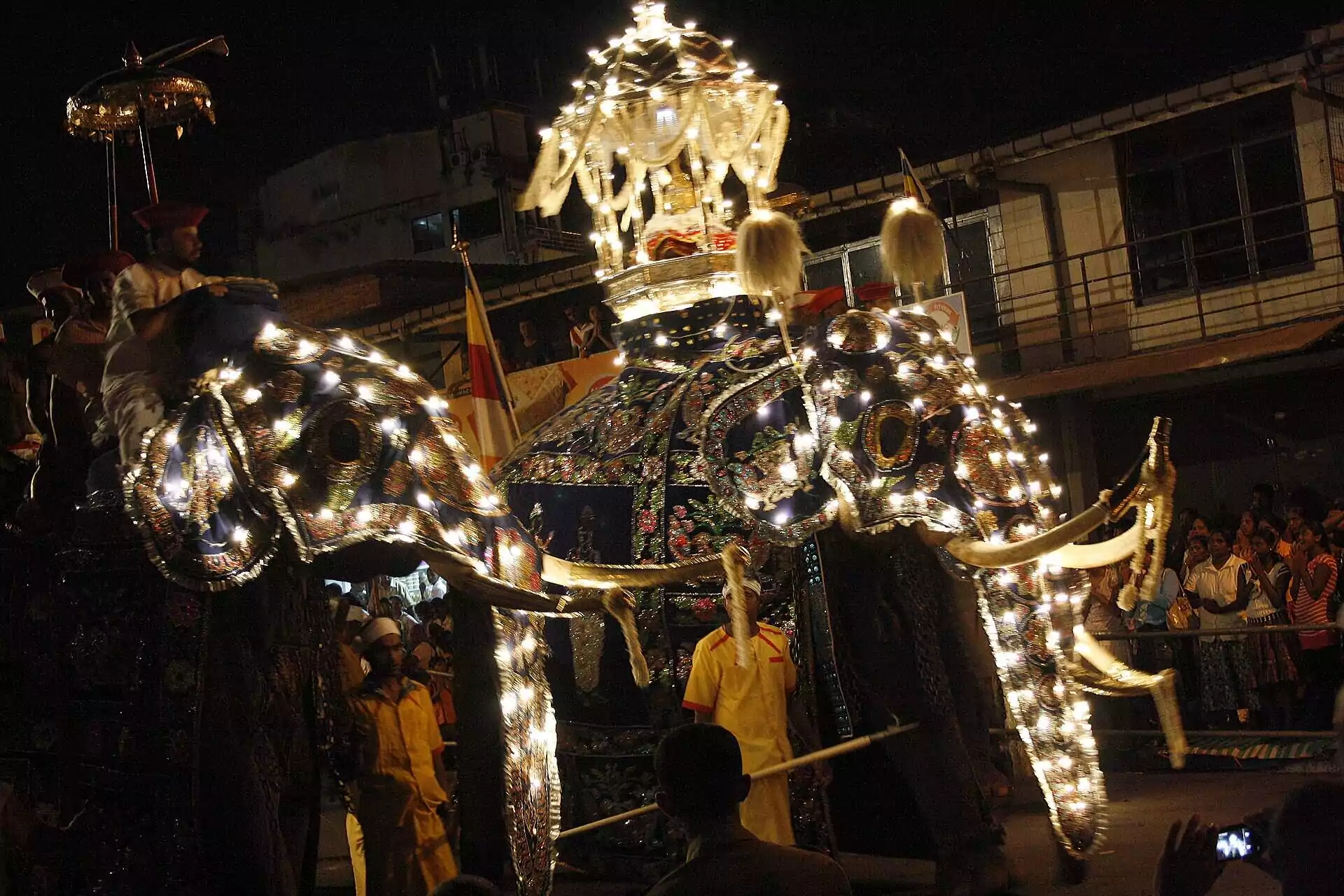
The Esala Perahera in Kandy is one of the world’s longest-running religious processions. The Dalada Perahera and the four devale peraheras were amalgamated into the form still used today during the reign of Kirti Sri Rajasinha in the 1750s, and it has run annually in July and August ever since, over ten nights.
The lead elephant, the Maligawa Tusker, carries a golden canopy holding a casket. Worth knowing before you go: the casket contains a replica. The Sacred Tooth Relic itself stays inside the Temple of the Tooth and does not go out on the street.
The number of elephants taking part has fallen. Recent peraheras have run with roughly 60 to 75 animals rather than the hundred often quoted, and organisers have publicly described a shortage, partly because the same limited pool of registered captive elephants is claimed by competing peraheras held on the same dates.
The procession is spectacular and it is contested. Welfare organisations point to heavy costumes worn for four or five hours at a stretch, chaining outside processional hours, chain scarring on the feet, crowds and firecrackers, and stereotypic weaving in visibly distressed animals. Reform arguments have been running for years without resolution.
Royal symbolism
Pre-colonial Sri Lankan kingdoms maintained royal elephant stables, and the number and quality of the animals in them was a direct measure of a king’s standing. Capturing and training wild elephants for royal service was a substantial industry, and the chronicles name individual royal tuskers as readily as they name kings.
The symbolism survives in modern politics. The elephant has been the electoral symbol of the United National Party since 1947, which is why an elephant on a poster in Sri Lanka is usually a party emblem rather than a wildlife appeal. The national emblem itself depicts a lion.
Working elephants
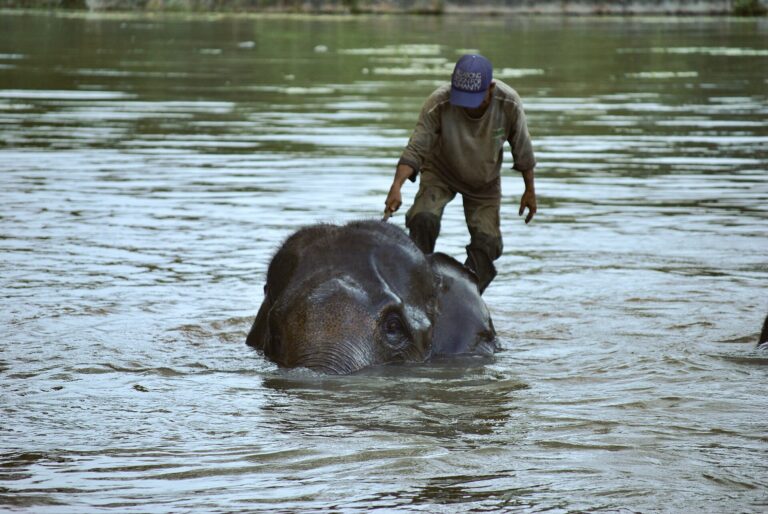
Domesticated elephants were the heavy-lift technology of pre-colonial Sri Lanka. Logging, temple work, ceremonial processions and warfare all ran on trained animals, and mahout knowledge passed down within families.
That world is closing. Capture from the wild has been banned for decades, the law now restricts how captive elephants may be used, mahout apprenticeships are not being taken up, and the temple sector has been under sustained NGO pressure over welfare. Reliable current totals for captive elephants are hard to come by: the 2011 national census recorded roughly 120 in captivity, registration records have been the subject of court disputes over illegally captured calves, and no dependable newer figure has been published.
The modern conflict
Behind the reverence sits the hard problem. Sri Lanka has the highest recorded annual elephant death toll from human-elephant conflict of any country. Between 2015 and 2024 the conflict killed 3,484 elephants and 1,195 people. 2023 was the worst year on record at 470 elephants and 176 people; 2024 came in at 388 elephants and 155 people.
Most incidents happen at farm boundaries, where elephants raid crops and farmers retaliate. Gunshot wounds, electrocution and hakka patas, explosives hidden inside food, account for most of the deliberate killings, with train collisions adding more.
Sri Lanka’s response has leaned on electric fences, relocation of problem elephants, and compensation schemes. Research increasingly finds that relocation in particular does not solve conflict and can spread it, since moved animals frequently walk back or start raiding somewhere new.
Read next
See our elephant facts pillar, our elephant species guide, our comparison of Asian and African elephants, and our piece on elephant matriarchs.
Frequently asked questions
Why are elephants important in Sri Lankan culture?
They run through Buddhist tradition, royal symbolism, temple processions and pre-colonial administration. A white elephant appeared to the Buddha’s mother in a dream. The number of royal elephants measured a king’s power. The Esala Perahera in Kandy still puts caparisoned elephants on the streets over ten nights every year.
What is the Esala Perahera?
An annual Buddhist procession in Kandy held in July and August over ten nights. The Maligawa Tusker leads it, carrying a casket that holds a replica of the Sacred Tooth Relic. The modern combined form dates to the 1750s.
How many elephants take part in the Perahera?
Fewer than the hundred often quoted. Recent years have run at roughly 60 to 75, and organisers have described difficulty securing even that many.
Are temple elephants treated well in Sri Lanka?
It varies, and the welfare concerns are serious and well documented: chaining, transport, heavy costumes worn for hours, and visible stereotypic behaviour. Licensing rules now require owners to demonstrate they can meet welfare obligations, but enforcement is the weak point.
How many captive elephants are there in Sri Lanka?
The 2022 Asian Elephant Range States meeting reported 215 living captive elephants in Sri Lanka: 102 government-owned and 113 privately owned.
Is there human-elephant conflict in Sri Lanka?
Yes, and it is the worst in the world by elephant deaths. 3,484 elephants and 1,195 people were killed between 2015 and 2024, peaking in 2023 at 470 elephants and 176 people. Most of it happens where farmland meets elephant range.
Read next
- Elephant Species: Complete Guide to All Living Elephants 2026: The three living elephant species and their subspecies: taxonomy, range, diet.
- White Elephants of Thailand: History, Royalty & Meaning: What a Thai white elephant actually is, the seven markers that define one, the war fought over them in 1563, and the 21 presented to King Bhumibol.
- Elephants in Thai Culture: Royalty, Buddhism & Tourism: The elephant in Thai history, monarchy and Buddhism, the 1989 logging ban that created the tourism elephant economy, and how to tell a real sanctuary from a rebranded ride camp.
- Elephants in Indian Tradition: Ganesha, Royal Processions and Modern Conflict: Ganesha, war elephants, Kerala’s temple processions, and the 2025 DNA-based census that put India’s wild elephant population at 22,446 rather than the 27,000 everyone had been quoting.
Updated 14 September 2026: corrected Sri Lanka’s captive elephant source.