
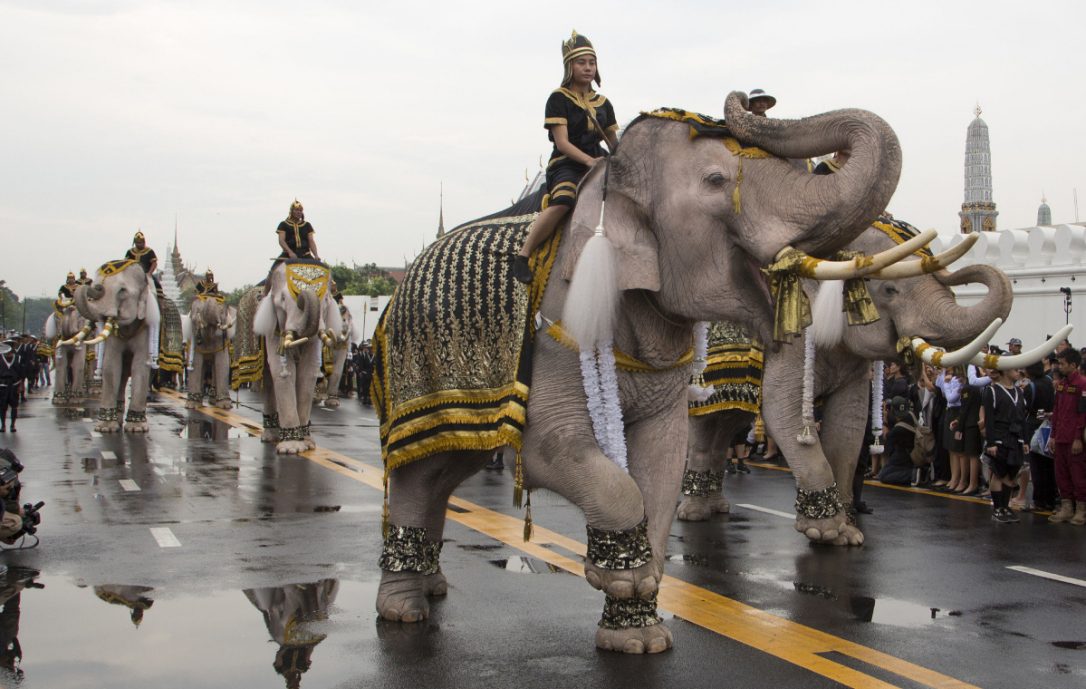
White Elephants of Thailand: History, Royalty & Meaning
Last updated: September 6, 2026
6 min read
The white elephant is the most revered animal in Thai royal tradition, a symbol of Buddhist merit and royal legitimacy with roots going back centuries. “White” here does not mean white. It means albino or near-albino, judged against a specific list of physical markers that royal officials have used to grade an individual animal. This is the story: where the idea comes from, the wars it started, the kings who collected them, and what happens to the royal elephants now.
Key facts at a glance
| What a white elephant actually is | An albino or near-albino Asian elephant, usually captured wild, not literally pure white |
| Religious basis | The Jataka tales and Queen Maya’s dream before the Buddha’s birth |
| Formal criteria | Seven markers, codified in the Wild Elephant Protection Act of 1921 |
| White elephants presented to King Bhumibol (Rama IX) | 21, more than any other monarch in Thai history |
| Royal Order of the White Elephant founded | 1861, under King Mongkut (Rama IV) |
| Historic national flag | White elephant on a red field, used until 1917 |
| Best-known modern royal elephant | Phra Sawet Adulyadej Phahon, registered 1959, died 2010 |
| War fought over white elephants | The Burmese-Siamese war of 1563 to 1564 |
The religious origin
Photo by Leon Aschemann on Pexels
The tradition comes out of Theravada Buddhism and the older Hindu-Buddhist court culture of south-east Asia. Several of the Jataka tales, the stories of the Buddha’s previous lives, cast the bodhisattva as a white elephant of unusual virtue. The most influential image is Queen Maya’s dream: while pregnant with the future Buddha she dreamt that a white elephant carrying a lotus entered her side, which was read as a sign that a great being was coming.
From that base the white elephant became a visible measure of merit (Pali: punna). A king who possessed them was demonstrably favoured, and therefore legitimate. The awkward corollary, that a king who could not obtain them was less worthy, turned out to have consequences.
The seven markers
Court practice graded a captured elephant against a set of physical characteristics, and Thailand’s Wild Elephant Protection Act of 1921 wrote them into law. The seven auspicious markers are white eyes, white palate, white toenails, white hair, white skin, white tail hair, and white genitals.
An elephant showing all seven is a full royal white elephant. One showing some of them may still be treated as rare and auspicious without qualifying. The assessment is made in person by royally appointed officials and experts, which is why the number of recognised animals is small even though pale-skinned Asian elephants are not vanishingly rare.
Sukhothai through Ayutthaya
The Thai white elephant tradition is documented from the Sukhothai period (1238 to 1438) and was fully developed by the Ayutthaya period (1351 to 1767), when the possession of celebrated elephants was central to how a court advertised its standing.
It was central enough to start a war. In 1563 the Burmese king demanded white elephants from the Ayutthaya court. Ayutthaya refused, Burma invaded, and the conflict is remembered as the War over the White Elephants. Ayutthaya fell to a later Burmese campaign in 1569.
The Battle of Nong Sarai in 1593, in which King Naresuan of Ayutthaya fought the Burmese crown prince in single combat on elephant-back, is the most famous battle in Thai national mythology. It is commemorated at the memorial at Don Chedi, near Suphan Buri.
The Bangkok era
The Chakri dynasty, founded in 1782, kept the white elephant at the centre of royal symbolism. King Mongkut (Rama IV) founded the Royal Order of the White Elephant in 1861, and it remains one of Thailand’s highest civil decorations. The national flag carried a white elephant on a red field until 1917, when Thailand adopted the modern tricolour.
King Bhumibol Adulyadej (Rama IX) received 21 white elephants over the course of his reign, more than any monarch before him. The first was Phra Sawet Adulyadej Phahon, a bull born in the forests of Krabi around 1951 and captured in 1956. He was registered as the first white elephant of the reign at a ceremony at the royal elephant stables in Dusit in November 1959, and he died at Klai Kangwon Palace in Hua Hin in April 2010.
The tradition beyond Siam
Photo by Magda Ehlers on Pexels
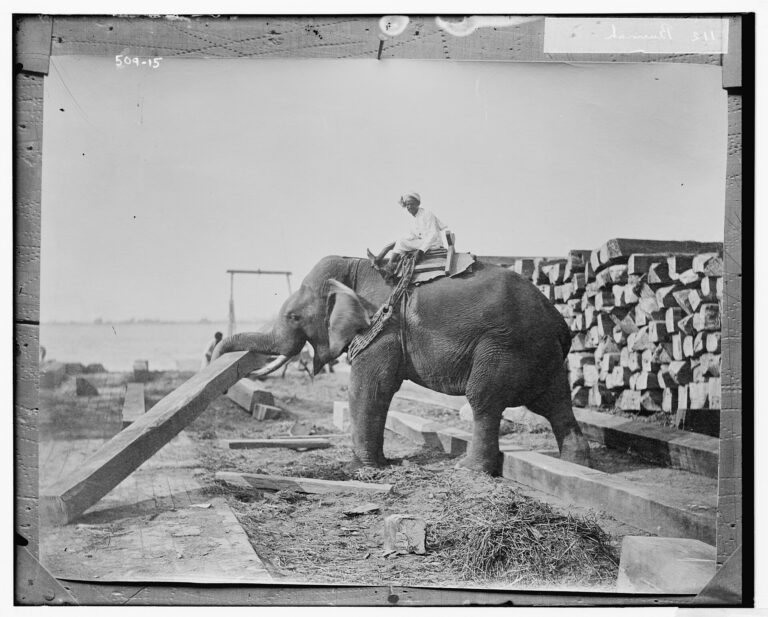
Burmese kings kept their own white elephants and built the animal into their titles: Hsinbyushin of the Konbaung dynasty means Lord of the White Elephant. The Cambodian and Lao courts drew on the same religious base. The Thai monarchy is simply the most visible inheritor of the tradition today.
The royal elephants now
Royal white elephants are a small, protected subset of Thailand’s captive elephant population, kept in dedicated stables with veterinary care funded by the royal household. They are not part of the commercial tourism system, and the welfare criticism that follows ride camps and performance venues has not attached itself to them in the same way.
The wider captive population is a different question entirely. Thailand holds somewhere around 3,800 captive elephants, most of them in tourism, and that story is covered in our pieces on the elephant entertainment industry and elephants in Thai culture.
Where to see the tradition
The Royal Elephant National Museum, also called the Chang Ton museum, occupies two former royal elephant stables built under Rama V in the Dusit Palace grounds in Bangkok. It holds regalia, howdahs, elephant armour and a model white elephant, and it is a museum of the ceremony rather than a place to see living animals. Check its current opening status before travelling, as access has been intermittent in recent years. The living royal elephants are held privately and are not on public display.
For wild elephants in Thailand, Khao Yai and Kui Buri national parks are the usual recommendations.
Where to go next
For the wider species and cultural context, see our Asian elephant species profile and our piece on elephants in Thai culture. For related cultural reads, see elephants in Indian culture. For sanctuary travel, see 10 ethical elephant sanctuaries. For broader hubs, see elephant conservation and elephant facts.
Frequently asked questions
What actually makes an elephant white in Thai tradition?
Not literal white colour. The formal test, codified in the Wild Elephant Protection Act of 1921, is a set of seven markers: white eyes, palate, toenails, hair, skin, tail hair and genitals. An animal with all seven qualifies as a full royal white elephant. The pure white elephant of the paintings is a religious ideal, not a biological one.
How many white elephants does the Thai king have?
The current figure is not published. King Bhumibol Adulyadej was presented with 21 over his reign, the largest number of any Thai monarch, and the best known of them, Phra Sawet Adulyadej Phahon, died in 2010.
Where does the tradition come from?
Theravada Buddhism. Several Jataka tales cast the bodhisattva as a white elephant, and Queen Maya dreamt of a white elephant carrying a lotus entering her side while pregnant with the future Buddha. From there the animal became a visible proof of a king’s merit.
Is the Royal Order of the White Elephant the same thing?
No. The order is a civil decoration founded by King Mongkut in 1861 and awarded to Thai and foreign recipients. It takes its name from the tradition but is a separate institution from the keeping of actual royal elephants.
Did kings really go to war over white elephants?
Yes. Burma demanded white elephants from Ayutthaya in 1563, Ayutthaya refused, and the resulting invasion is remembered as the War over the White Elephants. Ayutthaya fell to Burma in 1569.
What is the Battle of Nong Sarai?
The 1593 battle in which King Naresuan of Ayutthaya fought the Burmese crown prince in single combat on elephant-back. It is the best known battle in Thai national mythology and is commemorated at Don Chedi, near Suphan Buri.
Where can I see a white elephant?
Realistically, you cannot. The living royal elephants are kept privately. The Royal Elephant National Museum in Dusit holds the historic stables and the ceremonial material, and it is worth checking whether it is currently open before you make the trip.
Continue exploring at our store
If this article sparked your interest, head over to our elephant books collection for related reads and gear.
Related elephant coverage
- 100 Elephant Facts: Everything to Know About Earth’s Largest Land Animal: Our master elephant fact sheet: anatomy, cognition, matriarchal society, infrasound, the trunk, tusks and ivory, diet.
- Elephants in Thai Culture: Royalty, Buddhism & Tourism: The elephant in Thai history, monarchy and Buddhism, the 1989 logging ban that created the tourism elephant economy, and how to tell a real sanctuary from a rebranded ride camp.
- Elephants in Sri Lankan Culture: Temples, Ceremony and Conflict: Two thousand years of reverence, the Kandy Esala Perahera and its welfare argument, and a human-elephant conflict that killed 3,484 elephants and 1,195 people between 2015 and 2024.
- Elephants in Indian Tradition: Ganesha, Royal Processions and Modern Conflict: Ganesha, war elephants, Kerala’s temple processions, and the 2025 DNA-based census that put India’s wild elephant population at 22,446 rather than the 27,000 everyone had been quoting.



The 700-year Sukhothai lineage is important context. Western readers see the modern royal-elephant tradition and assume it is decorative. The religious legitimacy claim is the actual driver and it is older than most European royal traditions.