

How Many Elephant Species Exist Today?
Last updated: October 27, 2026
4 min read
Elephants have been hunted and displaced by people for centuries. So how many elephant species actually exist today?
Sri Lankan Elephant Herd (Author: Adbar cc 3.0)
Three. Hundreds of elephant and mammoth species have walked the earth, but only three survive: the African bush elephant, the African forest elephant, and the Asian elephant. They sit in two genera, Loxodonta for the African species and Elephas for the Asian one.
The two-versus-three question used to be genuinely contested. Africa’s forest and bush elephants were long treated as one species with two forms. Genetic and morphological work settled it, and when the IUCN reassessed African elephants in 2021 it assessed them separately for the first time. Let us look at each in turn.
A. African elephants
Two species: the savannah or bush elephant (Loxodonta africana) and the forest elephant (Loxodonta cyclotis). These are the largest land animals on the planet. Adult males are larger than females, and unlike Asian elephants, both sexes generally carry tusks, though tusklessness occurs.
1. Savannah or bush elephant (Loxodonta africana)
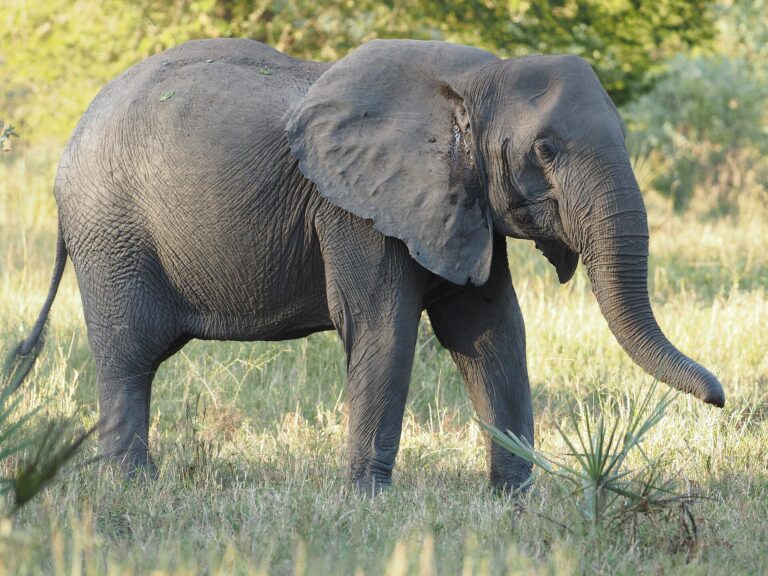
African Elephant
The larger of the two African species and the more widely distributed, found across eastern and southern Africa with fragmented populations in the west. It can reach around 4 metres (13 feet) at the shoulder and 6 tonnes.
Its enormous fan-like ears shed heat, and it has a longer trunk than other elephants. No subspecies of the African bush elephant are formally recognised. Regional populations differ in size and appearance, but those differences have not held up as separate taxonomic units.
The IUCN listed the African bush elephant as Endangered in 2021, upgrading it from Vulnerable.
2. The forest elephant (Loxodonta cyclotis)
Female African Forest Elephant And Calf, Congo (Author: Thomas Breuer cc 2.5)
The smaller African forest elephant lives in the forests of the Congo basin and West Africa. It is darker than the savannah species, with smaller, more rounded ears.
One useful field difference: the forest elephant has five toenails on the forefoot and four on the hind foot, where the bush elephant typically has four and three.
Its tusks are long, straight and hard, sometimes reaching the ground, which suits an animal that has to move through thick vegetation. It is exceptionally vulnerable to poaching because it reproduces so slowly, with females often not breeding until their twenties.
The IUCN listed the African forest elephant as Critically Endangered in 2021, after a decline of more than 86 percent over 31 years.
B. The Asian elephant
One species, Elephas maximus, found across South and Southeast Asia. African and Asian elephants look similar from a distance, but up close the differences are obvious. Asian ears are much smaller. Asian elephants have a twin-domed forehead with an indent between the two domes. Males may or may not have prominent tusks. Most females have small tushes that are often barely visible.
The IUCN has listed the Asian elephant as Endangered since 1986. Four subspecies are recognised.
1. The Indian elephant
Indian Elephant Bull, Bandipur National Park (Author: Yathin S Krishnappa cc 3.0)
Elephas maximus indicus, the mainland subspecies, and by far the most numerous. Adults reach 2 to 3.5 metres (6.5 to 11.5 feet) at the shoulder and 4 to 5 tonnes. Females are smaller than males.
Its skin is lighter than the Sri Lankan subspecies and darker than the Sumatran. Poaching, habitat loss, deforestation, and collisions on roads and railways are the main pressures on it.
2. The Sumatran elephant
Sumatran Bull Elephant, Ragunan Zoo, Jakarta (Midori cc 3.0)
Elephas maximus sumatranus, native to Sumatra. Shoulder height 2 to 3.2 metres (6.5 to 10.5 feet), weight 2 to 4 tonnes, with generally lighter skin than other Asian elephants.
It is one of the few elephant subspecies with its own IUCN assessment: Critically Endangered since 2011, after a population decline of at least 80 percent over three generations driven overwhelmingly by forest clearance.
3. The Sri Lankan elephant
Herd Of Sri Lankan Elephants At Yala National Park (Author: Adbar cc 3.0)
Elephas maximus maximus, the nominate subspecies, native to Sri Lanka and the largest-bodied of the Asian elephants. It is easily identified by patches of depigmentation on the ears, face, trunk and belly. Very few Sri Lankan males carry tusks, only around 7 percent.
4. The Borneo elephant
Herd Of Borneo Elephants (Author: Cede Prudente, WWF, Malaysia cc 2.5)
Elephas maximus borneensis, commonly called the pygmy elephant of Borneo, found in north-eastern Borneo in Sabah with a small overlap into Indonesian Kalimantan. It is the smallest Asian elephant, with a notably long tail for its body size.
Its origins were debated for a century. The old story was that these were descendants of captive elephants gifted to the Sultan of Sulu. Mitochondrial DNA work published in 2003 disproved it: the Borneo population is native and genetically distinct, though estimates of when it arrived range from about 300,000 years ago to about 11,000 to 18,000 years ago. In June 2024 the IUCN gave it its own Red List assessment, listing it as Endangered with a population of around 1,000.
So, three species and four subspecies
Three living species, all of them threatened. Two of the three were reclassified upward in 2021, and none of them is currently listed as anything less serious than Endangered.
Elephants are intelligent and highly social, and they generally avoid people where they can. Where they do come into conflict with humans it is almost always because the space between the two has run out. Humans have exploited every one of these species and subspecies for centuries, and that has to change if any of them are to recover.
Continue exploring at our store
If this article sparked your interest, head over to our deeper guide on elephant intelligence at the We Love Elephants store for related reads and gear.
Read next
- Elephant Species: Complete Guide to All Living Elephants 2026: The three living elephant species and their subspecies: taxonomy, range, diet.
- African Elephant Species Profile: Facts, Range, Conservation: Two species, not one.
- Asian Elephant vs African Elephant: Side-by-Side Comparison: Ears, tusks, trunk tips, back profile, size and conservation status compared across the Asian elephant and the two African species.
- Asian Elephant Species Profile: Facts, Range, Conservation: The Asian elephant in depth: four populations across 13 range countries, size, diet, musth, working elephants, the conflict numbers from India, and what conservation is actually working.
Updated 14 September 2026: qualified tusk claims for African and Asian elephants.
Updated 27 October 2026: corrected the dating of the 2003 Bornean elephant genetics study.




two-genus framing is the standard textbook setup but loxodonta cyclotis really has been treated as a full species since the 2010 genetics work. forest elephant divergence from bush is older than the human/chimp split apparently. would love to see this piece updated with that, the cyclotis paragraph could carry a lot more weight imo.
the subspecies count for the bush elephant got me curious. you say four recognised but the IUCN listing always reads three to me. is the fourth one a regional taxonomy thing? happy to be corrected, this isn’t my field i just read too much.