
Elephants Trivia
Last updated: October 26, 2026
4 min read
There are three living species of elephant, and most quiz answers come down to telling them apart. The African bush elephant is the largest land animal alive, the African forest elephant is its smaller rainforest relative, and the Asian elephant is the one you will meet across India and Southeast Asia. This page covers all three, plus a set of genuinely surprising facts and a row of trivia games to test what you have learned.
The three living species
African bush elephant (African savanna elephant)
- Habitat: grasslands, marshes and lakeshores across sub-Saharan Africa.
- Field marks: large ears shaped somewhat like the African continent; both sexes grow tusks.
- IUCN status: Endangered, listed in 2021.
- Fact: the largest land animal alive, with adult bulls reaching around 7 tonnes.
African forest elephant
- Habitat: dense rainforest of West and Central Africa.
- Field marks: darker, hairier skin; straighter, downward-pointing tusks; smaller than its savanna relative.
- IUCN status: Critically Endangered, listed in 2021.
- Fact: genetic work confirmed it as a full species in its own right rather than a subspecies, which is why the two African elephants now get separate Red List assessments.
Asian elephant
- Habitat: forests across South and Southeast Asia, including India, Thailand and Indonesia.
- Field marks: smaller ears; a domed back; only some males grow long tusks.
- IUCN status: Endangered.
- Fact: the proportion of tusked bulls varies enormously by region, from fewer than 7 percent in Sri Lanka to around 95 percent in south India.
How to tell the three apart at a glance
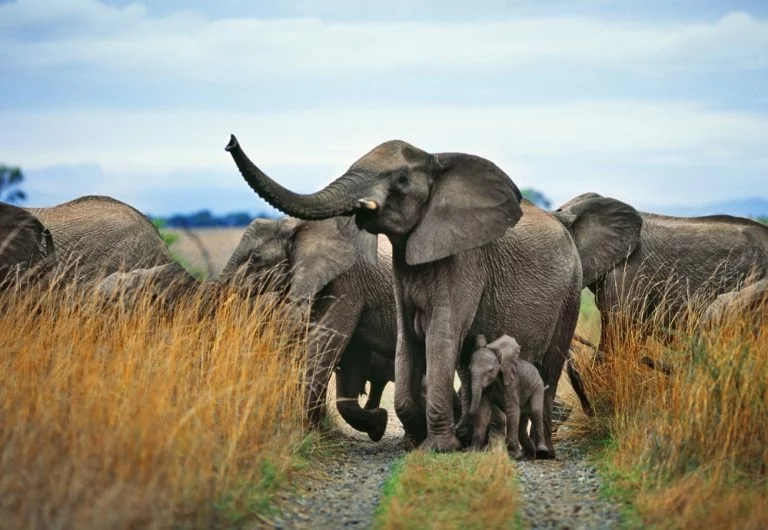
If you only remember one rule, make it ears. The African bush elephant has huge ears that roughly echo the shape of the African continent; the Asian elephant has noticeably smaller, rounder ears. Body shape is the next clue: African elephants have a dipped, swayed back, and Asian elephants have a domed back that rises in the middle.
Tusks split the field too. In African bush elephants both sexes usually grow them. In Asian elephants only some males carry long tusks, and tuskless males, sometimes called makhnas, are common.
Look at the trunk tip as a final check: an African elephant’s trunk ends in two finger-like lips, an Asian elephant’s in one. Forest elephants are the hardest to spot, since they stay in dense Central African rainforest, but they are smaller, darker and have straighter tusks pointing downward, which helps them move through thick undergrowth.
Elephant trivia games
Ready to test yourself? Pick one of the trivia games below. Each focuses on a different elephant population, so you can play several and compare your scores.
- Sri Lankan Elephant Trivia Game
- African Forest Elephant Trivia Game
- Borneo Elephant Trivia Game
- African Bush Elephant Trivia Game
- Asian Elephant Trivia Game
- Indian Elephant Trivia Game
Trivia to amaze your friends
- Teeth on a conveyor belt. An elephant grows six sets of molars in a lifetime. As one set wears down it is pushed forward and out and replaced from behind. When the sixth set is gone, the animal can no longer chew effectively, and old age in a wild elephant is usually a dental problem.
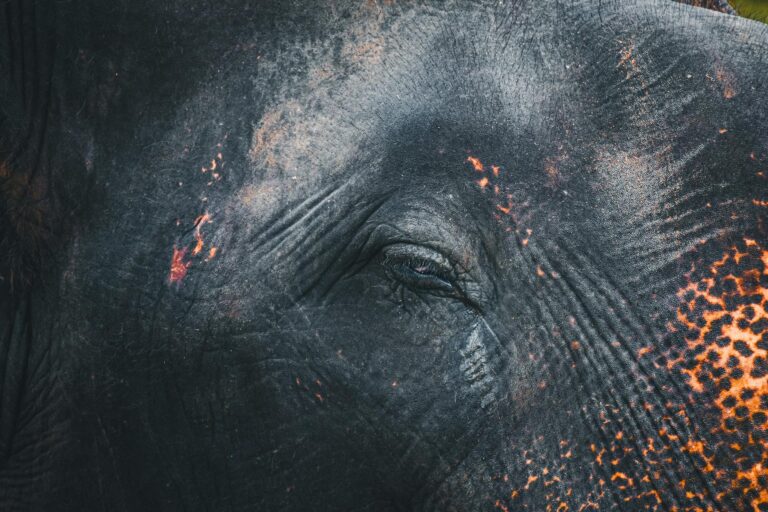
- Skin deep. Elephant skin is thick but sensitive, and elephants can get sunburned. It is one reason for the mud bath, which works as sunscreen and insect repellent at once.
- Skilled swimmers. Elephants swim well and use the trunk as a snorkel in deep water.
- Emotional depth. Elephants show a real range of emotional behaviour, including gathering around and returning to the bodies of dead herd members.
- Long gestation. 22 months, the longest of any land animal.
More facts worth knowing
- The trunk is a precision tool with no bone in it, built from tens of thousands of muscle units. It can uproot a tree or pick up a single blade of grass.
- Elephants communicate below human hearing. Deep infrasonic rumbles travel several kilometres through air and pass through the ground, where other elephants detect the vibration through their feet.
- Ears are radiators. A bush elephant’s ears are packed with blood vessels, and flapping them cools blood before it returns to the body, which matters because elephants do not sweat across most of their skin.
- Matriarchs recall the locations of distant water sources and recognise large numbers of individuals, which is what carries a herd through a drought.
- Wild elephants sleep very little, often only two to four hours a day, and may go a night or two without lying down at all.
- Calves are huge from day one, around 90 to 120 kg, and can stand and walk within hours of birth.
Why elephant facts matter beyond the quiz
All three species are in trouble, and it is worth knowing that they are in trouble separately. The African forest elephant is Critically Endangered, the African bush elephant Endangered, the Asian elephant Endangered. Habitat loss, poaching and conflict with people drive all three, in different proportions in different places.
Knowing how a herd thinks, communicates and raises its young is what makes the loss of a single population feel like something rather than a statistic. If you want to go deeper after the games, our African elephant species profile and our Asian elephant species profile cover each in full.
Continue exploring at our store
If this article sparked your interest, head over to the We Love Elephants merchandise store for related reads and gear.
This article is part of our elephant facts guide, which links every post on elephant bodies, minds and family life.
Elsewhere on We Love Elephants
- Elephant Species: Complete Guide to All Living Elephants 2026: The three living elephant species and their subspecies: taxonomy, range, diet.
- Asian Elephant Trivia: Facts, Quiz & 8 Questions: Asian elephant facts, the four recognised subspecies including the 2024 Bornean assessment, and an eight-question quiz with sourced answers.
- Elephant Quiz Trivia Game: An eight-question elephant quiz with the answers, plus the anatomy, behaviour and conservation facts you need to get them right.
- African Bush Elephant Quiz: Facts, Trivia & 8 Questions: Everything worth knowing about the largest land animal on Earth, plus an eight-question quiz with sourced answers on population, musth, trunk fingers and the Mali migration.
Updated 14 September 2026: qualified an anatomy claim.


did this one with my nephew over breakfast, he is nine and got further than i expected. he nailed the matriarch question first try which made me feel both proud and slightly outclassed. the African Bush vs Forest distinction in question two is the kind of thing that quietly upgrades how people see the species when they get it right.
question seven feels ambiguous, is the answer based on bulls only or both sexes? Asian elephants only some males carry tusks but the both-sexes-have-tusks line in the African Bush species fact box could be read as the answer to the same question. would tighten the wording on a re-export.
are there working elephant corridor projects you would point to as a model? Asian or African both fine. the Tsavo-Sagalla collaboration with Save The Elephants since 2009 i know about, but the South Indian elephant corridors administered by the Karnataka and Tamil Nadu forest departments are harder to find good public-facing writeups on.
the seven-ton male African Bush figure is the kind of thing that does not feel real until you watch one walk past at 30 metres. the recent genetic split confirming forest elephants as a distinct species is what most casual readers miss, the IUCN reclassified them in 2021 and the trivia-fact book industry has not caught up yet.
Ahmed, the matriarchal society piece is honestly the angle I find most fascinating after years of reading the field. The 2021 IUCN reclassification of L. cyclotis as a distinct species is the bit that updates most reference texts more slowly than it should. The Cynthia Moss longitudinal work in Amboseli is the gold standard if you want to go deeper.
spent a fortnight in tamil nadu during the temple-festival season last november, the welfare difference between Madurai Meenakshi and the smaller rural temples is night-and-day. the Madurai bulls get vet checks and chain-rotation, the rural temples basically chain the elephant to a tree and forget about it. it is the same subspecies, vastly different lived experience.