How Forest Elephants Raise Rainforest Carbon Storage
4 min read
Forest elephants change the forests they live in, and researchers have started to put numbers on what that means for carbon. Three pieces of work carry most of the argument: a 2019 modelling study, a 2023 study of what forest elephants eat, and a 2020 attempt by IMF economists to put a price on the result. Here is what each one found, and where the limits are.
Which elephant this is about
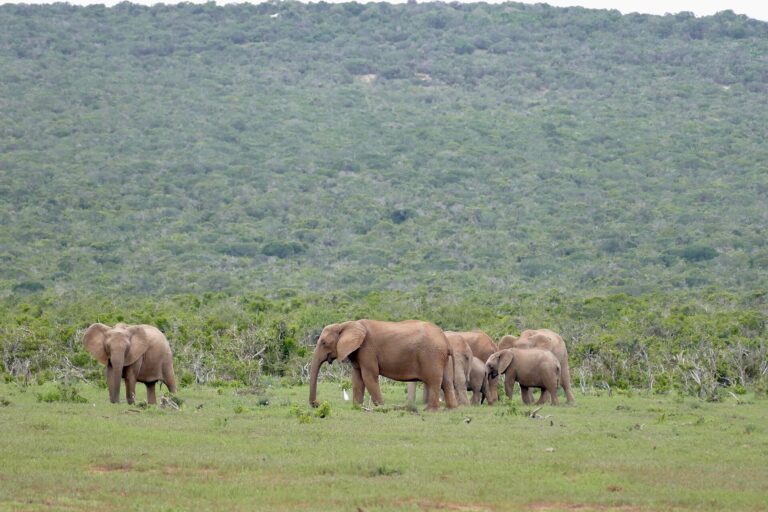
The research below concerns the African forest elephant of Central and West Africa. In March 2021 the IUCN listed it as Critically Endangered, after its numbers fell by more than 86% over 31 years, with poaching for ivory and habitat loss as the main causes. A survey report released in November 2025 put the population at about 135,690 in systematically surveyed areas, plus 7,728 to 10,990 in areas surveyed less reliably. Gabon holds 66% of them and the Republic of the Congo 19%.
For more on the species itself, including how it differs from the savanna elephant, see our African forest elephant guide.
How elephants thin a forest
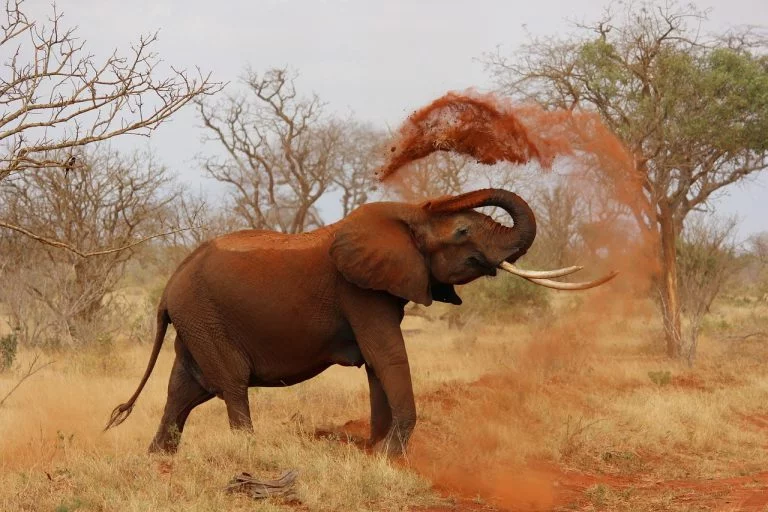
Forest elephants push through the understorey, trample young trees and eat others. In 2019 Fabio Berzaghi and colleagues fed that disturbance into a forest model called Ecosystem Demography and published the result in Nature Geoscience. Fewer stems meant less competition for light, water and space among the trees that remained. Over time the modelled forest shifted towards fewer, larger trees with denser wood.
That matters for carbon because dense wood holds more carbon in the same volume. The model estimated that elephant disturbance adds roughly 26 to 60 tonnes of aboveground biomass per hectare at typical elephant densities. Losing forest elephants altogether would cut aboveground biomass in central African rainforests by about 7%. The authors checked the model against tree inventory data from two lowland primary forests, and suggested elephants may help explain why African rainforests are built differently from the Amazon.
One detail is easy to miss. The same study found that elephants lower net primary productivity, the rate at which a forest adds new plant growth. A forest with elephants grows a little more slowly, yet stores more in the long run, because more of its mass ends up in big, slow, dense trees.
What they eat, and what they plant
The 2019 study treated elephants as thinners. A 2023 follow-up in PNAS, by Berzaghi, François Bretagnolle, Clémentine Durand-Bessart and Stephen Blake, looked at diet. The team combined unpublished field data with published browsing studies: 197,557 feeding records from 730 plant species whose wood density could be determined, plus nutritional data for 145 species.
Two patterns came out of it. Elephants prefer the leaves of low wood density trees, which are more palatable and easier to digest. Browsing pressure therefore falls on light-wooded, fast-growing species, and the dense ones get room to grow. Elephants also disperse the seeds of trees that are relatively large and have the highest average wood density of the dispersal groups the study compared. The authors describe forest elephants as moving more seeds of more species than any other animal.
Take the elephants away and both effects run in reverse. The study projects more fast-growing, low density trees and a 6% to 9% fall in aboveground carbon, driven by elephant-dispersed trees failing to regenerate. The two study sites gave different answers: 9.2% at LuiKotale, on the edge of Salonga National Park in the Democratic Republic of the Congo, and 5.8% in the Ndoki Forest of the northern Republic of the Congo. Our page on elephants in the DRC covers the Congo Basin populations in more detail.
Putting a price on it
In September 2020 the IMF magazine Finance and Development published an article by Ralph Chami, Connel Fullenkamp, Thomas Cosimano and Berzaghi that tried to value this service. They estimated that about 1.1 million forest elephants once lived across 2.2 million square kilometres, and that today’s population is about 9% of its size before poaching.
If forest elephants recovered to their former numbers and range, the authors estimated carbon capture would rise by 13 metric tons per hectare, which they give as more than 6,000 metric tons of carbon dioxide per square kilometre. At a carbon price of just under $25 per tonne of carbon dioxide, the 2019 average, they valued the service at over $150 billion, or more than $1.75 million per elephant. For comparison, they put the ivory from one poached elephant at about $40,000.
That per-elephant figure gets quoted a lot, often without its conditions. It is a modelled present value. It moves with the carbon price and the discounting, and it assumes the elephant lives out its life in the forest. Its use is as a comparison between a living elephant and a dead one, which is how the authors frame it.
Has anyone been paid for it?
I have not found a scheme that pays for forest elephants as carbon. The closest real example is forest carbon finance in Gabon, home to most of the remaining forest elephants. In 2021 Gabon became the first African country to be paid for protecting its forests: $17 million from Norway through the Central African Forest Initiative, the first part of a $150 million commitment made in 2019 and tied to deforestation rates in 2016 and 2017.
That payment was for avoided deforestation. Elephants were not part of the calculation, though in Gabon the overlap is large: the same report notes that 88% of the country is covered in tropical rainforest. If the research above holds, keeping those forests standing and keeping their elephants are closer to one goal than two.
The limits of the evidence
Both carbon estimates come from models, built on data from a small number of sites. The 2023 percentages come from two forests, and they differ from each other by several points. They are projections of a future without elephants, so the honest way to quote them is as a range with its source attached.
The research is also about one species. The 2023 authors point out that most of what we know about very large herbivores comes from African savannas, with much less known about forest species. I have not found a comparable carbon estimate for Asian elephants, which also live in forest, so I would not stretch these figures to them.
With those caveats, the two studies point the same way: these forests hold more carbon with their elephants than without them. That gives the decline of the African forest elephant a cost that reaches beyond the species. Our elephant conservation hub covers the protection work on the ground.
If you know of other research on elephants and carbon, especially anything on Asian elephants, please add it in the comments.