

Elephants in the Central African Republic: The Dzanga Bai
Last updated: October 14, 2026
4 min read
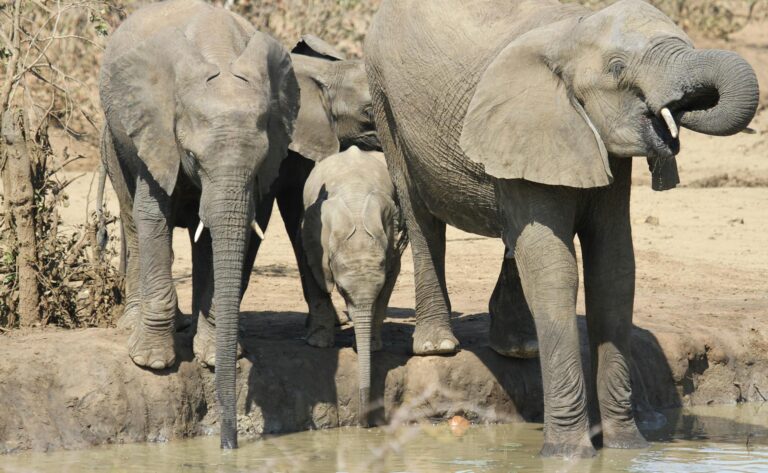
African elephant, Dzanga Sangha, Central African Republic (18322370163), by U.S. Fish and Wildlife Service Headquarters, Public domain, via Wikimedia Commons.
Almost all of the Central African Republic’s forest elephants live in one place: the Dzanga-Sangha protected areas in the far south-west, part of the Sangha Trinational World Heritage site shared with Cameroon and the Republic of Congo. At its heart is Dzanga Bai, a forest clearing where elephants gather every single day of the year.
The Dzanga Bai
Dzanga Bai is a natural clearing where mineral-rich water wells up through the swamp. Elephants come to drink it and to dig in the clay. Between roughly 40 and 100 animals use the bai on almost any given day, which makes it the largest reliable gathering of forest elephants known anywhere.
Andrea Turkalo began the study in 1990. Conflict forced her out in 2013, she returned in 2014, and the work produced a 27-year dataset. Elephants are recognised individually from ear tears and holes, tusk shape, tail form and body scarring. More than 4,000 individuals have been catalogued and over 1,000 followed for long enough to trace their life histories. That makes it the longest individual-based dataset on forest elephants in existence, and it is the source of most of what is known about the species’ demography: females first breed at around 23, and calve only every five or six years.
Dzanga is also one of very few places where forest elephants can be watched at close range, from viewing platforms built at the edge of the clearing.
Conservation pressures
The CAR has been in conflict since 2012. Dzanga-Sangha has held up better than most protected areas in the country, partly because of WWF’s long-term presence on the ground and partly because the BaAka, the indigenous forest people of the region, have retained a working relationship with the forest and the project.
In May 2013 armed poachers linked to the Seleka coalition occupied the bai and killed at least 26 elephants over several days. It drew international attention and enforcement was strengthened afterwards. The site’s daily elephant numbers have not collapsed since, which is the cleanest single indicator that the wider population is holding on.
Newer pressure comes from outside the reserve. Russia’s Wagner Group, now operating as Africa Corps, has had a documented presence in the CAR since 2018 and holds mining and logging interests near the elephant range, which UN Panel of Experts reporting has repeatedly flagged. Cross-border incursions from the north and east are a recurring threat. And because forest elephants breed so slowly, even modest annual losses cause demographic damage that takes decades to undo.
How many are there?
Dzanga-Sangha holds one of the country’s best-studied forest elephant populations. A reliable current national total is not available.
A national total for the CAR is harder to give with confidence. Outside the south-west there is very little surveyed elephant habitat left, and the security situation makes counting difficult. If you have access to a recent published national figure we have missed, leave a comment and we will update this section.
Visiting Dzanga
Tourism continues despite the regional instability, but operators are few and specialised, and access is via the town of Bayanga. Dawn and dusk visits to the platforms are the point of the trip.
There are two established places to stay. Doli Lodge, on the river at Bayanga, is the lodge run through the Dzanga-Sangha project itself and is the starting point for most official activities, including the bai visits and the BaAka tracker walks. Sangha Lodge, a little upriver, is a privately run lodge owned by Rod and Tamara Cassidy and is the other well-known base. Several specialist tour operators build CAR itineraries around Dzanga combined with the lowland gorilla habituation programme; check directly what each one contributes locally rather than assuming.
If you want to support the science rather than the trip, the long-running Dzanga monitoring work sits with the Wildlife Conservation Society and Cornell’s Elephant Listening Project, both of which take direct donations.
Read next
Frequently asked questions
How many elephants are in the Central African Republic?
Over 3,000 forest elephants are estimated for the Dzanga-Sangha protected areas, which hold the overwhelming majority of the country’s remaining population. A reliable national total is not currently available.
What is Dzanga Bai?
A natural forest clearing where mineral-rich water wells up through the swamp. Between about 40 and 100 elephants use it on almost any day of the year, and it is one of the few places on Earth where forest elephants can be watched reliably at close range.
Who is Andrea Turkalo?
An American researcher who began monitoring the Dzanga Bai elephants in 1990 and built the longest individual-recognition dataset on forest elephants anywhere, covering more than 4,000 identified animals.
Is it safe to visit the CAR?
Most of the country is not a tourism destination. Dzanga-Sangha in the south-west has maintained operations through the instability, but any visit should be arranged through an experienced specialist operator and checked against current travel advice.
What happened at Dzanga Bai in 2013?
In May 2013 poachers linked to the Seleka coalition occupied the clearing and killed at least 26 elephants over several days. The incident drew international attention and enforcement was strengthened afterwards.
Related reading
- Elephant Conservation 2026: How to Save the Last Giants: Poaching trends, the 1989 ivory ban, the zoo and sanctuary debate, trophy hunting.
- African Forest Elephant: The Critically Endangered Rainforest Species: A full species since the genetic split, Critically Endangered since 2021, and the tree-planter the Congo Basin cannot replace.
- Elephants in the DRC: Forest Elephants of the Congo Basin: The DRC holds most of Central Africa’s forest and almost none of its forest elephants.
- Elephant Family Structure: Matriarchs, Bond Groups and Bulls: What fifty years of continuous records at Amboseli show about elephant families: who leads, when bulls leave, and the experiments that proved older matriarchs really do know more.
Updated 14 September 2026: corrected the Dzanga study history and removed an unsupported count.




Dzanga Bai is the closest thing to a permanent elephant gathering anywhere on Earth. The mineral content draws them daily, year round. Anyone interested in forest elephant behaviour should treat the WCS camera-trap data from there as core reading.