10 Elephant Rescue Stories That Stayed With Us
Last updated: November 26, 2026
4 min read
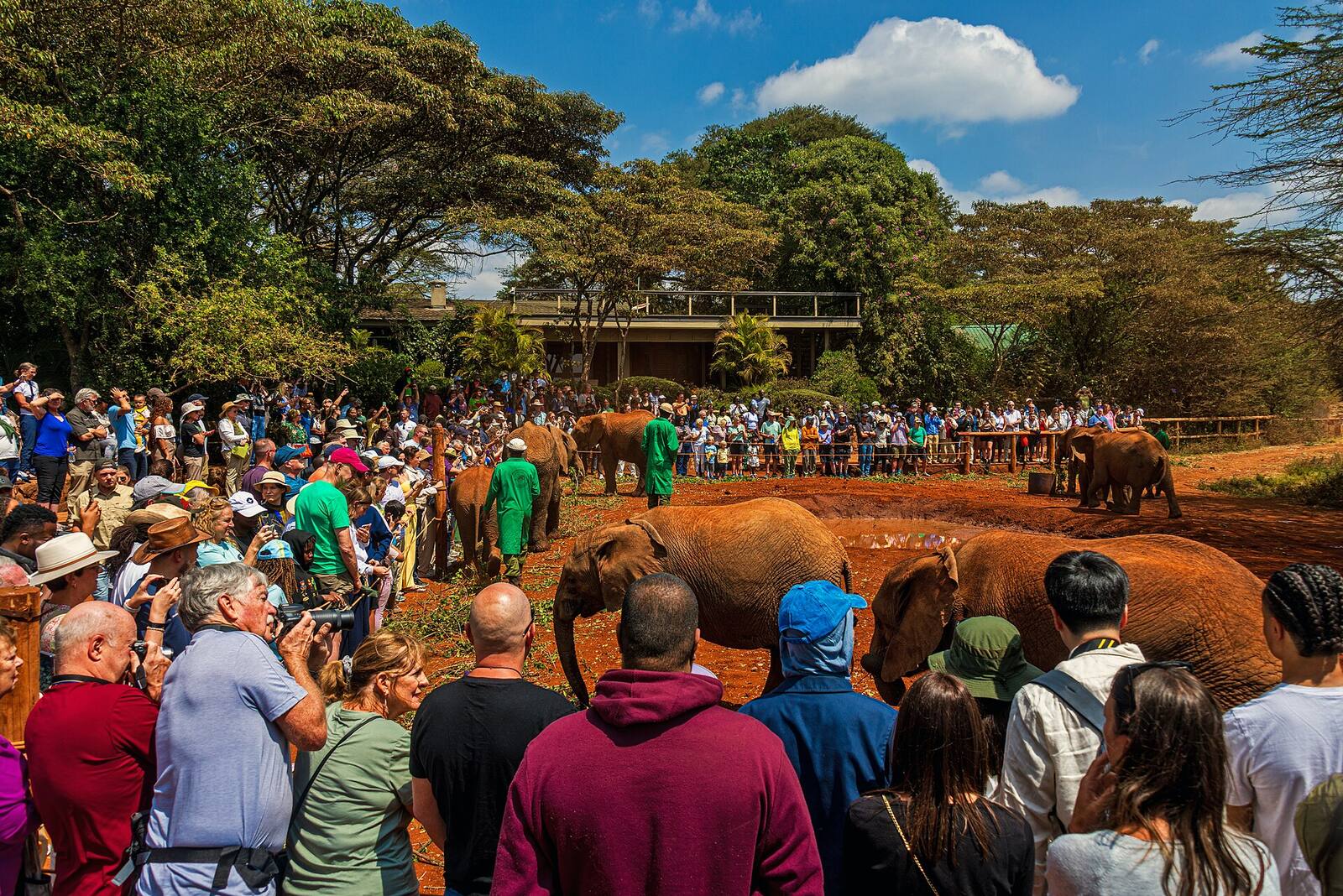
Tourists viewing orphaned elephants at Sheldrick Wildlife Trust, Nairobi, Kenya, by Daniel Case, CC BY-SA 4.0, via Wikimedia Commons.
The best rescue stories are the ones you can check. Every case below is on the record with the organisation that ran it, or with the news outlets that covered it at the time. Where the ending is unhappy, we have said so rather than tidy it up.
Orphan calves
1. Ndotto, Kenya, 2014. Herders in the Ndoto Mountains of Samburu found a newborn calf sheltering among their goats and sheep. He was roughly 48 hours old with the umbilical cord still attached, the smallest elephant the Sheldrick Wildlife Trust had ever taken in, and the area had no roads, so the rescue was flown. He was raised at the Nairobi nursery and later moved to the Voi reintegration unit in Tsavo, where he is now one of the larger characters in the orphan herd.
2. Khanyisa, South Africa, 2020. An albino calf found on 7 January 2020 near Hoedspruit with a poacher’s snare wrapped around her head. Vets estimated she had been trapped in it for about four days. The snare took the top lobe off her left ear and cut deep into her cheeks and neck. She was raised at HERD, the Hoedspruit Elephant Rehabilitation and Development orphanage, and integrated with the Jabulani herd. Her colour made her a news story. The snare is the part worth remembering.
Snare and gunshot survivors
3. Ben, Zimbabwe, 2016. A bull walked up to the staff houses at Bumi Hills Safari Lodge on 28 May 2016 with a bad limp, two bullet holes through his left ear and a septic wound in his left shoulder, apparently from a failed poaching attempt. The Bumi Hills Anti-Poaching Unit called in the wildlife vet Richard Hoare, who flew in and treated him that afternoon. He recovered.
4. Footloose, Botswana, 2019. A young bull with a snare around a front leg, spotted near Camp Kazuma, which called in Elephants Without Borders to help. The snare was cut away and the lodge named him afterwards. Elephants Without Borders runs this kind of call-out often enough that it is a standing part of its wildlife rescue work rather than a one-off.
Captive cases
5. Mali, Philippines, 1977 to 2023. Born in Sri Lanka in 1974 and given to the Philippines in 1977, Mali was the only elephant in the country and spent more than four decades alone at Manila Zoo. A long campaign to move her to a sanctuary never succeeded, and she died there on 28 November 2023 of congestive heart failure. She is here as a difficult case, not a success.
6. Tarra and Bella, Tennessee, 2003 to 2011. Tarra, a former circus elephant at the Elephant Sanctuary in Tennessee, formed a close and much-filmed attachment to a stray dog named Bella. The friendship lasted until Bella died in 2011.
Larger scale
7. Akashinga, Zimbabwe, ongoing. The all-female ranger unit run by the International Anti-Poaching Foundation began patrolling the Phundundu Wildlife Area, a former trophy hunting concession in the Zambezi Valley, in 2017. By the end of 2019 its work was credited with an 80 percent fall in elephant poaching across the mid and lower Zambezi Valley, achieved alongside more than 300 arrests without a shot fired.
8. Gorongosa, Mozambique, ongoing. The park’s large mammals were all but wiped out during the civil war, elephants included, falling from roughly 2,500 to fewer than 250. Under the Gorongosa Restoration Project, the partnership formed in 2008 between the Mozambican government and a foundation set up by the American philanthropist Greg Carr, the elephant population has climbed back to around 800.
The people behind the work
9. Daphne Sheldrick, 1934 to 2018. Founded the orphan nursery in Nairobi that carries her husband’s name and worked out the milk formula that finally let hand-reared elephant calves survive infancy. Her milk formula enabled many hand-reared elephant calves to survive infancy.
10. Lek Chailert, born 1961. Founded Elephant Nature Park near Chiang Mai in the mid 1990s and built the template the Thai sanctuary sector now copies: no riding, no shows, no bullhooks. She has been threatened and sued by the tourist-camp trade for it and is still working.
Frequently asked questions
What is the most famous elephant rescue organisation?
The Sheldrick Wildlife Trust in Nairobi, Kenya, founded by Daphne Sheldrick and known as the David Sheldrick Wildlife Trust until 2019. It runs the best-known orphan nursery and reintegration programme in the world.
Can you really raise an orphan baby elephant on cow milk?
No. Calves fed cow milk sickened and died, and working out why took Daphne Sheldrick the better part of three decades. The answer was the fat. She built the formula on SMA, a human infant milk, and used coconut oil as the closest available match for the fat in elephant milk.
Is there an elephant sanctuary in the US?
Yes. The Elephant Sanctuary in Tennessee, at Hohenwald, takes retired zoo and circus elephants. It is closed to the public by design, so there is nothing there for a visitor to see.
How has Gorongosa’s elephant population recovered?
From fewer than 250 after the civil war to around 800 today, under the Gorongosa Restoration Project. Sustained anti-poaching plus the natural breeding of the survivors did most of the work.
Who founded Elephant Nature Park?
Lek Chailert, near Chiang Mai in northern Thailand, in the mid 1990s.
Each account below is limited to details supported by named historical, institutional or field sources. If you know of a documented elephant rescue we have missed, especially one from Asia, leave a comment and point us at the source.
- Elephant Conservation 2026: How to Save the Last Giants: Poaching trends, the 1989 ivory ban, the zoo and sanctuary debate, trophy hunting.
- How the David Sheldrick Wildlife Trust Raises Orphan Elephants: 327 orphans raised, 94 wild-born calves since, and a milk formula that first worked in 1974.
- Ethical Elephant Sanctuaries: No Rides, No Shows, and Where to Go: How to tell a real sanctuary from a camp, which lists to trust, and sanctuaries checked in Thailand, India, Kenya, Europe and the US.
- Elephants in Mozambique: Gorongosa and the Recovery Story: Mozambique’s 2025 national census counted 22,718 elephants, more than double the 2018 figure, and the carcass ratio collapsed from 48 percent to under 5.
Updated 14 September 2026: removed unsupported rescue-story claims.