Can Elephants Run? What Gait Measurements Show
5 min read
Watch an elephant charge and your eyes report a run. The ears flare, the dust rises, and an animal weighing several tons covers ground faster than you can back away. Yet if you slow the footage down, something odd shows up. At no point does the whole animal leave the ground.
That one detail has kept biomechanics researchers busy for years, and the answer to “can elephants run?” turns out to be yes and no, depending on how you define running.
What the footfall pattern shows
Most four-legged mammals change gait as they speed up. A horse walks, then trots, then canters, then gallops. Elephants do not. A 2008 study notes that elephants do not normally trot or gallop, even as juveniles, but can move smoothly to fairly fast speeds, about 6.8 metres per second, without changing their footfall pattern. That is the speed reported in the 2003 Nature paper Are fast-moving elephants really running?, which used video analysis of Asian elephants.
The 2008 study also states that across the whole speed range, an elephant constantly keeps at least one foot on the ground. There is no suspended moment, the instant when every foot is in the air that defines a gallop or a sprint in a dog or a horse.
The 2010 PNAS study, covered below, found that elephant limbs are compliant enough to keep peak forces low even in walking.
The speed ceiling
Elephants are quick enough to matter if you meet one on foot. A 2010 study in PNAS reports that they seem unable to exceed about 7 metres per second, or 15 mph. That is roughly 25 kilometres an hour, which matches the fastest reliably measured speed we cover in our post on elephant myths.
Bigger does not mean faster, and it does not mean slower by a fixed rule either. A 2025 analysis in Scientific Reports compared body mass and top speed across mammals and found that live elephants consistently move below the lower bounds predicted by the mass and speed models. In plain terms, an elephant is slower than its size alone would suggest. The authors also point out that the fastest animals are not the largest.
A body built like a set of stilts
Part of the story is how the legs are built. A 2025 comparison of skeletons in the Journal of Anatomy found that elephant limbs are very tall, behind only the giraffe among large hoofed mammals, and that the height comes from the upper segments of the limb. The authors say this lets elephants use straight-legged walking that works like an inverted pendulum, where the body vaults over the planted leg.
An inverted pendulum is an efficient way to move at a steady pace. It saves energy because the body swings up and over each leg and recovers much of the movement. It works best at slow speeds, though, and elephants lose that advantage as they hurry.
Bouncing on pogo sticks
This is where the running question gets interesting. In 2008, researchers fitted African and Asian elephants at two safari parks with motion sensors and recorded hundreds of strides at speeds from 0.5 to 3.5 metres per second. They found that African and Asian elephants moved very similarly.
At gentle walking speeds the elephants vaulted over stiff legs like the pendulum above. As they sped up, the mechanics changed gradually. By about 2.2 metres per second, the hind legs were no longer vaulting. The authors write that elephants begin using their compliant hindlimbs like pogo sticks, bouncing over relatively stiff front legs. They concluded that elephants use regular walking and at least one form of running gait.
The 2010 PNAS work supports this. It states that at faster speeds elephants switch to biomechanical running, that is, bouncing, with no discrete gait transition. So the shift from walk to run is smooth rather than a clear step, and no aerial phase appears even when the bouncing begins.
So the answer depends on the definition. If running means “all feet off the ground at once”, elephants never run. If it means “the body bounces on springy legs instead of vaulting over stiff ones”, they do, and they start doing it at a speed well below their top pace.
Compliant legs, not columns
The usual picture is of elephant legs as stiff columns. The PNAS team tested that. Using force plates and motion cameras on elephants in Thailand, they found the limbs are remarkably compliant even in walking, which keeps peak forces low. Their measure of mechanical advantage in the limb joints (how well the muscles pull against the load) came out at roughly one-third of what the elephant’s size predicts. It was lower than in horses, which have a tenth of the mass, and close to the value for human limbs.
That mechanical advantage also drops as elephants speed up, much as it does when people shift from walking to running. The muscles then have to work harder, and more muscle gets recruited with each step. The authors suggest that this low mechanical advantage could help keep elephants from reaching high speeds, and that the energy cost limits their endurance.
The same study found that front and hind legs share the work of braking and pushing. Many four-legged animals split those jobs between the ends of the body. Elephants behave, the authors write, like four-wheel-drive vehicles.
What this means in the field
None of this makes an elephant safe to approach. A pace of 7 metres per second can cover a short gap in seconds. The soft pads under the feet, which we describe in our piece on elephant feet, showed up in the 2008 data as well. The researchers noted that the foot sensors gave a much lower peak at touchdown than at lift-off, presumably because of the large, soft foot pads.
The research also leaves questions open. The experiments used elephants in safari parks and in Thailand, either in open fields or along a straight, level path, with food rewards at the fastest speeds. They did not measure wild elephants that are truly alarmed, on uneven ground. Neither study reached the ceiling itself. The 2008 recordings stopped at 3.5 metres per second and the 2010 recordings at 4.83. The figure of about 7 comes from earlier work, and the 2006 study of 14 African and 48 Asian elephants puts the fastest reliably recorded speed at 6.8.
Sources
- Ren, Miller, Lair and Hutchinson, limb compliance and power in elephants (PNAS, 2010)
- Ren and Hutchinson, The three-dimensional locomotor dynamics of African and Asian elephants reveal a smooth gait transition at moderate speed (Journal of the Royal Society Interface, 2008)
- Hutchinson et al., The locomotor kinematics of Asian and African elephants: changes with speed and size (Journal of Experimental Biology, 2006)
- Hutchinson et al., Biomechanics: Are fast-moving elephants really running? (Nature, 2003)
- The body mass-maximum speed relationship and the athletic capability of giant proboscideans and sauropods (Scientific Reports, 2025)
- Comparative study of the body proportions in Elephantidae and other large herbivorous mammals (Journal of Anatomy, 2025)
Have you watched elephants move up close, or seen footage that shows how they pick up speed? Tell us what you noticed in the comments.
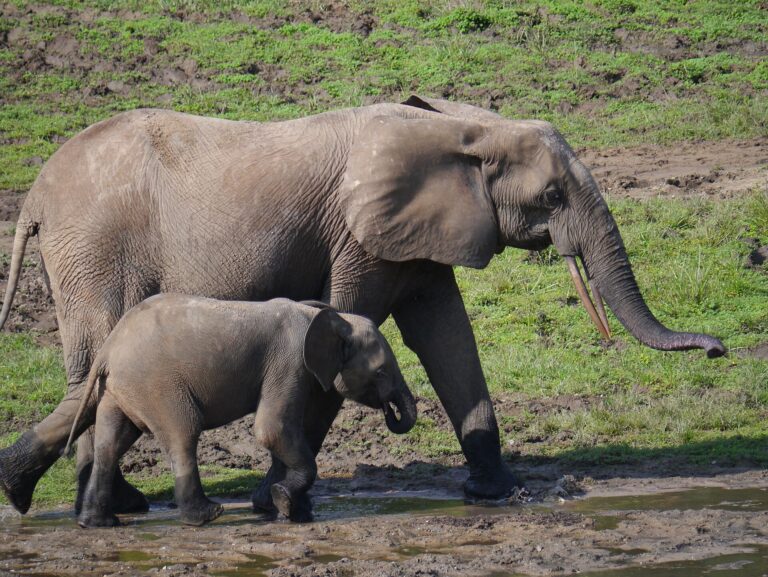
Photo: Candy Piercy, CC0, via commons.wikimedia.org.