Elephant Evolution: Mammoths, Mastodons and Living Elephants
4 min read
Three elephant species walk the Earth today. For most of the last 60 million years the family was far bigger. Researchers have described more than 180 extinct members of the order that holds elephants, called Proboscidea, according to the Wikipedia overview of the group. Most of them are gone, but their DNA is still readable, and it tells a stranger story than the old family tree drawings.
It started small
The earliest known proboscidean, Eritherium, lived in Africa in the Paleocene, around 60 million years ago. It weighed about 3 to 8 kilograms. That is closer to a large cat than to anything with a trunk. Moeritherium, a later relative, is suggested to have been semi-aquatic.
Size, tusks and trunks came later. The skull grew, the neck shortened to carry it, and the nose stretched into a long, muscular trunk to reach food from a body that could no longer bend down easily. The second upper incisor became a tusk that never stops growing. The teeth changed too: molars stopped being replaced from below and began moving forward from the back of the jaw. The result is the tooth conveyor belt described in our post on elephant teeth across a lifetime.
The family tree, from DNA
Fossils show the shape of a family. DNA shows who was closest to whom. A 2007 study in PLoS Biology sequenced the complete mitochondrial genome of an American mastodon from an Alaskan fossil between 50,000 and 130,000 years old. The authors used it as an outgroup and put the mastodon split from the elephant line at 24 to 28 million years ago (Rohland et al.).
From that anchor they dated the branching inside the elephant family:
- African elephants split from the line leading to mammoths and Asian elephants about 7.6 million years ago.
- Mammoths and Asian elephants parted about 6.7 million years ago.
- The African savanna and forest elephant lines diverged about 4.0 million years ago, by their estimate.
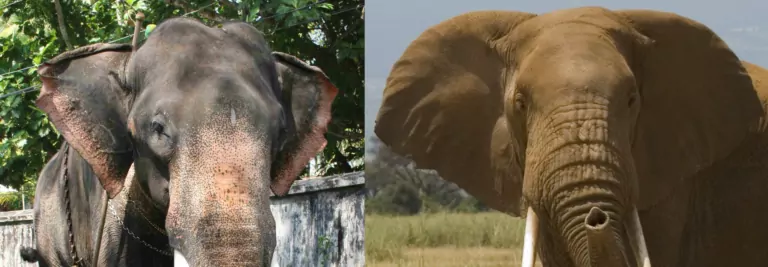
That means a woolly mammoth was a closer cousin of the Asian elephant than the Asian elephant is of either African species. A mammoth was not a hairy African elephant. Our comparison of the Asian and African elephants shows how different the living branches already are.
Hybrids everywhere
The tidy branching tree took a hit in 2018. A team that included Elle Palkopoulou and David Reich reported 14 genomes in PNAS: two from American mastodons and twelve from living and extinct elephantids, including a straight-tusked elephant about 120,000 years old, a Columbian mammoth and woolly mammoths. Their finding was that interspecies hybridisation has been a recurrent feature of elephantid evolution (Palkopoulou et al.).
The straight-tusked elephant is the clearest case. Most of its ancestry came from a lineage related to the ancestor of African elephants. A large share came from a lineage related to forest elephants, and another from one related to mammoths. Columbian and woolly mammoths also showed signs of interbreeding in North America.
Forest and savanna elephants kept apart
The same study found the opposite pattern between the two African species. Their ancestors were almost completely isolated from each other for about 500,000 years. The authors say this gives compelling justification for treating forest and savanna elephants as separate species. The IUCN has assessed them separately since 2021. For the species themselves, see our guide to the African forest elephant and the post on how many elephant species exist.
The two papers differ on the date of the African split: about 4.0 million years in 2007, and a long period of near-isolation lasting about 500,000 years in 2018. They measure different things, so treat the numbers as a range of evidence and not a single settled date.
Shrinking on islands, vanishing on Wrangel
When sea levels isolated elephant populations on islands, some shrank. Elephas falconeri of Malta and Sicily stood about 1 metre tall. The pygmy mammoth of California’s Channel Islands descended from Columbian mammoths and reached 1.2 to 1.8 metres, per the Wikipedia overview. A living echo of this idea is the small elephant of Sabah, covered in our Borneo post, though it is not a dwarf species in this fossil sense.
By the start of the Late Pleistocene there were around 23 proboscidean species. Then came a steep decline. Woolly mammoths lasted longest on Wrangel Island. A 2024 study in Cell analysed 21 Siberian woolly mammoth genomes. Mammoths became isolated there around 10,000 years ago and survived more than 200 generations, going extinct about 4,000 years ago. The population recovered quickly from a severe bottleneck and stayed stable for six millennia. Even so, mildly harmful mutations built up over time, which the authors read as inbreeding depression lasting for hundreds of generations (Dehasque et al.).
The paper does not say what finally ended the Wrangel mammoths, and neither can we. It does show that a population can look stable and still carry a genetic cost for a very long time.
What it means for living elephants
Three species remain out of at least 180 known. Each one holds a share of a lineage that is millions of years old, and the genetic record says that small, isolated groups pay a price for generations. That is one reason corridors and connected habitat matter so much for the Asian and African populations we write about here.
Do you know a fossil, museum skeleton or study we should cover next? Add what you know in the comments.
Sources
- Palkopoulou et al., “A comprehensive genomic history of extinct and living elephants,” PNAS, 2018
- Rohland et al., “Proboscidean mitogenomics,” PLoS Biology, 2007
- Dehasque et al., “Temporal dynamics of woolly mammoth genome erosion prior to extinction,” Cell, 2024
- Proboscidea, Wikipedia
Photo: HTO, Public domain, via commons.wikimedia.org.