Tuskless Elephants: How Poaching Changed Gorongosa’s Herd
4 min read
A tusk is a handy tool for an African savanna elephant. It digs for water, strips bark from trees and settles arguments with other elephants, as NPR and the Associated Press describe it. In one Mozambican park, though, the same pair of tusks became a death sentence. The survivors of a war on elephants were mostly the ones born without them.
That story comes from Gorongosa National Park. It shows people changing the biology of a wild animal in a matter of years. Here is what the researchers found, how the trait is passed on, and what is still unknown.
A war fought with ivory
Mozambique’s civil war ran from 1977 to 1992. According to the Sci.News summary of the study, armed forces on both sides relied on the ivory trade to pay for the fighting. In the area that is now Gorongosa, around 90 percent of the elephants were killed (NPR). For the background on the park and its rebuild, see our guide to elephants in Mozambique.
Poachers chose animals with big tusks. An elephant that never grew tusks had nothing worth taking, so it was far more likely to live through the war.
What the survivors looked like
Before the war, less than a fifth of the park’s females were tuskless. Among the survivors, about half were (NPR). Tusklessness had been a rare trait. After the war it was common.
The team led by Shane Campbell-Staton at Princeton University published the work in the journal Science in October 2021 (Campbell-Staton et al., Science). They used historical field data and population modelling, and the authors report that poaching produced strong selection that favoured tusklessness while the population collapsed. Campbell-Staton said the years of unrest “changed the trajectory of evolution in that population” (NPR).
The researchers did not rely on one headcount. Biologists in Mozambique, including Dominique Goncalves and Joyce Poole, watched the park’s roughly 800 elephants over several years and built a catalogue of mothers and their offspring. That record is what let the team trace who passed the trait to whom.
How the trait is inherited
Whether an elephant grows tusks is set by genes, in the way eye colour is in people (NPR). The Gorongosa pattern pointed to a particular kind of inheritance. About half the daughters of tuskless mothers were tuskless. Two thirds of their offspring were female. And the study found a stark lack of tuskless males (Sci.News).
The authors concluded that the survey data fit a trait carried on the X chromosome that is dominant and lethal to males. In plain terms, a female needs only one altered copy to be tuskless. If the same copy is passed to a son, the researchers think he likely dies early in development, as a miscarriage, according to co-author Brian Arnold (NPR). That would explain why daughters outnumber sons among the offspring of tuskless mothers.
To look for the genes, the team took blood samples from seven tusked and eleven tuskless females and compared their DNA (NPR). Two candidate genes stood out, AMELX and MEP1a. Both have known roles in mammalian tooth development, including the formation of enamel, dentin, cementum and the tissue that anchors a tooth (Science abstract).
There is a human parallel. One of those genes, AMELX, is linked to an X-linked dominant syndrome in people that is lethal to males and reduces the growth of the upper lateral incisors. Those teeth are the human counterpart of an elephant’s tusks, since a tusk is an elongated upper incisor. Our post on how elephant tusks grow and work covers the anatomy.
Not only Gorongosa
Joyce Poole, scientific director of ElephantVoices and a co-author, had already seen disproportionately large numbers of tuskless females after heavy poaching in Uganda, Tanzania and Kenya (NPR). She said she had been puzzling for a long time over why it is the females who lose their tusks. The Gorongosa study offers an answer: if the gene sits on the X chromosome and kills male embryos, tusklessness will show up in females.
Researchers who were not part of the work welcomed it. Chris Darimont of the University of Victoria called it the “smoking-gun evidence for genetic changes.” Samuel Wasser of the University of Washington pointed to the speed: selection for tusklessness happened over about 15 years, which he called one of the most astonishing findings. Most of us picture evolution as something that takes hundreds or thousands of years.
What a tuskless herd eats
Tusks are working equipment, so losing them may change how elephants use the land. Preliminary analysis of dung samples suggests the Gorongosa elephants are shifting their diet. Without long incisors to peel bark from trees, the tuskless females ate mostly grass, while tusked animals ate more legumes and tough woody plants, said Princeton biologist Robert Pringle (NPR). He expects the changes to last for at least several elephant generations.
This matters because elephants shape their habitat. The paper calls the species a keystone, and the authors note that human-driven selection on traits like these can have cascading effects on how an ecosystem works (Sci.News). Nobody has yet measured those effects in full.
What we still do not know
- How the trait behaves over many more generations. The studies so far cover one park and one war.
- Whether the ecosystem effects of a diet shift are large or small. The dung analysis was described as preliminary.
- How common the same genetic change is in other poached populations. Poole saw similar patterns in three other countries, but the genetic work here covers Gorongosa.
Tusklessness does not make elephants safe. Ivory still drives killing, and the trade remains one of the main threats to the species. Our plain-language guide to the ivory trade explains how it works. Gorongosa shows how long the effects of that trade can outlast the shooting.
If you have watched elephants in a park where poaching was heavy, or know of other research on tusklessness, add what you know in the comments.
Sources
- Elephants have evolved to be tuskless because of ivory poaching, a study finds (NPR, with the Associated Press, 22 October 2021)
- Campbell-Staton et al., “Ivory poaching and the rapid evolution of tusklessness in African elephants,” Science 374(6566): 483 to 487, 2021 (abstract, as indexed by Europe PMC)
- Study: Intense Ivory Poaching Resulted in Rapid Evolution of Tusklessness in African Elephants (Sci.News, 22 October 2021)
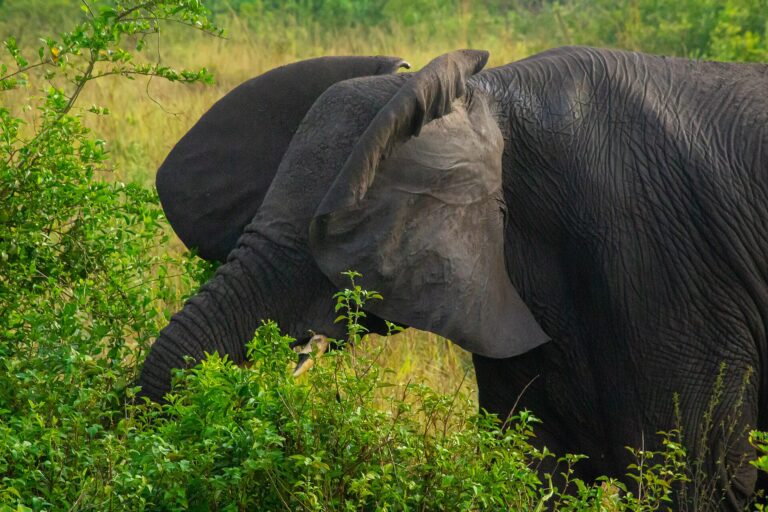
Photo: Bernard Dupont, CC BY-SA 2.0, via commons.wikimedia.org.