The 2020 Botswana Elephant Die-Off: What the Evidence Says
4 min read
In May and June 2020, aerial surveys over the Okavango Panhandle in northern Botswana found elephant carcasses. First 169, then, a month later, around 350. They were all ages and both sexes, the tusks were still on them, and many had fallen on their faces, which suggests a fast collapse rather than a slow decline. Poaching was ruled out early. Anthrax was ruled out. Then the answer went missing for four years.
Why the cause was so hard to pin down
The die-off happened in a remote part of a large country during the first year of the COVID-19 pandemic. Getting fresh tissue out of a carcass in the Panhandle and into a laboratory that could run a toxin panel was slow, and elephant tissue degrades quickly in that heat. Most of the samples that reached a lab were already too far gone to be conclusive.
In September 2020 the Botswana Department of Wildlife and National Parks announced that cyanobacterial neurotoxins had been detected and named them as the cause. That answer was widely reported and widely doubted, because the government did not release the underlying data, and because it did not explain why only elephants died when every other animal in the Panhandle drinks from the same water.
What the satellite data showed
In late 2024 Davide Lomeo and colleagues at King’s College London published a study in Science of the Total Environment that took a different route to the question. Rather than chase tissue samples, they went back through satellite imagery.
The team mapped roughly 3,000 seasonal pans across the area and tracked their water levels and algal activity from 2015 to 2023, then compared that record against where the carcasses were found. Twenty pans close to fresh carcasses showed satellite indicators consistent with 123 algal bloom events during 2020, against 23 in the previous three years combined, and the highest average phytoplankton biomass in the nine-year record.
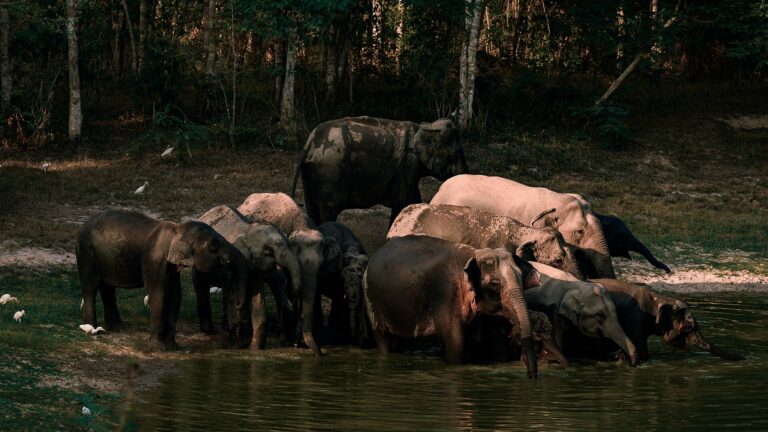
The blooms were in seasonal, rain-fed pans rather than the permanent rivers and lagoons. That detail matters, because it explains the species pattern. Elephants drink far more than anything else in the landscape, they wallow in the shallow pans that concentrate a bloom, and they suck water up a trunk from near the surface where the scum sits.
The weather that caused it
The mechanism the study describes is a whiplash from drought to flood. 2019 was extremely dry in the region. Organic material and nutrients built up in the dry pan beds with nothing to flush them. 2020 was extremely wet. The rain refilled the pans quickly, suspending all of that accumulated nutrient load at once, in shallow warm water under strong sun. That is close to a laboratory recipe for a cyanobacteria bloom.
Dry-to-wet swings of that severity are one of the better established consequences of a warming climate in southern Africa, which is why the study was reported as a climate story rather than a toxicology one. It fits the pattern we covered in climate stress across elephant range.
How fast it killed
The spatial analysis put the elephants’ likely survival time after exposure at up to about 88 hours. That is consistent with the carcass distribution: animals drank, walked some distance, and died at varying points away from the pan. It also explains why the deaths looked scattered and random on a map rather than clustered around a single poisoned waterhole.
What is still not proven
The 2024 study is remote sensing and spatial statistics. It shows an extraordinary bloom in exactly the right pans at exactly the right time, and it shows that carcass locations line up with those pans. It does not put a measured cyanotoxin concentration in a dead elephant, because those samples no longer exist.
So the honest description is a very strong circumstantial case that matches the government’s 2020 conclusion, rather than a closed file. A few researchers still argue for a pathogen that was never isolated. Given that the alternative explanations have had six years and produced nothing, the bloom hypothesis is where the weight of evidence sits.
Why it matters beyond 2020
Botswana holds the largest elephant population in the world, 131,909 in the 2022 KAZA-wide aerial survey, and a large share of them depend on seasonal pans in exactly this kind of landscape. If the die-off was driven by a rainfall whiplash, it is repeatable, and it is not something anti-poaching patrols can prevent.
The practical response is monitoring. Satellite bloom detection over pan networks costs a fraction of an aerial carcass survey, and the method the study used retrospectively could be run live as an early warning system.
Frequently asked questions
How many elephants died in Botswana in 2020?
Around 350, found in the Okavango Panhandle in northern Botswana between May and July 2020. An initial survey counted 169 and the total roughly doubled a month later.
What killed the Botswana elephants?
Cyanotoxins remain the leading hypothesis. Botswana named them as the cause in 2020, but the 2024 satellite study said the evidence remained inconclusive and that cyanobacterial toxicity could have contributed.
Was poaching responsible?
No. The tusks were intact on the carcasses, and there were no gunshot or wire injuries. Poaching was ruled out within weeks.
Why did only elephants die?
Exposure. Elephants drink far more water than other species, wallow in shallow pans, and draw water from near the surface where a bloom concentrates. Body size does not protect an animal that takes in a much larger dose.
Could it happen again?
It could. If the cyanobacterial-toxin explanation is correct, similar dry-to-wet swings could recreate the risk. Satellite monitoring may help identify unusual blooms, but it does not identify the toxin itself.
Sources
- Lomeo, Tebbs, Babayani and colleagues, “Remote sensing and spatial analysis reveal unprecedented cyanobacteria bloom dynamics associated with elephant mass mortality”, Science of the Total Environment 957, article 177525, December 2024
- King’s College London, satellite evidence bolsters case that climate change caused the mass die-off
- Plymouth Marine Laboratory on the same paper
- CNN, Botswana says cyanobacteria caused the elephant deaths, September 2020
- Azeem and colleagues, “The 2020 elephant die-off in Botswana”, 2020
Related reading
- Elephant Conservation 2026: Poaching trends, the ivory ban, trophy hunting and the community conservancy model.
- Elephants and Water: How much an elephant drinks, and why the pan matters more than the river.
- Elephant Poaching Trends: What the MIKE data shows about the threat that gets all the attention.
- Mali’s Desert Elephants: A herd that survives on seasonal water in a far harder landscape.
Updated 14 September 2026: qualified the cyanotoxin hypothesis.