Elephants in Botswana: Africa’s Largest Population
Last updated: October 25, 2026
9 min read
Botswana holds 131,909 elephants, counted in the north of the country by the 2022 KAZA aerial survey. That is the largest national population in Africa. When the Great Elephant Census counted 352,271 savanna elephants across 18 countries in 2014 and 2015, more than a third of them were in Botswana. A herd this size puts Botswana at the centre of the arguments over elephant density, trophy hunting, ivory and the cost to farmers.
The animal: the African savanna elephant
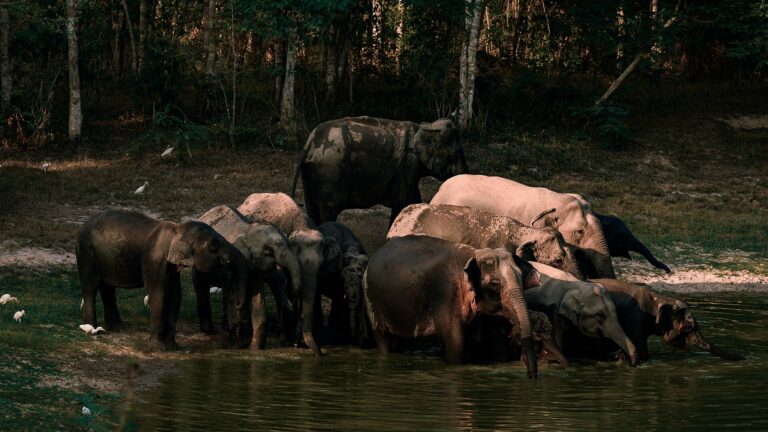
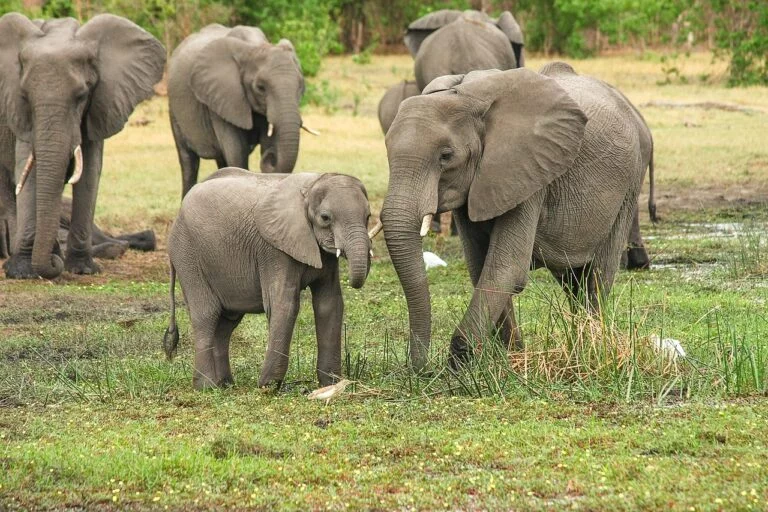
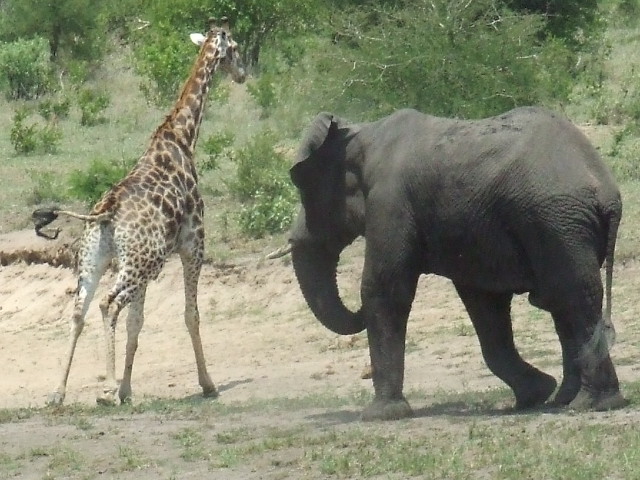
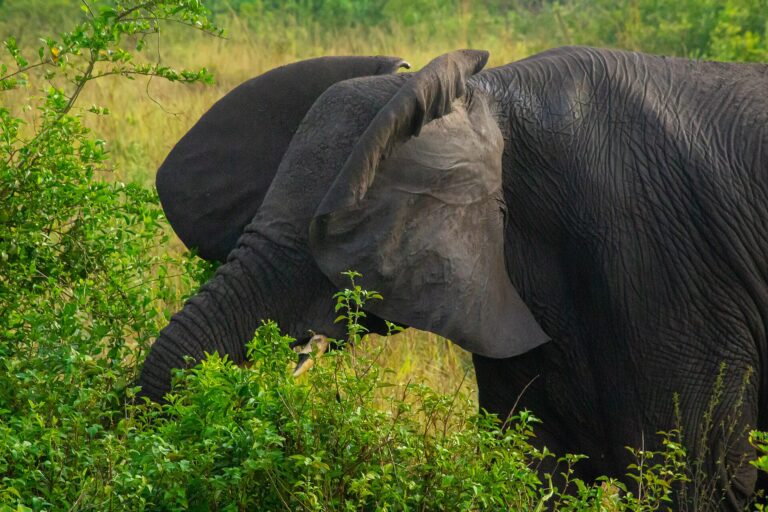
Botswana’s elephants are African savanna elephants, Loxodonta africana, also called bush elephants, the largest land animal alive today. They are easy to tell from Asian elephants by their large ears, shaped roughly like the African continent, and by the fact that both sexes typically carry tusks. They are also dryland specialists, well suited to the savanna, mopane woodland and river systems that define northern Botswana.
Where they live
The great majority of Botswana’s elephants are in the north of the country, across three connected systems:
- Chobe National Park: one of the densest dry-season gatherings of elephants in Africa, along the Chobe river, where herds come down to the permanent water. Boat cruises from Kasane let visitors watch family groups drink and cross the river at sunset.
- Okavango Delta: elephants all year in a delta where the Okavango river fans out into the Kalahari sands and never reaches the sea. Groups here are smaller, and from a mokoro (dugout canoe) visitors can watch elephants wade and swim between the islands.
- Linyanti and Savuti: a mix of dry grassland and woodland that holds consistent populations through the year.
Smaller numbers occur in the Tuli Block in the east, with seasonal movements of elephants out of Hwange in neighbouring Zimbabwe. Further south, large groups of bulls gather along the Boteti river in Makgadikgadi Pans National Park in the dry season. The river flows again after 18 dry years, and Elephants for Africa, which studies the bulls there, sees very few breeding herds. Botswana’s elephants do not stay neatly inside one park, which is exactly why the regional picture matters so much.
How many elephants, and who counted them
Botswana’s elephants are counted from the air. In the 2022 KAZA survey, crews flew more than 67,000 kilometres of transects, counting live elephants and carcasses, and the totals were scaled up to the whole area. The result is an estimate with a margin of error, so the trend across several surveys tells you more than any single count.
The recent counts line up closely. The Great Elephant Census put Botswana at 130,451 in 2015, as Mongabay’s 2024 analysis reports. The IUCN African Elephant Status Report of 2016 gave 129,939. The KAZA survey, flown from August to October 2022 and released in August 2023, gave 131,909. The KAZA Secretariat’s results table lists the 2016 and 2022 figures side by side.
Numbers were lower a generation ago. Aerial surveys of northern Botswana began in 1973, and a 1998 review in Pachyderm estimated about 80,000 elephants, growing about 6 percent a year since 1987. Growth has since slowed sharply. A 2021 report by Botswana’s Department of Wildlife and National Parks extrapolated 6 percent a year from an older survey, but Elephants Without Borders, the research group led by Mike Chase, found numbers in northern Botswana essentially unchanged between 2010 and 2022, growing about 1 percent a year. The population is large and broadly stable.
KAZA: elephants without borders
Botswana’s herd is the core of something bigger. The Kavango-Zambezi Transfrontier Conservation Area, known as KAZA, stitches together protected land across five countries: Botswana, Zambia, Zimbabwe, Namibia and Angola. It covers about 520,000 square kilometres, according to the KAZA Secretariat. It is by a wide margin the largest elephant range in Africa, and its whole purpose is connectivity, keeping the elephant subpopulations of those five countries linked rather than marooned in separate islands of habitat.
The KAZA survey, flown between August and October 2022, counted an estimated 227,900 elephants across the zone. Botswana held 131,909 of them, about 58 percent, followed by Zimbabwe with 65,028, Namibia with 21,090, Angola with 5,983 and Zambia with 3,840. Set against the 352,271 savanna elephants of the Great Elephant Census, that means most of the species lives in this one cross-border zone. Elephants cross these borders freely, which is why the five governments now count them together. Our profile of elephants in Zimbabwe covers the second largest share.
One caveat on the arithmetic: the African savanna elephant and the African forest elephant are separate species, assessed separately by the IUCN, and forest elephants (135,690 in systematically surveyed areas, in an IUCN report released in November 2025) live in the forests of Central and West Africa, nowhere near KAZA. Any figure that folds both into one “African elephant” number will mislead you.
Density, vegetation and the offtake argument
Elephants are heavy feeders and shape their habitat. They strip bark, push over trees and clear scrub. Northern Botswana has some of the highest local elephant densities in Africa, near the rivers in the dry season, and the riverbanks show it. Along the Chobe, riverside woodland has turned into shrubland dotted with dead trunks. Along the Linyanti, a 2010 study in Pachyderm recorded a steady loss of the two most common Acacia trees, mainly from elephants felling them and stripping their bark. The same authors note that climate may also play a part, and that a team of Norwegian and local researchers found the Chobe changes had little effect on animal numbers or diversity, apart from a decline in bushbuck.
This is the heart of the policy argument for managed offtake, the controlled removal of a small number of animals. Critics counter that “carrying capacity” is hard to define, that elephants move and self-regulate, and that culling or hunting is a blunt tool. There is no settled answer.
How Botswana’s elephants die
Aerial crews count dead elephants as well as live ones. The carcass ratio, dead animals as a share of all elephants seen, is a rough early warning. Across KAZA in 2022 it stood at 10.47 percent, which the Secretariat said warranted closer inspection and may indicate higher mortality.
The Elephants Without Borders analysis split that figure for Botswana. In Chobe National Park, Moremi Game Reserve and other tourism areas closed to hunting, the ratio stayed near 8 percent in 2022. Elsewhere it averaged about 12 percent. A ratio above 8 percent suggests deaths may be outpacing births. The group also found 56 carcasses with the tusks removed in one surveyed area between October 2023 and February 2024, direct evidence of poaching.
Not every death is human. Between May and June 2020, more than 300 elephants died suddenly in the Okavango area of northwestern Botswana. A study led by Davide Lomeo, reported by the Natural History Museum, linked the deaths to toxic cyanobacteria blooms in about 20 waterholes after a swing from a very dry 2019 to a wet 2020. The link is inferred from satellite data rather than proven in tissue, and we go through the evidence in our piece on the 2020 Botswana die-off.
The trophy hunting debate
Botswana stopped elephant hunting in 2014 under President Ian Khama. On 22 May 2019 the government of President Mokgweetsi Masisi lifted the ban, Al Jazeera reported, saying elephant numbers were hurting farmers’ livelihoods. A committee Masisi set up in 2018 had also called for a regular but limited cull. Defenders of hunting say licence money gives rural communities a reason to tolerate elephants that raid their crops. Critics say it removes the wrong animals.
Quotas have climbed since. The elephant quota was 290 in 2019 and 410 in 2025, and a preliminary draft raised it to 430 for 2026, Down to Earth and Al Jazeera reported. Duma Boko, president since November 2024, has kept hunting and raised the quota. The season grew from six months to nine in 2024, and the government has proposed making elephant hunting year round. Environment Minister Wynter Mmolotsi told Al Jazeera that hunting licence sales earned more than $4 million in 2024, up from $2.7 million in 2023.
Against 131,909 elephants, 410 is about 0.3 percent, by Daily Maverick’s reckoning. The objection from researchers is about which elephants die. Hunters and poachers both take older bulls with big tusks. A 2025 Elephants Without Borders report, covered by Mongabay, modelled hunting at about 0.3 percent a year and found it could cut the number of bulls older than 30 by a quarter and those older than 50 by half. Comparing its own 2018 survey with the 2022 count, the group also found elephant numbers down 25 percent in areas open to hunting and up 28 percent in areas closed to it.
The debate sharpens whenever a famous old bull is killed. We look at one case in our article on a giant tusker killed in Botswana, and at the wider evidence in whether trophy hunting helps elephants.
Ivory and CITES
All African elephants went onto CITES Appendix I in 1989. The populations of Botswana, Namibia, Zimbabwe and South Africa were later moved to Appendix II, but a binding annotation keeps their ivory out of open trade. Two one-off sales of government stock went ahead, to Japan in 1999 and to Japan and China in 2008.
Botswana has pushed to sell its stockpile again. At the 2019 CITES meeting in Geneva, a proposal from Botswana, Zimbabwe and Namibia to allow stockpile sales was rejected by 101 votes to 23, Mongabay reported. No international commercial trade in ivory was permitted at the time of that vote.
Living alongside elephants
Rural Botswana carries the day to day cost of a large herd. One of the more careful pictures comes from the Western Okavango Panhandle, where farming villages sit beside the elephant range. A 2023 study in People and Nature by Buchholtz and colleagues combined reported conflict incidents from 2008 to 2016, surveys of local perceptions reaching back to the late 1990s, and field assessments of raids in 2016.
The team found that conflict incidents had increased over time, mainly in the northern part of the Panhandle. The damage from a single raid depended largely on how many elephants came in, rather than on anything the farmer controlled, such as guarding or the crop planted. Prevention schemes that leave the whole burden on the household miss that.
Best time to visit
The dry season, roughly May to October, is the peak safari window. Elephants concentrate at the permanent water, the bush is short, and the Chobe riverfront gets busier with elephants as the season goes on. The Okavango flood keeps a different clock. Summer rain in the Angolan highlands takes months to travel south, enters the delta from around April and peaks around July, so the channels are fullest in the middle of Botswana’s dry winter. The wet season, roughly November to March, brings thicker bush and more scattered herds, with greener country and fewer visitors.
Read next
See our elephant species guide, our African elephant species profile, our elephant conservation pillar and our elephant facts hub.
Frequently asked questions
How many elephants are in Botswana?
131,909 in the 2022 KAZA-wide aerial survey, usually rounded to around 132,000. That is the largest single national population in Africa.
Is Botswana’s elephant population still growing?
Barely. Northern Botswana had about 80,000 elephants in the late 1990s, but Elephants Without Borders found numbers essentially unchanged between 2010 and 2022, growing about 1 percent a year.
Where should I go to see elephants in Botswana?
Chobe National Park for sheer numbers, particularly in the dry season. Linyanti and Savuti for quieter experiences. The Okavango Delta for year-round wildlife.
Is trophy hunting legal in Botswana?
Yes, since the 2019 reversal of the 2014 ban. The elephant quota was 410 in 2025, up from 290 when hunting resumed in 2019, and a preliminary draft for 2026 proposed 430.
Are elephants overpopulated in Botswana?
Northern Botswana has some of the highest local elephant densities in Africa, near the rivers in the dry season, and elephants have turned riverside woodland along the Chobe into shrubland. Whether that counts as overpopulation is contested, and numbers have barely grown since 2010.
What is KAZA?
The Kavango-Zambezi Transfrontier Conservation Area, a five-country zone covering parts of Botswana, Zambia, Zimbabwe, Namibia and Angola. It is the largest elephant range area in Africa, holding an estimated 227,900 elephants at the 2022 survey.
Sources
- KAZA Secretariat (2023): 2022 KAZA elephant survey results
- Mongabay (2024): analysis of largest elephant surveys ever shows stable population but disturbing trends
- Elephants Without Borders (2024): technical report on elephant population trends
- Gibson, Craig and Masogo (1998), Pachyderm 25: trends of the elephant population in northern Botswana
- Teren and Owen-Smith (2010), Pachyderm 47: elephants and riparian woodland changes in the Linyanti region
- Natural History Museum (2024): climate change linked to mass poisoning of hundreds of elephants
- Al Jazeera (2025): why are conservationists alarmed about Botswana’s biggest elephant hunt?
- Mongabay (2025): Botswana’s elephant hunting quota threatens to wipe out mature bulls
- Buchholtz et al. (2023), People and Nature: human-elephant conflict in the Western Okavango Panhandle
Also worth reading
- Elephant Species: Complete Guide to All Living Elephants 2026: The three living elephant species and their subspecies: taxonomy, range, diet.
- The 2020 Botswana Elephant Die-Off: What the Evidence Says: More than 300 elephants died in the Okavango area in 2020, and satellite data on seasonal waterholes points at toxic algae.
- Elephants in Zimbabwe: Hwange and the KAZA Anchor: Hwange, Mana Pools and Gonarezhou, why Zimbabwe’s elephant abundance is its central conservation problem, and where the CITES ivory argument actually stands.
- African Bush Elephant Quiz: Facts, Trivia & 8 Questions: Everything worth knowing about the largest land animal on Earth, plus an eight-question quiz with sourced answers on population, musth, trunk fingers and the Mali migration.
Updated 14 September 2026: corrected the savanna elephant figure and Botswana quota history.
Updated 25 October 2026: merged our post on Botswana’s elephants and safari viewing into this guide, and added the survey history, carcass counts, the 2020 die-off, CITES and farm conflict. Corrected the hunting quotas (410 in 2025, a draft 430 for 2026) and dated the forest elephant figure.